


Most mining pool launches pass quietly. A few developers announce a new platform, miners test it, and the network keeps running. But every so often a launch hints at something larger.
2026 looks like another such moment. The mining sector is moving in new directions — and block rewards and hardware are only part of the story. Infrastructure is getting bigger. Energy relationships are becoming more complex. And some mining companies are beginning to think less like crypto startups and more like operators of large computing facilities.
Seen in that context, the appearance of new mining pools starts to look less routine. It may be a signal about where the industry is heading.
Pools Were Never Just a Convenience
Bitcoin mining stopped being a solo activity long ago. The math simply stopped working for individuals once the network became large enough.
A single machine can run for months without finding a block. Pools changed that dynamic. They allow miners to combine hash power and share rewards in proportion to the work each machine contributes. That system made mining predictable enough to become an industry.

Webopedia has a solid rundown of the technical side. Essentially, thousands of machines send partial results to the pool, and when a block is finally found, the payout is divided according to each miner’s contribution. It’s simply how mining works now. Almost every large operation runs through a pool.
The Halving Changed the Math Again
Bitcoin’s April 2024 halving reduced the block reward to 3.125 BTC. That forced a reset across the mining economy.
Margins tightened quickly. Electricity costs suddenly mattered a lot more. Machines that were still profitable a year earlier began dropping off the network.
Large operators adapted faster than smaller ones. Companies running modern ASIC hardware and long-term energy contracts kept expanding. Some publicly traded miners even increased their infrastructure capacity during the same period.
Hashrate tells the story clearly. Even after the halving, the network’s total hash power continued rising through 2025 and into 2026. Competition, if anything, only got stiffer. For miners, that means efficiency is no longer optional.
And that pressure is changing how pool platforms operate.
Pools Are Quietly Becoming Infrastructure Platforms
A mining pool used to be little more than a coordination server. Today the larger ones look more like software platforms.
Operators now rely on dashboards that track the performance of machines across entire mining farms. Some pools even offer firmware tools aimed at squeezing a bit more efficiency out of ASIC hardware. Others integrate monitoring systems that help operators manage thousands of devices simultaneously.
These services matter because large facilities run fleets of machines that operate continuously.
Mining Sites Are Beginning to Resemble Data Centers
Modern mining facilities already resemble data centers in many ways.
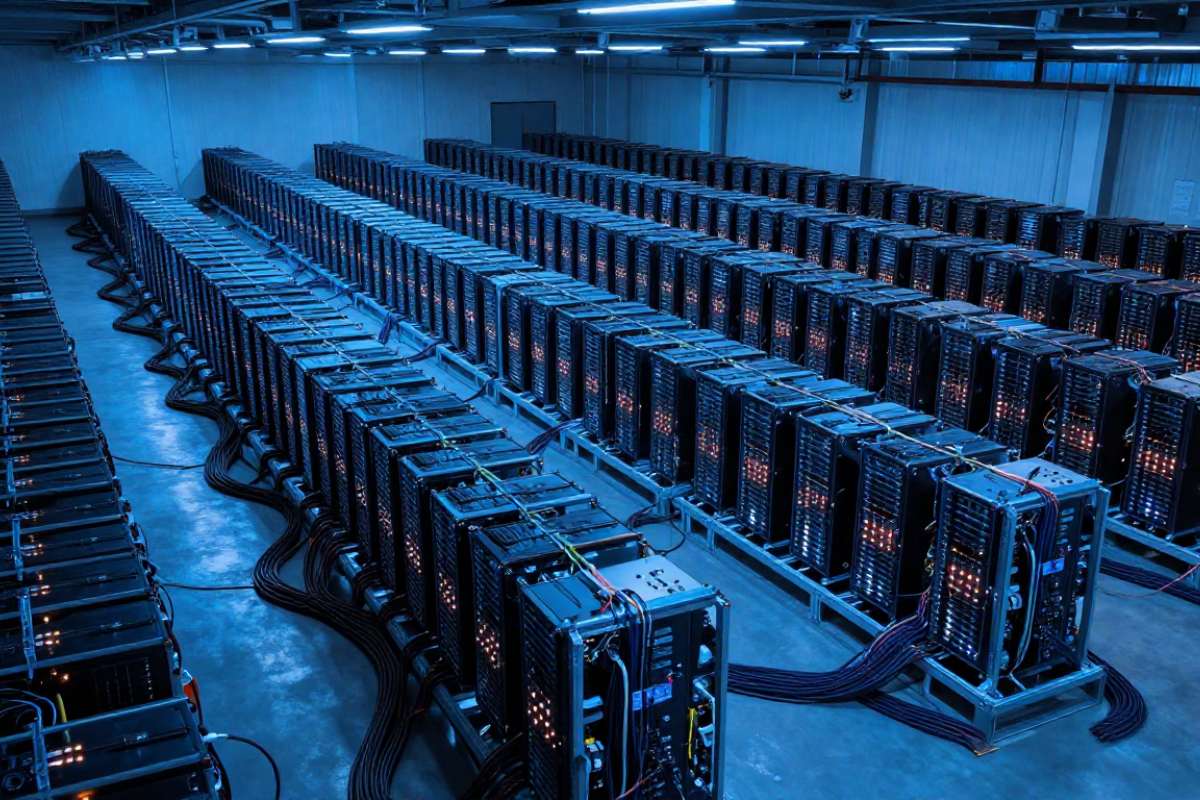
Rows of machines run inside long metal racks while powerful ventilation systems push heat out of the building. Power infrastructure supports massive electrical loads around the clock. The result is a facility that looks strikingly similar to a modern data center — something that has begun attracting attention beyond the crypto industry.
Reuters recently reported, citing analysis from Bridgewater Associates, that technology companies could invest about $650 billion in artificial intelligence infrastructure in 2026, including new data centers and high-performance computing capacity.
The world is building enormous computing facilities. Mining infrastructure already shares many of the same requirements.
The Overlap With AI in Mining Infrastructure
Mining companies are beginning to notice that overlap. Large mining farms already share many of the same requirements as AI computing clusters, from massive power supply and cooling systems to physical space for hardware and strong network connections. That combination opens up new possibilities.
A handful of operators have moved into hybrid facilities, running ASIC miners alongside GPU clusters for AI workloads. Power systems, cooling, and physical infrastructure carry both without major modification. The result is an operation that can redirect computing capacity depending on where the economics make more sense.
Energy Is Still the Core Variable
Electricity determines whether a mining operation survives. That has always been true, but the industry’s relationship with energy markets has become more sophisticated in recent years.
Many mining facilities are now located close to renewable energy projects or regions with excess electricity. Some operators even participate in grid-balancing programs, switching machines off when power demand rises. The arrangement works particularly well alongside wind and solar generation, where surplus electricity has no obvious destination. Mining farms can absorb that excess rather than letting it go to waste.
New mining pools are occasionally launched around these energy partnerships. Instead of attracting miners from anywhere in the world, they coordinate machines located within specific energy ecosystems.
That structure ties mining operations more closely to regional infrastructure.
The Geography of Mining Keeps Changing
The global map of Bitcoin mining has shifted repeatedly over the past decade. China once dominated the sector. After restrictions in 2021, much of that hash power moved elsewhere. The United States quickly became one of the largest mining hubs, particularly in regions with strong energy capacity.
Canada also expanded its role. Parts of Central Asia and the Middle East entered the industry as well.
The result is a far more distributed mining network. New pools sometimes emerge as regional operators attempt to coordinate local infrastructure. These platforms often integrate with hosting facilities, energy contracts, or regulatory frameworks specific to their region.
That specialization may gradually reshape the pool landscape. Instead of a small number of global operators dominating the market, multiple regional ecosystems could develop around different infrastructure clusters.
Software May Decide the Next Phase
Hardware innovation still matters. More efficient ASIC machines can dramatically change mining economics. But software is becoming just as important.
Large mining facilities now operate thousands of machines simultaneously. Monitoring those systems requires detailed analytics and automation.
Some pools are beginning to build tools that resemble data center management platforms. Machine performance tracking. Automated firmware tuning. These features are increasingly part of the service.
The mining pool itself becomes the interface through which operators manage large fleets of hardware.
Why a New Pool Matters Right Now
Seen in isolation, the launch of a new pool may look routine. The mining industry, however, is entering a moment of transition.
Infrastructure is expanding. Energy partnerships are evolving. Data center investment across the technology sector is accelerating.
Mining sits directly inside that intersection. Pools are evolving along with it. They are no longer just reward distribution systems for hash power. They are becoming coordination layers for large computing networks.
The Direction of the Industry
Bitcoin mining has reinvented itself several times already. The earliest miners ran software on ordinary home computers. Industrial ASIC hardware changed that model completely. Large mining farms followed soon after.
Now another transition appears to be underway.
Mining companies are building infrastructure that overlaps with broader computing systems. Energy strategy is becoming more complex. Data center economics are starting to influence decisions that once belonged entirely to the crypto world.
New mining pools launching today are part of that evolution. They are not simply adding hash power to the network. They are appearing at the point where cryptocurrency infrastructure meets the wider computing economy.
Get 3 Free Stock Ebooks
Discover top-performing stocks in AI, Crypto, and Technology with expert analysis.
- Top 10 AI Stocks - Leading AI companies
- Top 10 Crypto Stocks - Blockchain leaders
- Top 10 Tech Stocks - Tech giants


