


TLDR
- AMD shares fell 5% despite reporting earnings of $1.20 per share versus $1.16 expected and revenue of $9.25 billion versus $8.74 billion expected
- The chipmaker posted 36% revenue growth year-over-year and net income increased from $771 million to $1.24 billion
- Fourth-quarter revenue guidance of $9.6 billion beat the $9.15 billion consensus estimate
- Market concerns about AI spending returns overshadowed the company’s strong performance
- Multiple analysts raised price targets, with UBS lifting its target to $300 from $265
AMD posted impressive third-quarter numbers Tuesday evening. Investors responded by selling the stock anyway.
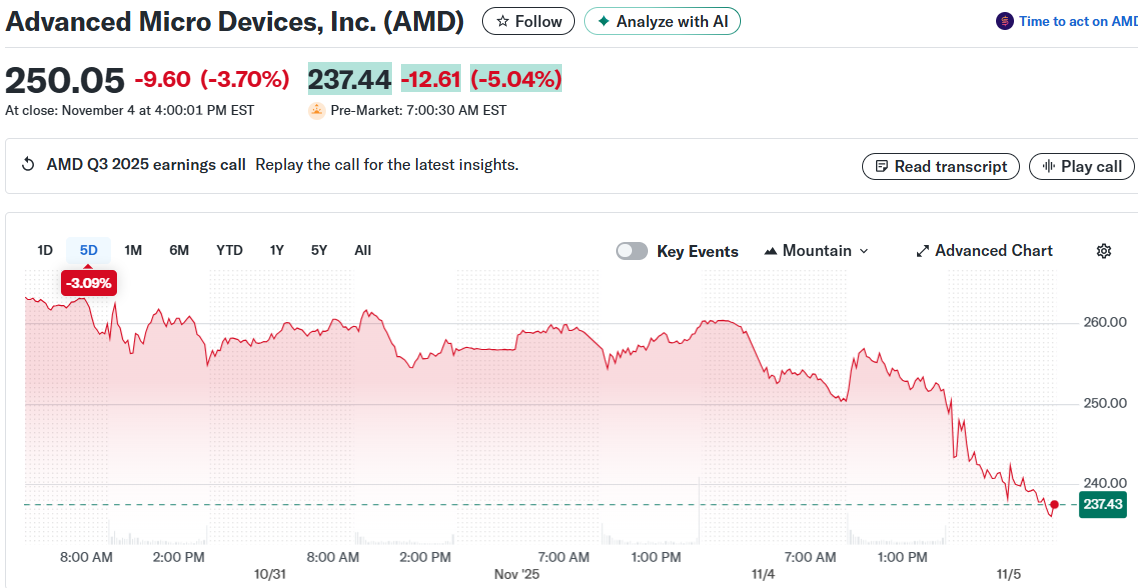
Shares dropped nearly 5% in pre-market trading Wednesday. The decline came despite the company beating on both earnings and revenue.
AMD reported adjusted earnings of $1.20 per share. Analysts had projected $1.16 per share.
Revenue totaled $9.25 billion. Wall Street expected $8.74 billion.
The company grew revenue 36% compared to last year. Net income jumped to $1.24 billion from $771 million in the prior-year period.
These results would typically send a stock higher. Not this time.

Fourth-Quarter Outlook Tops Estimates
AMD’s guidance for the current quarter also exceeded expectations. The company forecasts revenue of roughly $9.6 billion.
That implies 25% growth. The Street was looking for $9.15 billion.
Gross margins matched analyst estimates. They didn’t beat, which may have disappointed some investors.
The weakness in AMD’s stock price reflects broader concerns about the AI sector. Investors are questioning whether massive capital expenditures on AI infrastructure will pay off.
Companies like Nvidia, Meta, and Microsoft have committed billions to AI development. The return on these investments remains unclear.
Both the S&P 500 and Nasdaq fell Tuesday. AI stocks led the decline.
AMD has made progress closing the gap with Nvidia in AI chip technology. But sector-wide pessimism is dragging down even the winners.
Wall Street Stays Bullish on AMD
UBS lifted its price target on AMD to $300 from $265. The firm maintained its Buy rating.
At current prices around $250, the new target represents meaningful upside. UBS advised clients not to sell ahead of AMD’s upcoming analyst day.
The event will be the company’s first analyst day since ChatGPT launched. It could provide important details about AMD’s AI strategy.
UBS expects AMD to outline how it plans to reach $15-20 in earnings per share later this decade. That would represent massive growth from current levels.
The investment bank noted some AI GPU sales may have pulled forward from the fourth quarter into the third. Oracle could have been involved in this timing shift.
AMD addressed questions about a possible slowdown in AI GPU sales during the first half of 2026. The company said GPU revenue would be back-end loaded next year due to an OpenAI ramp.
Agentic AI is driving refresh cycles in traditional server infrastructure. UBS estimates this business could generate over 35% of AMD’s earnings per share in 2026.
AMD should benefit as Intel struggles with its product roadmap. Intel has lost ground in recent quarters.
Several other firms raised their AMD price targets recently. Loop Capital moved to $290 while Piper Sandler went to $280.
Baird and Roth/MKM both established $300 targets. Jefferies kept its $300 price target unchanged.
Get 3 Free Stock Ebooks
Discover top-performing stocks in AI, Crypto, and Technology with expert analysis.
- Top 10 AI Stocks - Leading AI companies
- Top 10 Crypto Stocks - Blockchain leaders
- Top 10 Tech Stocks - Tech giants


