


TLDR
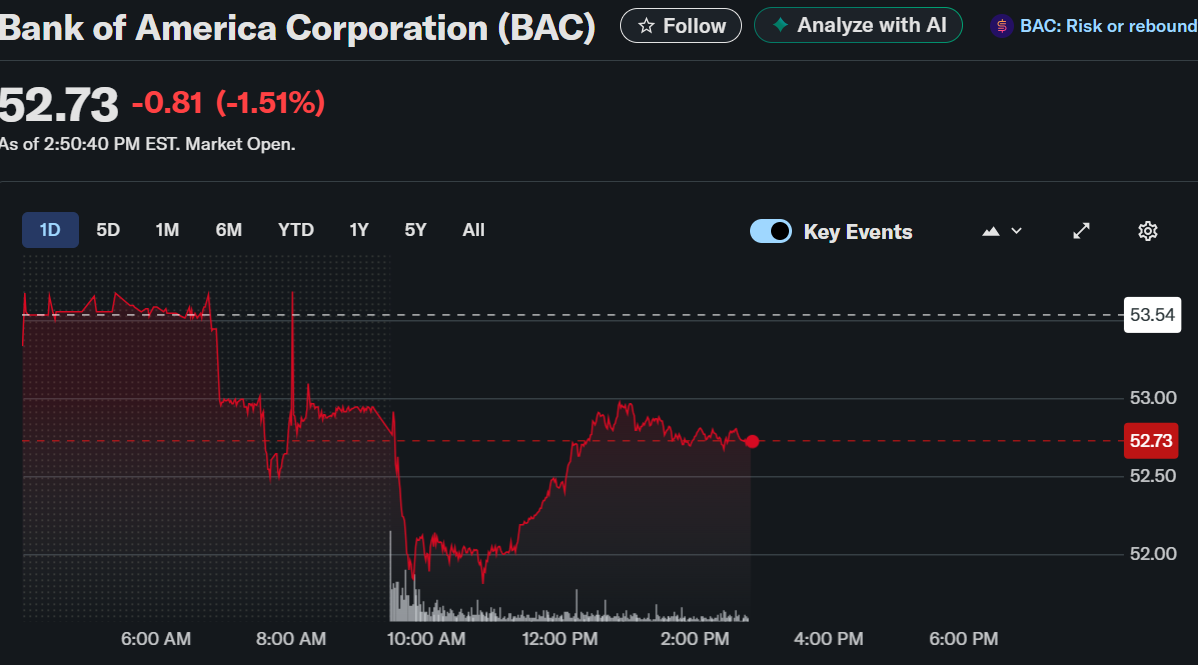
- Bank of America ($BAC) fell 1.8% to $52.76 after its Investor Day presentation.
- The bank set medium-term goals including 5%-7% net interest income growth and 12%+ EPS growth.
- ROTCE is targeted at 15% short term, 16%-18% medium term.
- CEO Brian Moynihan hinted at potential U.S. payment acquisitions.
- Wealth management aims for 4%-5% annual net new asset growth.
Bank of America (NYSE: BAC) stock dropped 1.8% to $52.76 during Wednesday’s session, following the company’s 2025 Investor Day.
 Bank of America Corporation (BAC)
The presentation outlined new medium-term financial goals that, despite being positive, did not spark investor enthusiasm.
The bank introduced updated growth metrics, including 4%+ deposit growth, 5%+ loan growth, and 5%-7% compound annual growth rate in net interest income. These forecasts aim to strengthen Bank of America’s revenue profile amid evolving market conditions.
The company also set a 12%+ annual earnings per share (EPS) growth target and a return on tangible common equity (ROTCE) of 15% in the near term, increasing to 16%-18% over the medium term.
Financial Goals Compared to Peers
These updated projections slightly exceed the company’s previous targets (2015–2024), which aimed for 10%-12% EPS growth and 12%-15% ROTCE. The new framework emphasizes achieving 200-300 basis points in operating leverage and maintaining an efficiency ratio between 55% and 59%.

The assumptions underpinning these targets include moderate U.S. GDP and CPI growth, no recession, and stable interest rates. Despite this cautiously optimistic approach, many investors viewed the projections as conservative, leading to muted trading sentiment.
Evercore ISI analyst Glenn Schorr commented that while the ROTCE target aligns with expectations, achieving it consistently “will require credibility and execution discipline.” He described the return goals as “good enough to keep investors engaged.”
Possible Acquisitions in the U.S. Payments Sector
During the Investor Day event, CEO Brian Moynihan suggested that the bank may consider acquiring more payments businesses in the U.S., though he ruled out overseas deals. He referred to BofA’s 2021 acquisition of Axia Technologies, a healthcare payment firm, as an example of strategic domestic expansion.
This signals that BofA could enhance its presence in digital payments to compete with fintech players while leveraging its existing infrastructure.
Wealth Management Sets Aggressive Growth Goals
Executives from Merrill Wealth Management—a key BofA division—revealed targets of 4%-5% net new asset growth in the medium term, with pre-tax margins projected to increase 4%-6%. Co-presidents Eric Schimpf and Lindsay Hans said the business plans to add $135 billion to $150 billion in fee-generating assets annually.
Currently, BofA’s core wealth business manages $4.6 trillion in client assets, compared with JPMorgan’s $6.8 trillion and Morgan Stanley’s $7 trillion. Including consumer wealth assets, the total rises to $6.4 trillion.
Outlook
This marks Bank of America’s first Investor Day in nearly 15 years, highlighting its renewed commitment to transparency and growth alignment. While its updated financial goals appear achievable, the muted investor response underscores the need for tangible results in upcoming quarters.
As BofA refines its operational strategy, the coming months will determine whether these ambitions translate into sustained shareholder confidence and improved market performance.
Get 3 Free Stock Ebooks
Discover top-performing stocks in AI, Crypto, and Technology with expert analysis.
- Top 10 AI Stocks - Leading AI companies
- Top 10 Crypto Stocks - Blockchain leaders
- Top 10 Tech Stocks - Tech giants


