


TLDR
- Bitcoin declined 1.5% on Friday, settling near $67,766, yet maintained a modest 0.6% gain for the week within a constrained trading band
- Market experts characterize the decline as a leverage liquidation event rather than a reversal of the underlying trend, with buying interest returning Friday morning
- Alternative cryptocurrencies outpaced Bitcoin over the week — Cardano climbing 7%, Solana advancing 5.5%, Ethereum gaining 4.8%, BNB rising 4.3% — while XRP declined 0.1%
- Nvidia (NVDA) declined 5.5% following earnings that exceeded expectations, pressuring U.S. stock futures and contributing to crypto weakness
- Asian stock markets are poised for their strongest February performance since 1998, redirecting investment flows from American exchanges
Bitcoin retreated on Friday as U.S. equity futures declined in response to a significant drop in Nvidia’s stock price. The cryptocurrency selloff reflected a wider risk-averse sentiment sweeping through international financial markets.
Bitcoin was changing hands near $67,766, representing a 1.5% decline during the trading session. The downturn notwithstanding, the leading digital asset preserved a 0.6% advance for the weekly period.
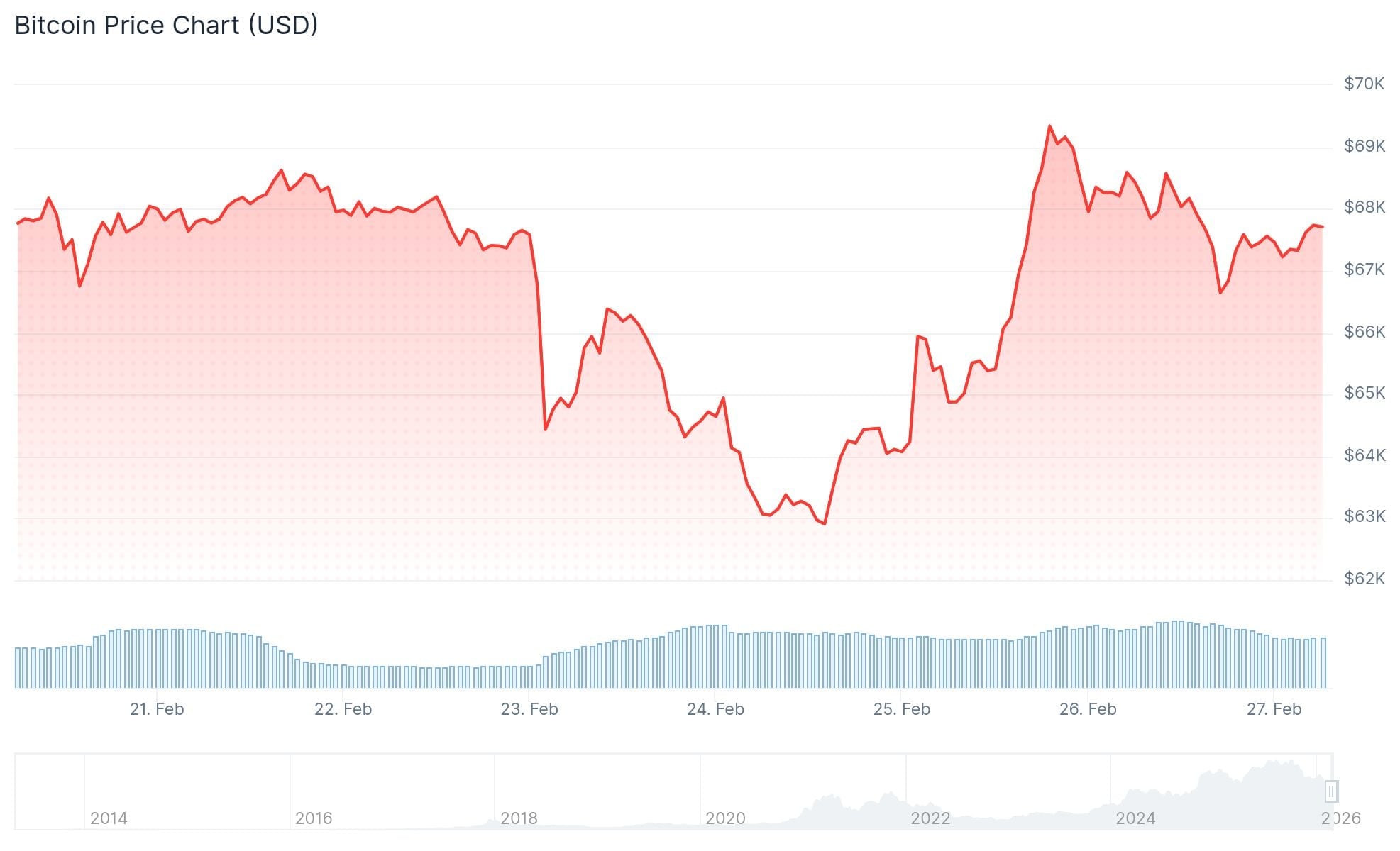
Ethereum dropped 1.5% across 24 hours, settling just north of $2,047. Both dominant cryptocurrencies remain confined within a tight trading corridor that has persisted following the February 5 market correction.
Nvidia tumbled 5.5% on Thursday despite surpassing fourth-quarter earnings projections. The decline seemed to capture investor skepticism regarding whether substantial artificial intelligence investments can sustain current market valuations.
Cryptocurrency assets tracked equities downward as market participants withdrew from risk-oriented positions. This correlation has remained consistent throughout recent weeks, with Bitcoin demonstrating tight correlation to Nasdaq movements.

“What’s happening right now reflects Bitcoin’s behavior as part of the wider risk asset complex,” explained Daniel Reis-Faria, CEO of ZeroStack. “The Nasdaq retreated following Nvidia’s earnings release, and digital assets followed suit.”
He characterized the price action as a position reset rather than a directional shift. “Significant leverage accumulated during the recent rally, and when equities begin declining, cryptocurrency markets typically experience the earliest de-risking.”
By early Friday trading hours, hourly cryptocurrency returns had shifted into positive territory. This pattern indicates renewed buying activity emerged after overnight liquidations eliminated excessive leveraged positions.
Alternative Cryptocurrencies Show Weekly Strength Against Bitcoin
Cardano topped major digital assets with a 7% weekly advance. Solana posted a 5.5% gain, Ethereum climbed 4.8%, and BNB increased 4.3%, each surpassing Bitcoin’s performance.
XRP represented the sole major asset posting negative seven-day returns, declining 0.1% weekly and 3.7% over 24 hours. This relative weakness proved noteworthy considering most alternative cryptocurrencies weathered identical macroeconomic headwinds without surrendering their weekly advances.
U.S. Stock Futures and International Capital Movement
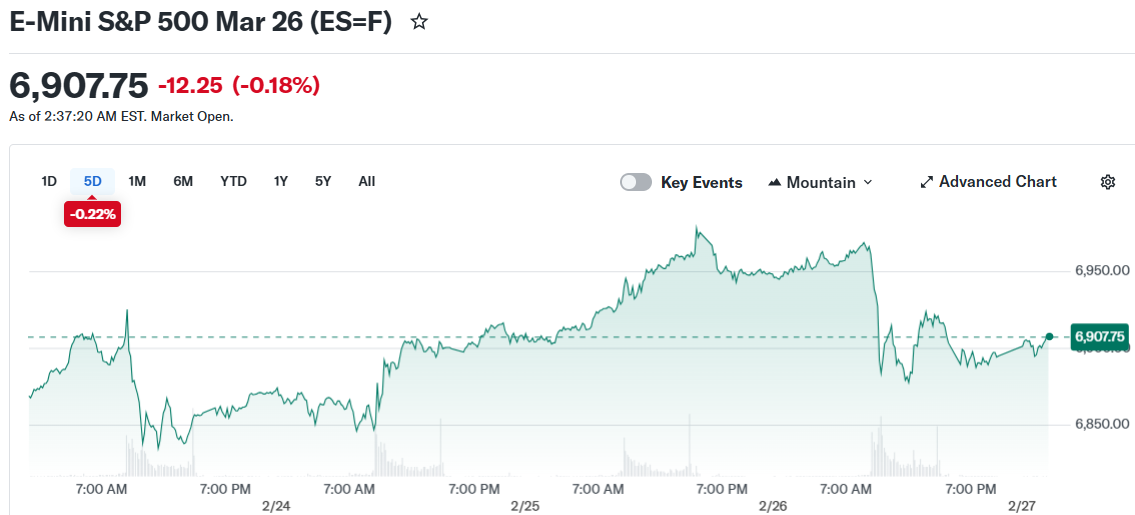
Dow futures decreased approximately 0.6%, S&P 500 futures contracted 0.4%, and Nasdaq 100 futures fell 0.3% during Friday’s overnight session.
Asian stock markets are tracking toward their most impressive February since 1998. South Korean technology shares surged approximately 20% throughout the month, with market participants rotating capital into artificial intelligence infrastructure companies.
The MSCI Asia Pacific Index appears positioned to exceed S&P 500 returns for a consecutive third month. This capital reallocation has diminished investment flows directed toward American markets.
Block’s shares surged over 23% in after-hours trading following CEO Jack Dorsey’s announcement that the company would reduce its workforce by nearly half, attributing the restructuring to artificial intelligence capabilities transforming business operations.
Market attention now shifts to Friday’s producer price index release, with economic forecasters anticipating a 0.3% monthly increase in both headline and core wholesale inflation measurements.
Get 3 Free Stock Ebooks
Discover top-performing stocks in AI, Crypto, and Technology with expert analysis.
- Top 10 AI Stocks - Leading AI companies
- Top 10 Crypto Stocks - Blockchain leaders
- Top 10 Tech Stocks - Tech giants


