



Key Takeaways
- Seasoned trader Peter Brandt identified a rising wedge formation, suggesting BTC could decline to $60,000 or potentially $49,000.
- BTC plummeted more than 4% on March 27, hovering between $65,720 and $66,030.
- Deribit’s massive $14.16 billion options settlement eliminated 40% of open interest and sparked over $115 million in long liquidations.
- Escalating U.S.-Israel tensions with Iran are pushing capital into the U.S. dollar and out of high-risk assets such as Bitcoin.
- Market experts from CEX.IO and Bitget Wallet anticipate additional downside pressure, with $60,000 identified as the critical support zone.
Bitcoin experienced a sharp selloff on March 27, tumbling more than 4% to settle near $65,720 amid a confluence of geopolitical instability and a historic options expiration event.
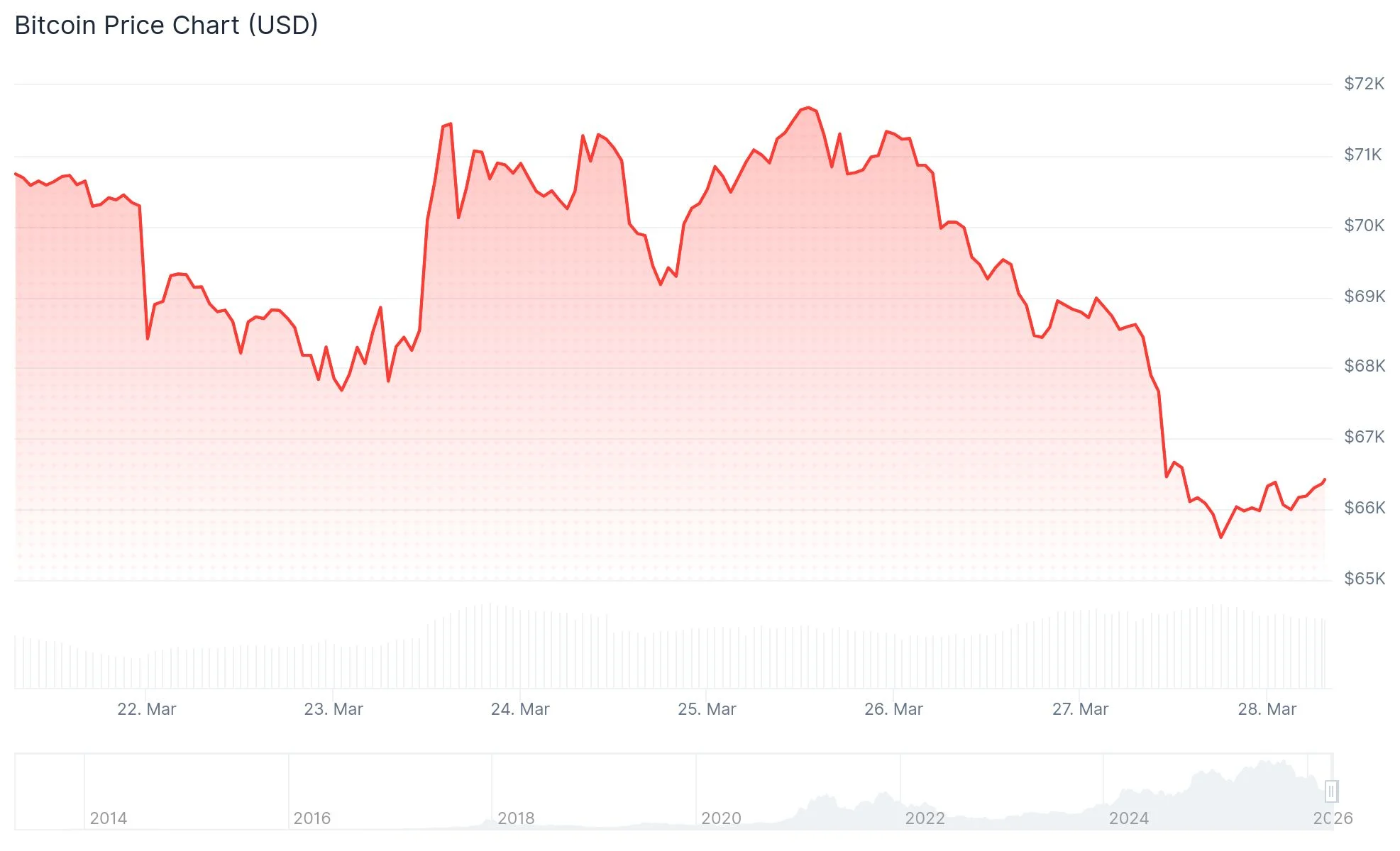
The decline coincides with intensifying U.S.-Israel confrontations with Iran, prompting investors to seek refuge in traditional safe-haven assets like the U.S. dollar. Iran’s announcement that the Strait of Hormuz remains blocked compounded market anxieties, despite President Trump’s assertion that Iran permitted 10 oil tankers to transit as a diplomatic gesture.
Trading veteran Peter Brandt shared analysis on X highlighting Bitcoin’s formation of a rising wedge pattern—a classic bearish indicator. His technical assessment identifies $60,000 as the immediate downside objective.
In a follow-up post, Brandt presented another chart pinpointing $49,000 as a plausible long-term floor for Bitcoin. He emphasized that BTC adheres to traditional charting principles more consistently than many other financial instruments.
Brandt’s earlier forecasts anticipated Bitcoin would breach the $50,000 threshold during the ongoing bearish cycle. His recent commentary validates that outlook.

Record-Breaking $14B Options Settlement Triggers Liquidation Cascade
On March 27, leading derivatives platform Deribit processed $14.16 billion worth of Bitcoin options contracts at 08:00 UTC. This marked 2026’s largest expiration event, clearing approximately 40% of total outstanding positions on the platform.
Long position liquidations exceeded $115 million within a 60-minute window. Bitcoin’s current put/call ratio stands above 0.62, indicating bearish positioning outweighs bullish expectations among derivatives traders.
Illia Otychenko, chief analyst at CEX.IO, noted that both macroeconomic conditions and market sentiment currently favor bears. He cautioned that a breakdown below existing channel support would likely trigger a retest of the $60,000 level.
Market Experts Anticipate Heightened Turbulence
Lacie Zhang, market strategist at Bitget Wallet, explained that institutional players have systematically sold call options throughout the quarter to generate income. With these contracts now settled, that protective buffer has vanished.
Market analyst Ted forecasts Bitcoin could breach $50,000 during Q2 2026, followed by a sharp V-shaped rebound toward $100,000 before year-end.
Zhang emphasized that Bitcoin must recapture and sustain levels above $75,000 to reverse bearish momentum. Absent that recovery, expect amplified volatility and unpredictable price action.
Surging crude oil costs have driven the U.S. 10-year Treasury yield to its highest point since July 2025, applying additional downward pressure on non-interest-bearing assets including Bitcoin.
Despite near-term headwinds, Bernstein analysts maintained their year-end projection of $150,000, contending that Bitcoin typically outperforms gold during periods of exceptional market turbulence.
Bitcoin’s immediate critical threshold sits at $66,000. A confirmed daily close beneath this support level could catalyze a descent toward the $50,000 zone, according to technical chartists.
Get 3 Free Stock Ebooks
Discover top-performing stocks in AI, Crypto, and Technology with expert analysis.
- Top 10 AI Stocks - Leading AI companies
- Top 10 Crypto Stocks - Blockchain leaders
- Top 10 Tech Stocks - Tech giants


