



TLDR
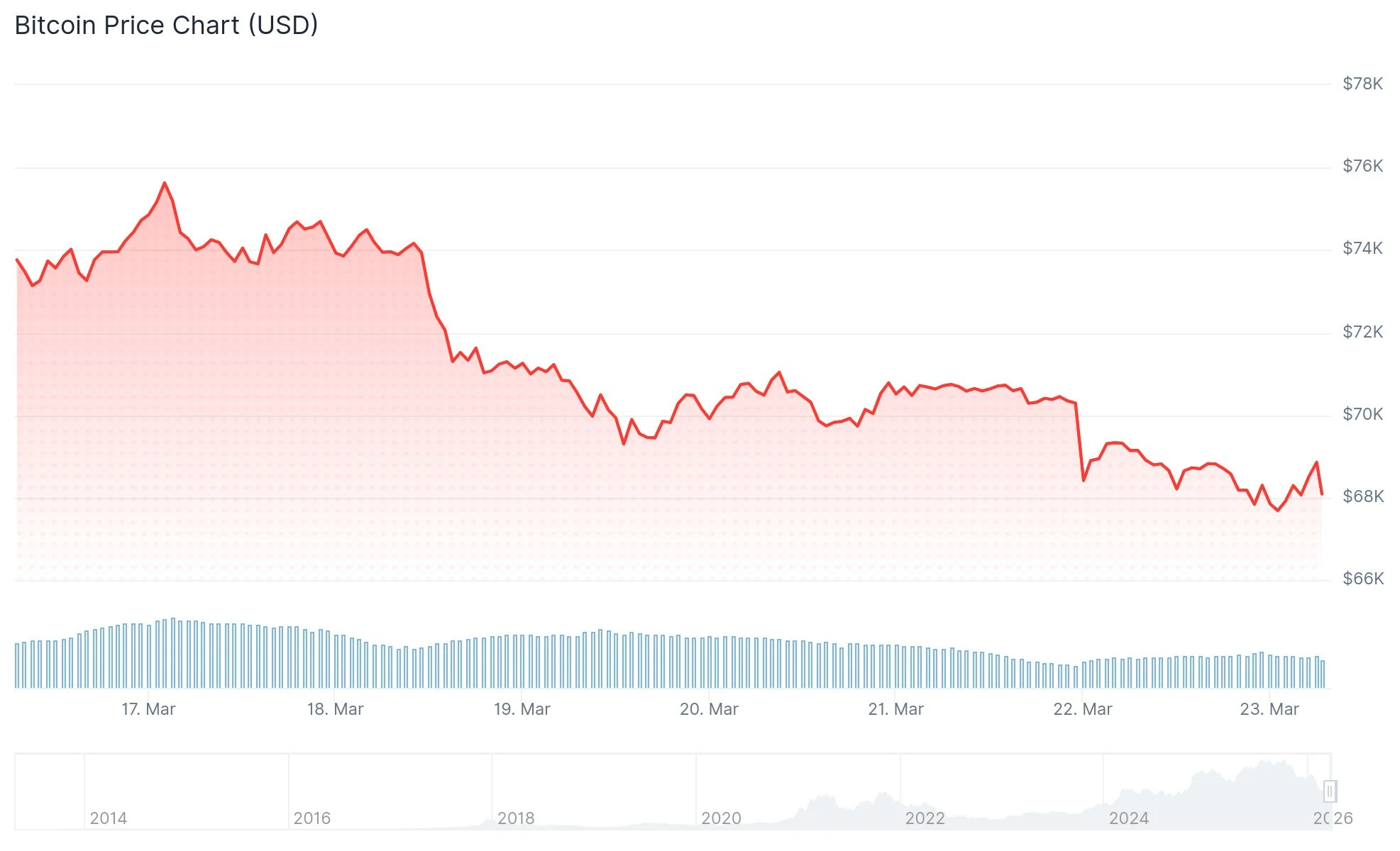
- Bitcoin declined to approximately $68,652, losing 0.7% during Monday’s session as escalating tensions with Iran drove investors toward safer assets.
- President Trump issued a 48-hour ultimatum to Iran demanding the reopening of the Strait of Hormuz under threat of military action.
- BTC remains down more than 20% since the start of the year, though it has gained roughly 6% over the last 30 days.
- Critical support is positioned at $67,250, with potential further declines toward $65,000 or $63,500 if this level fails.
- Spot Bitcoin ETFs registered $95.18 million in net inflows during the March 16–20 period, extending the streak to four consecutive weeks.
Bitcoin retreated to $68,652 during Monday trading, shedding 0.7% as escalating geopolitical concerns surrounding the U.S.-Israel standoff with Iran prompted investors to exit risk-sensitive positions. The decline continued the downward pressure from weekend sessions and pushed BTC further below its recent monthly peak above $72,000.
The market-wide selloff was comprehensive. Equities, precious metals, and foreign exchange markets all experienced declines alongside digital assets as traders responded to heightened Middle Eastern instability.
President Donald Trump delivered a 48-hour ultimatum to Tehran over the weekend, demanding Iran reopen the strategically vital Strait of Hormuz shipping lane or face American military strikes targeting essential energy facilities. Iran countered by threatening complete closure of the waterway and retaliatory strikes against energy and water infrastructure throughout Persian Gulf states.
[[EMBED_0]]The ongoing conflict has now stretched into its fourth straight week without any indication of de-escalation.
Where Bitcoin Stands Technically
Bitcoin breached the $71,200 and $70,000 levels earlier in the session, reaching an intraday low of $67,343 before staging a modest rebound. The cryptocurrency is currently positioned beneath the 100-hour simple moving average, while a descending trend line has established resistance near the $69,200 mark.

For upward movement, BTC must penetrate the $69,200 resistance zone and sustain prices above $70,000 to reverse the immediate bearish bias. Successful clearing of these levels would bring $71,650 and $72,800 into focus as subsequent targets.
Should the cryptocurrency fail to reclaim higher ground, the initial support level demanding attention sits at $67,250. A breakdown below this threshold would expose the $66,500 level, followed by $65,000. Market participants view the $63,500 area as a critical demand zone.
Bitcoin vs. Gold
Notwithstanding the recent decline, Bitcoin has demonstrated relative strength compared to gold throughout the past month. BTC has appreciated approximately 6% during this timeframe, whereas gold has retreated roughly 18% from its late-January all-time high, succumbing to substantial profit-taking activity.
Gold has notably failed to capture safe-haven capital flows during the Iranian crisis, partially because market participants anticipate the conflict could accelerate global inflation and trigger higher interest rate policies.
From a year-to-date perspective, however, Bitcoin continues to trade more than 20% lower, while gold has remained relatively unchanged.
Alternative cryptocurrencies similarly faced headwinds on Monday. Ether decreased 2.2% to settle at $2,061.77, XRP fell 1.9% to $1.3853, and Dogecoin edged down 1.3%.
[[EMBED_2]]According to Wu Blockchain, spot Bitcoin ETFs attracted net inflows totaling $95.18 million throughout the March 16–20 trading week, representing the fourth straight week of positive capital flows into BTC exchange-traded fund products.
Get 3 Free Stock Ebooks
Discover top-performing stocks in AI, Crypto, and Technology with expert analysis.
- Top 10 AI Stocks - Leading AI companies
- Top 10 Crypto Stocks - Blockchain leaders
- Top 10 Tech Stocks - Tech giants


