



Key Highlights
- BTC declined approximately 3% to settle near $68,500 on Friday, extending weekly losses to 2.7%
- Friday’s $14 billion Bitcoin derivatives expiry has created significant market tension, with maximum pain positioned around $75,000
- Market sentiment indicators show extreme fear at 13 on the Crypto Fear & Greed Index
- Major holders (whales and sharks) have acquired 61,568 BTC throughout the past 30 days
- Spot Bitcoin ETFs attracted $2.5 billion in net capital over the last month despite bearish price action
Bitcoin experienced a significant 3% downturn to reach $68,507 on Friday, extending a challenging week influenced by persistent Middle East conflict concerns and an impending $14 billion derivatives expiration event.
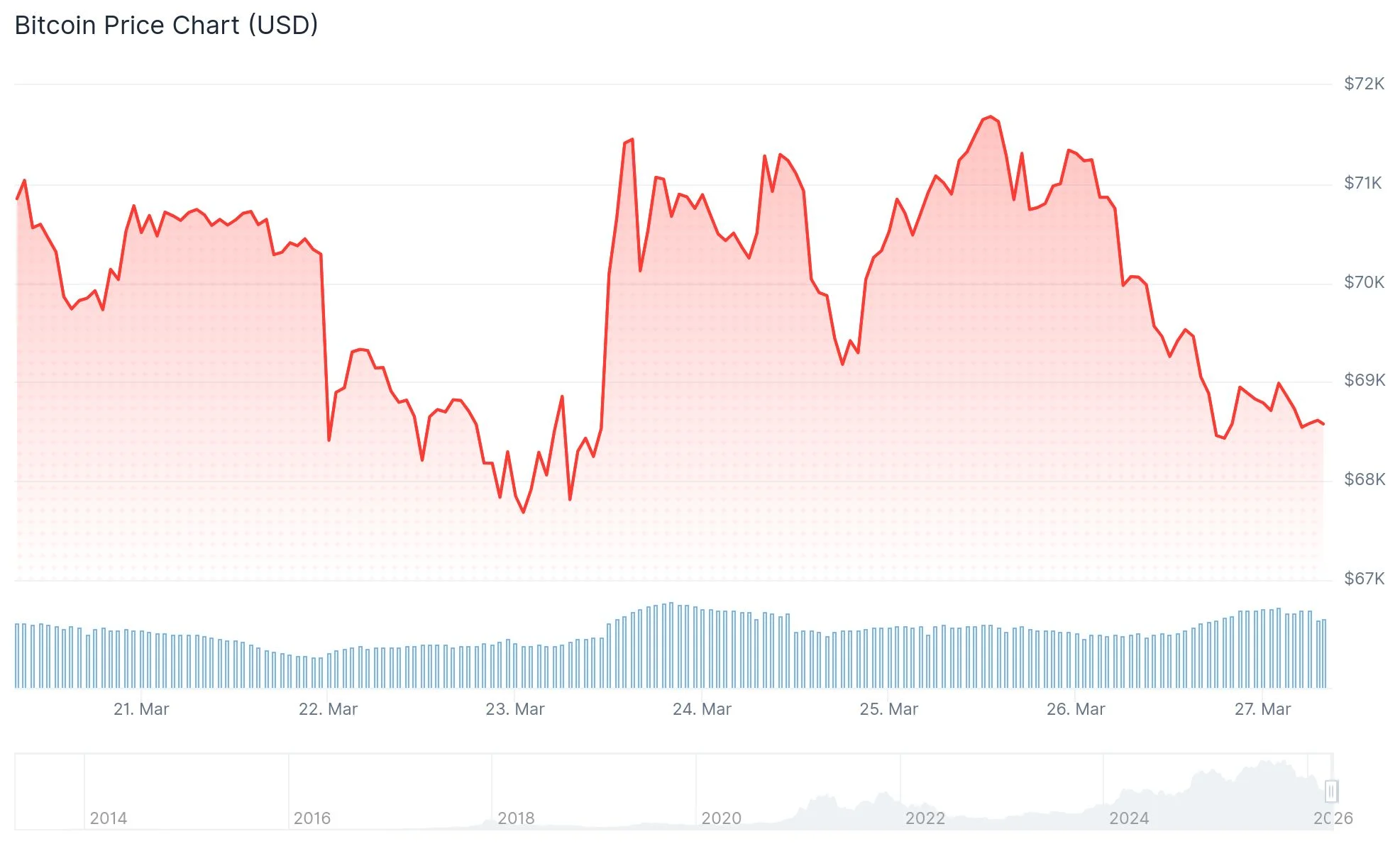
The selloff maintained a pattern established over five straight weeks. After President Trump announced a 10-day extension to his Iran ceasefire timeline, markets initially responded positively with crypto rallying and crude oil retreating. However, subsequent Wall Street Journal reporting revealed Pentagon plans to potentially deploy 10,000 additional ground forces to the Middle East, quickly reversing those gains.
Brent crude initially declined 1.3% to $106 before the military deployment reports surfaced. The total cryptocurrency market capitalization contracted nearly 1%, falling to approximately $2.4 trillion.
Ether experienced a sharper 4.6% decline to $2,050. Solana decreased 5.3% to reach $85.93. XRP shed 2.8% to trade at $1.36, accumulating a 6.5% weekly loss. Tron emerged as the sole outperformer among major cryptocurrencies, gaining 1.2% during the session.
Massive $14 Billion Derivatives Expiration Looms
Approximately $14 billion worth of Bitcoin options contracts are scheduled to expire Friday on Deribit, the dominant crypto derivatives platform. Market analysts from Bloomberg identified the maximum pain threshold near $75,000—the strike price where the greatest number of contracts would expire without value.

Following this expiration event, short-term hedging dynamics in cryptocurrency markets are anticipated to diminish substantially, potentially exposing Bitcoin to heightened volatility driven by Middle Eastern geopolitical developments.
Bitcoin has repeatedly failed to sustain levels above $75,000 throughout the nearly month-long conflict period. The cryptocurrency remains approximately 50% below its late-2025 all-time high near $126,000.
Asian equity markets similarly declined 0.6% during Friday trading. South Korean technology equities drove regional losses, with semiconductor giants Samsung and SK Hynix weighing on the KOSPI index, which fell 2.3%.
Large Holders Aggressively Accumulating During Drawdown
Major Bitcoin stakeholders continue accumulating despite bearish price momentum. Addresses classified as whales and sharks—those controlling between 10 and 10,000 BTC—expanded their positions by 0.45% over the trailing month, collectively acquiring 61,568 BTC, according to blockchain intelligence provider Santiment.
Smaller retail wallets holding less than 0.01 BTC contributed an additional 213 BTC during the identical timeframe, representing a 0.42% expansion.
Dominick John, market analyst at Zeus Research, observed that whales are “quietly stacking during consolidation periods” in anticipation of a potential price breakout. He suggested that excessive retail FOMO could trigger a temporary correction or distribution phase before the subsequent accumulation cycle begins.
Bitcoin spot ETFs have captured $2.5 billion in net positive flows throughout the past month, according to Bloomberg data. BlackRock’s flagship bitcoin ETF has achieved top 2% ranking among all ETFs by year-to-date inflows.
BlackRock analysts noted this week that institutional capital is concentrating heavily in bitcoin and ether while demonstrating clear avoidance of the wider altcoin ecosystem.
The Crypto Fear & Greed Index registered 13 on Friday, firmly entrenched in “extreme fear” territory, maintaining consistency with readings observed throughout February and recent weeks.
Traders are now focusing on early April, when President Trump’s extended Iran ceasefire deadline reaches its conclusion.
Get 3 Free Stock Ebooks
Discover top-performing stocks in AI, Crypto, and Technology with expert analysis.
- Top 10 AI Stocks - Leading AI companies
- Top 10 Crypto Stocks - Blockchain leaders
- Top 10 Tech Stocks - Tech giants


