



Key Takeaways
- Friday’s quadruple witching event will trigger simultaneous expiration of trillions in stock and index derivatives
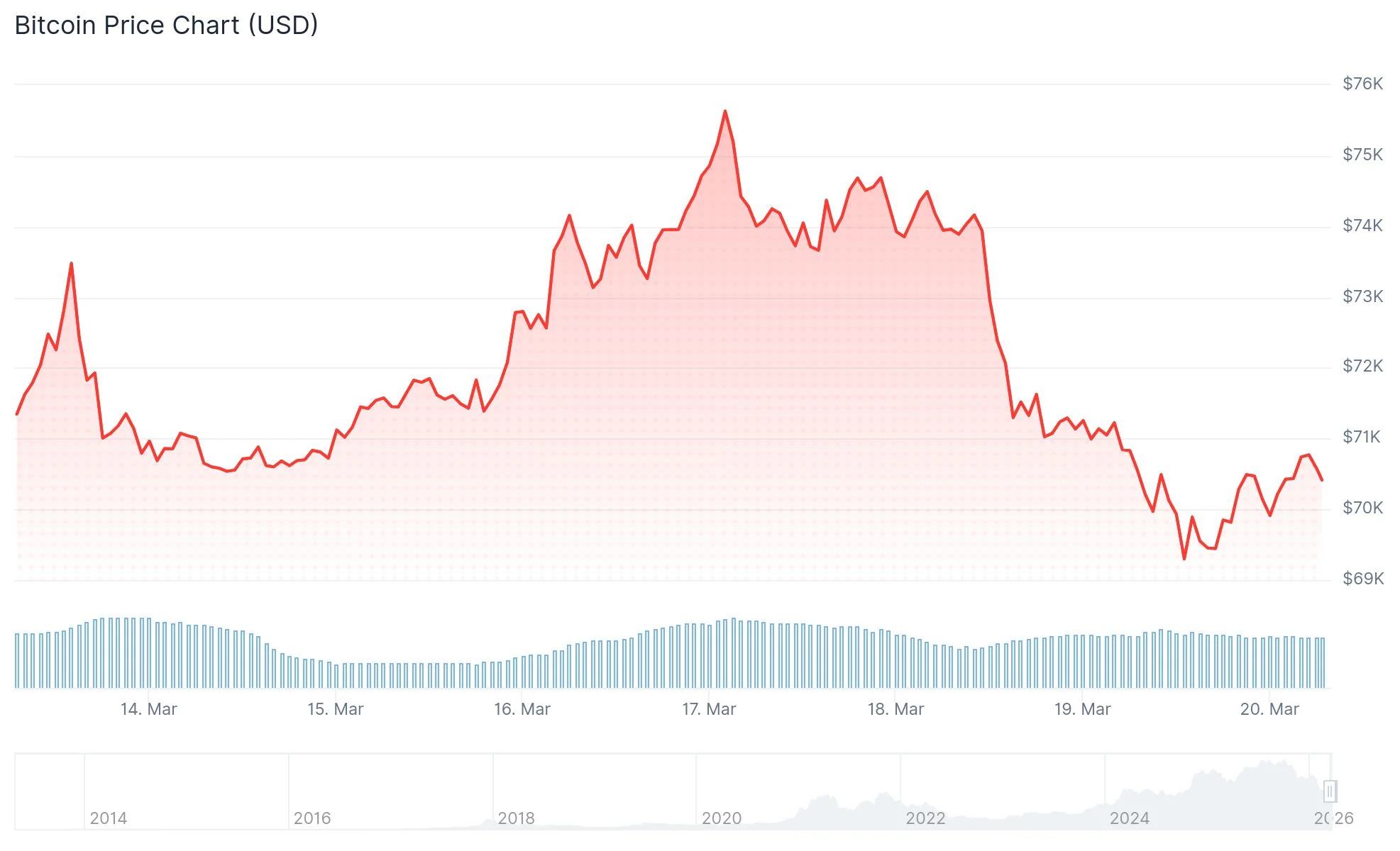
- Bitcoin slipped under the $70,000 threshold on Thursday amid growing market uncertainty
- Historical data reveals quadruple witching typically leads to muted daily moves but extended weakness afterward
- Leveraged futures traders are the primary force behind the current crypto market decline, not spot buyers
- Deribit will see $13.5 billion in crypto derivatives expire on March 27
Bitcoin’s price dipped below the $70,000 mark on Thursday as financial markets worldwide braced for one of the year’s most significant quarterly derivatives events.
Known as quadruple witching, this phenomenon occurs quarterly on the third Friday of March, June, September, and December. It represents the concurrent expiration of four derivative categories: stock index futures, stock index options, individual stock options, and individual stock futures.
The magnitude of this quarterly event is substantial. March 2025 witnessed approximately $4.7 trillion in equity and index derivatives reaching expiration within a single trading session. That particular day registered the year’s highest S&P 500 trading volume, according to data from TradeStation.
Expiry figures for March 2026 remain unpublished at this time.
These events compel institutional players to simultaneously close, roll forward, or settle their existing positions. Market activity typically intensifies during these periods, with heightened price volatility particularly evident during the trading day’s final sixty minutes.

Cole Kennelly, CEO of Volmex Finance, indicated the event might impact cryptocurrency markets. He suggested “quadruple witching could trigger a spike in cross-asset volatility as large derivatives positions expire,” noting that the Bitcoin Volmex Implied Volatility index was already showing upward momentum ahead of the event.
Bitcoin’s Historical Performance During Witching Events
Analyzing 2025 data reveals that Bitcoin’s price movements on actual quadruple witching days were generally subdued. More significant declines materialized in subsequent days and weeks.
On March 21, 2025, Bitcoin experienced minor daily losses before ultimately bottoming around $76,000 following market reactions to President Trump’s “Liberation Day” tariff announcements. June 20 saw a 1.5% decline, with a local bottom near $98,000 occurring just forty-eight hours later.
September 19 brought a 1% drop, followed by a dramatic plunge from $177,000 to $108,000 over the next seven days. December 19 closed approximately 3% higher at $85,000, though the asset remained trapped in a broader bearish trend.
The recurring theme is clear: minimal movement on the expiry day itself, accompanied by sustained weakness throughout the following period.
Forces Behind the Present Market Decline
Market data indicates futures traders, rather than spot market participants, are primarily responsible for Bitcoin’s current downturn. The Coinbase premium gap has shifted negative, signaling diminished demand from U.S. investors.
Crypto analyst IT Tech observed that while spot selling decreased by approximately $40 million, perpetual futures market selling reached a substantially higher $506.75 million. This disparity highlights leveraged traders as the dominant force behind the price decline.
Certain market participants anticipate a potential near-term bounce. Should Bitcoin successfully recapture $70,000, analysts project $76,000 as the subsequent target. Conversely, a breakdown below $68,300 would expose support zones at $65,000 and $62,000.
Bryan Tan of Wintermute proposed that “being flat is a strong position” under current conditions and advised maintaining cash reserves until market direction becomes more definitive.
External factors are compounding cryptocurrency market stress. Oil prices have climbed toward $120 per barrel, the VIX volatility index surged past 35 last week — marking its highest reading in twelve months — and gold declined below $4,600.
On the horizon, Deribit is scheduled to process a separate $13.5 billion crypto derivatives expiration on March 27. Market positioning suggests traders are favoring volatility strategies over strong directional wagers.
Get 3 Free Stock Ebooks
Discover top-performing stocks in AI, Crypto, and Technology with expert analysis.
- Top 10 AI Stocks - Leading AI companies
- Top 10 Crypto Stocks - Blockchain leaders
- Top 10 Tech Stocks - Tech giants


