



Key Takeaways
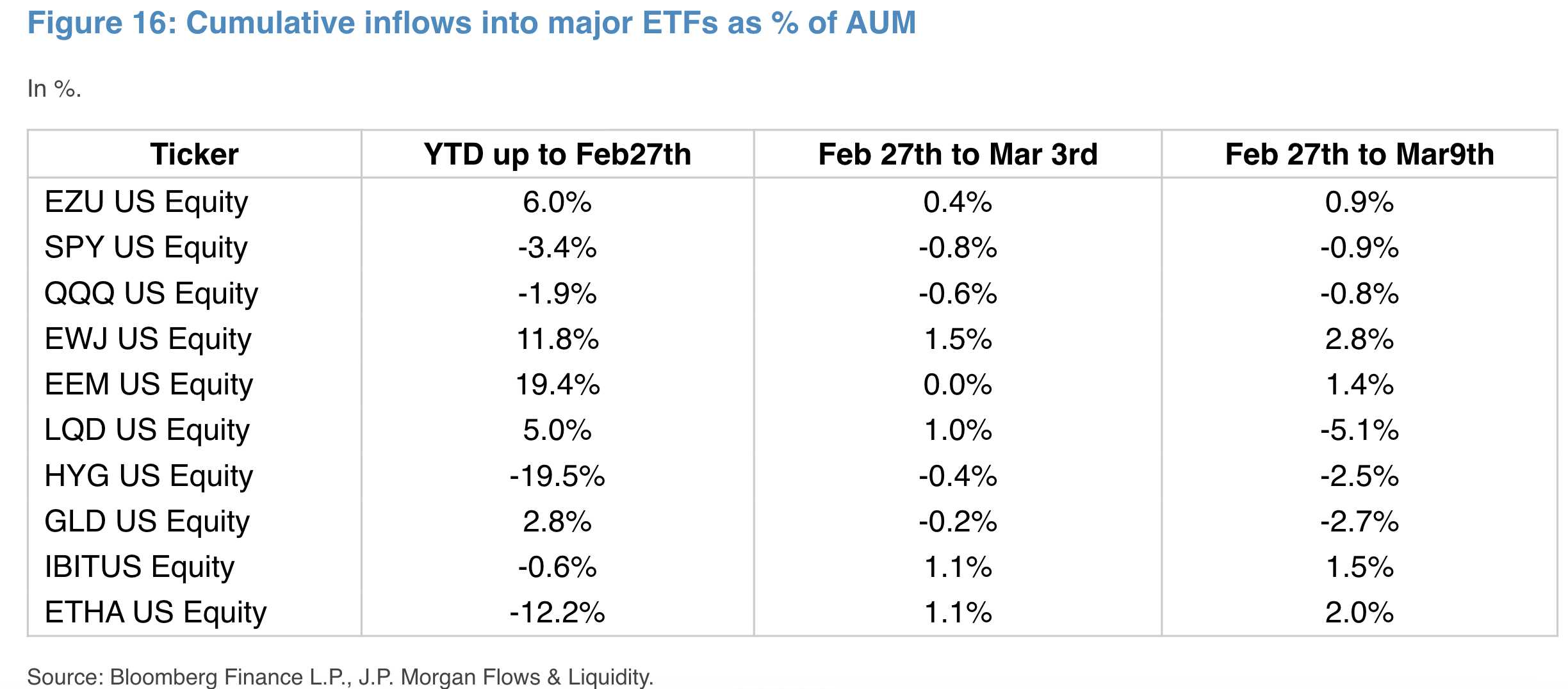
- Gold ETF outflows reached 2.7% of total assets while Bitcoin ETF inflows climbed 1.5% since the Iran conflict began
- GLD, the biggest gold ETF, experienced a $3 billion single-day exodus on March 6—the largest in over two years
- In the 30 days ending March 11, Bitcoin ETFs attracted $906 million in net inflows, a reversal from the previous month’s $1.9 billion outflow
- JPMorgan research indicates Bitcoin’s price volatility is declining as institutional participation increases
- Historical data shows Bitcoin has delivered average 54% gains during the 12 months after US midterm elections
A remarkable capital rotation has taken shape since late last month’s escalation of the Iran war, with investors abandoning gold exchange-traded funds in favor of Bitcoin investment products at an unexpected velocity.
SPDR Gold Shares (GLD), the world’s premier spot gold ETF, has hemorrhaged approximately 2.7% of its total assets under management. Meanwhile, BlackRock’s iShares Bitcoin Trust (IBIT), the dominant spot Bitcoin ETF, has absorbed inflows representing roughly 1.5% of its assets during the identical timeframe. These findings originate from research conducted by JPMorgan analysts under managing director Nikolaos Panigirtzoglou’s leadership.
March 6 marked a watershed moment when GLD suffered a staggering $3 billion single-day withdrawal. According to The Kobeissi Letter, this exodus exceeded any previous daily outflow by more than 200% across the preceding two-year span.
Bitcoin ETF performance painted a contrasting picture. By March 11, the 30-day net inflow metric had climbed to $906 million, a dramatic improvement from the $1.9 billion outflow registered just one month prior. Bitcoin ETF holdings measured in native units also demonstrated recovery, reaching positive 12,909 BTC following a previous decline of 34,197 BTC.
This divergence effectively eliminated the year-to-date performance edge that gold ETFs maintained over Bitcoin ETFs before the Iran situation intensified.

Wall Street’s Asset Allocation Undergoes Transformation
JPMorgan’s research team observed that between October and early 2026, capital flowed from Bitcoin into gold, with retail participants driving much of the movement. Throughout this window, IBIT experienced withdrawals while GLD captured substantial inflows.
However, the recent transformation extends beyond simple ETF flows. Short positioning in IBIT expanded during recent months while short interest targeting GLD contracted. According to analysts, this pattern indicates hedge funds and similar institutional participants scaled back Bitcoin holdings while favoring gold exposure during that earlier phase.
The put-to-call ratio for IBIT options also exceeded GLD’s metric and remained elevated since November, representing the first sustained interval where Bitcoin ETF derivatives displayed stronger appetite for downside hedging compared to gold ETF options.
Despite the preceding caution, Bitcoin ETFs maintain their lead over gold ETFs in aggregate cumulative inflows dating back to 2024. IBIT’s lifetime inflows stand at approximately twice GLD’s total during the comparable period.
Bitcoin Price Swings Show Signs of Stabilization
JPMorgan’s analyst team highlighted that Bitcoin’s volatility characteristics are exhibiting compression patterns. They credit this development to expanding institutional ownership and enhanced market liquidity conditions.
Michaël van de Poppe, founder of MN Capital, observed that the Bitcoin-to-gold ratio displays a bullish divergence on the relative strength index using daily timeframes. The ratio recently touched a support zone near 12-13, an area that functioned as resistance during 2017 before transitioning to support status in 2022 and 2023.
Implied volatility derived from GLD options has escalated more aggressively than IBIT’s in recent months, indicating market participants anticipated more pronounced price fluctuations in gold.
Binance Research characterized the present market conditions as an “opportunity within risk” for Bitcoin, observing that BTC has tracked macro assets including oil and US equities since the Iran war commenced.
Bitcoin ETF transaction volumes from US spot products have climbed lately. Nevertheless, US spot ETFs represent merely 9% of aggregate Bitcoin spot trading volume, substantially below the 30-40% ETF penetration observed in US equity markets.
Looking at historical precedents, the 12-month window following US midterm elections has never delivered negative S&P 500 returns since 1939, averaging 19% appreciation. Bitcoin has posted average 54% rallies across all three post-midterm election years in the available dataset.
JPMorgan analysts confirmed their long-term Bitcoin price projection of $266,000, derived from a volatility-adjusted valuation framework relative to gold.
Get 3 Free Stock Ebooks
Discover top-performing stocks in AI, Crypto, and Technology with expert analysis.
- Top 10 AI Stocks - Leading AI companies
- Top 10 Crypto Stocks - Blockchain leaders
- Top 10 Tech Stocks - Tech giants


