



Key Takeaways
- BTC experienced a sharp decline of nearly 5%, falling to approximately $63,000 following coordinated U.S.-Israeli military operations against Iran
- This price level marks the lowest point since February 5, when bitcoin momentarily traded below $60,000
- Israel’s Defense Minister Israel Katz announced a nationwide state of emergency following the commencement of strikes
- The cryptocurrency’s continuous trading schedule positions it as an immediate outlet for risk-averse trading behavior during off-market hours
- Market participants liquidated bitcoin positions due to limited availability of other liquid assets during weekend hours
The world’s leading cryptocurrency experienced a significant downturn on Saturday, February 28, 2026, plummeting toward $63,000 following military strikes executed by the United States and Israel targeting Iran.
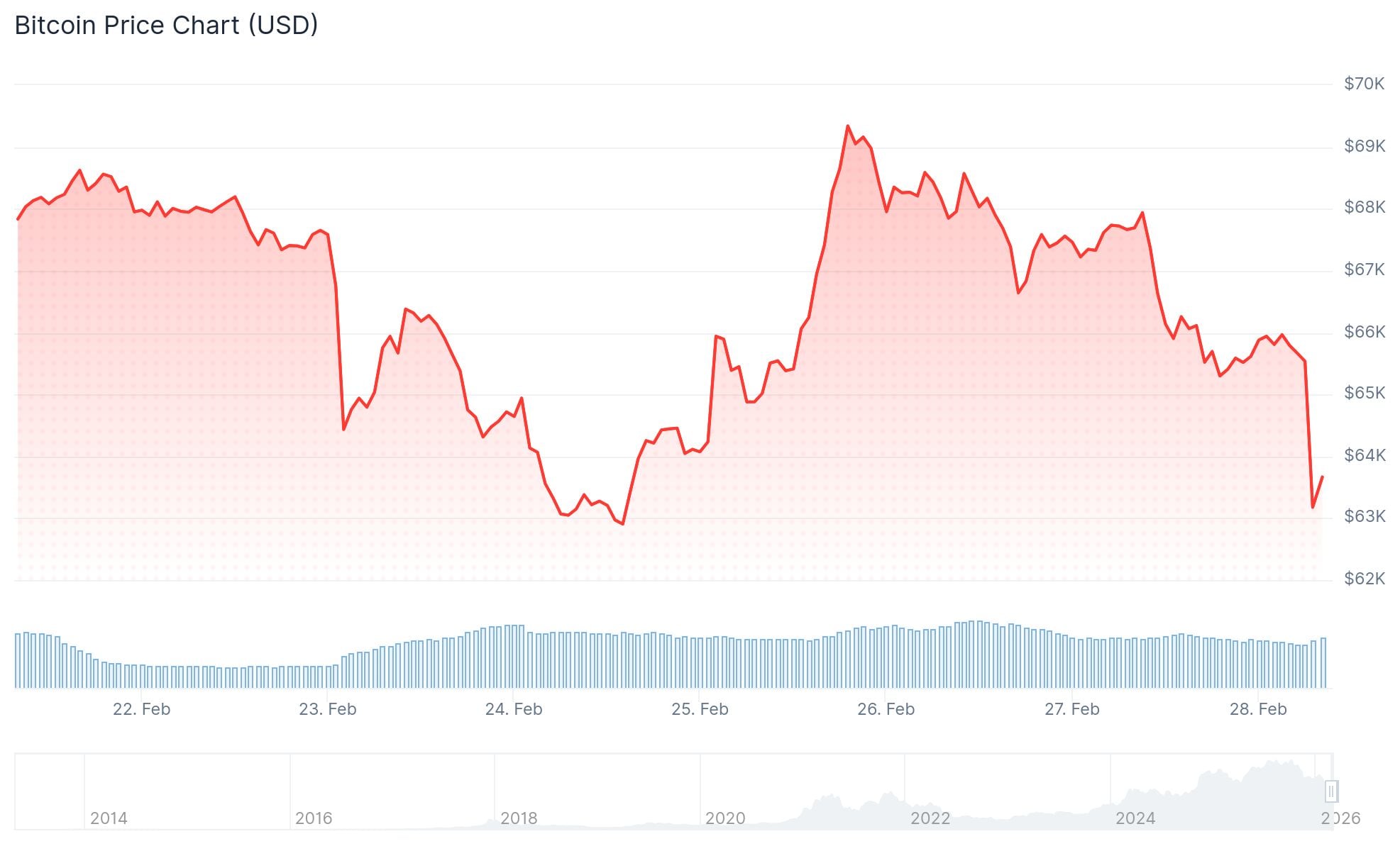
The cryptocurrency witnessed a dramatic decline of approximately 5% within mere minutes.
This downturn pushed bitcoin to price levels not witnessed since the market correction on February 5, during which BTC temporarily fell beneath the $60,000 threshold.
In response to the escalating situation, Israeli Defense Minister Israel Katz promptly announced a comprehensive state of emergency throughout the entire nation.
According to reporting from The Wall Street Journal, a U.S. government official verified American involvement in the military operations.

Reuters reported that Israeli authorities characterized the military action as a “preemptive strike,” based on official statements from the nation’s defense leadership.
The Mechanics Behind Bitcoin’s Initial Decline
Unlike traditional equity and fixed-income markets that cease operations during weekends, Bitcoin maintains continuous trading activity throughout every day of the week.
This characteristic establishes bitcoin as among the few substantial, highly-liquid assets accessible to market participants when geopolitical risk accelerates during non-standard trading periods.
Historical precedent supports this behavior pattern. Bitcoin frequently experiences rapid sell-offs in response to geopolitical instability, with recoveries typically materializing after conventional markets resume operations.
“Bitcoin just dropped off a cliff,” remarked one market observer on X, further predicting that “Monday will be a bloodbath in the market.”
International Relations and Market Impact
The military operations arrive after several weeks characterized by increasing U.S. military presence in the region and unsuccessful diplomatic efforts regarding Tehran’s nuclear program.
Market analysts had previously discussed potential ramifications of Iranian conflict scenarios on bitcoin, precious metals, and equity markets.
The offensive action heightens concerns about expanded regional instability in a zone critical to global economic stability.
Recent months have shown bitcoin failing to maintain correlation with gold prices, creating questions about its legitimacy as a hedge asset or “digital gold” alternative.
By Saturday morning hours, bitcoin was exchanging hands near the $63,000 mark, with additional volatility anticipated upon the reopening of conventional financial markets on Monday.
Get 3 Free Stock Ebooks
Discover top-performing stocks in AI, Crypto, and Technology with expert analysis.
- Top 10 AI Stocks - Leading AI companies
- Top 10 Crypto Stocks - Blockchain leaders
- Top 10 Tech Stocks - Tech giants


