



There is a thought experiment worth running when evaluating any gambling platform. If this did not already exist and someone built it today from scratch, would it look like this? For William Hill, the honest answer is almost certainly no. A platform designed in 2026 would not process payments exclusively through banks. It would not carry a casino library that pales next to what newer operators launch with. It would not run a loyalty programme that most players barely notice. William Hill looks the way it does because it was built across many decades, with each era leaving its fingerprints on the product. ZunaBet looks the way it does because it was built this year, in one focused effort, with no fingerprints from the past. That difference defines everything about how the two platforms compare.
William Hill: The Weight of Every Era It Has Survived
William Hill’s story starts in 1934 in the United Kingdom. Across nine decades it has adapted from illegal off-course bookmaking to licensed betting shops to telephone wagering to online platforms to mobile apps. It is now owned by Caesars Entertainment, placing it within one of the largest gambling corporations in the world. The brand operates across multiple international markets with both sportsbook and casino products.
The sportsbook remains the strongest pillar. Coverage runs deep across football, horse racing, and a wide range of traditional sports that form the backbone of the British and international betting markets. Odds are competitive, live betting is available, and the mobile app handles standard sportsbook functions without significant issues. The casino supplements the sportsbook with slots, table games, and live dealer rooms from recognised providers. The library is sized consistently with what sportsbook-first legacy operators typically carry — enough to satisfy casual casino interest without competing with the depth that dedicated casino platforms deliver.
Every payment travels through traditional infrastructure. Debit cards, bank transfers, PayPal, Skrill, and similar services handle all transactions. Deposits process predictably in most cases. Withdrawals depend on the payment method and the institutions involved, with timelines stretching from same-day for certain e-wallets to multiple business days for bank transfers. Cryptocurrency is not part of the payment landscape.
New player offers include free bets on the sportsbook side and deposit matches or free spins for the casino. Amounts shift by market and promotional period but consistently stay within the range that established operators maintain across the industry. The loyalty system rewards wagering through point accumulation and periodic promotional offers without a structured public tier system or gamified framework.
The cumulative effect of ninety years of layered development is a platform that works but does not excite. The interface shows the evidence of many hands across many years — functional but cluttered, navigable but not intuitive, updated but not reimagined. Every section feels like it was added to something that already existed rather than designed as part of a unified whole. William Hill’s platform tells you it has been around for a long time. What it does not tell you is that it has any particular vision for where it is going next.

ZunaBet: Single Vision, Single Build, Current Moment
ZunaBet came into existence in 2026. Strathvale Group Ltd owns it, an Anjouan gaming license governs it, and a team with over 20 years of combined industry experience designed it. The platform carries no inherited code, no outdated design decisions, and no features that exist only because removing them would break something else. Everything on ZunaBet is there because someone decided in 2026 that it belonged there.
The visual experience communicates that instantly. A dark-themed HTML5 interface loads with the kind of speed and smoothness that only comes from modern web technology applied without legacy constraints. Content is organised with clean hierarchy and intuitive flow. Players find what they are looking for without navigating through menus that accumulated over years of feature additions. The design feels unified because it was created as a single cohesive product, not assembled across multiple redesign cycles.
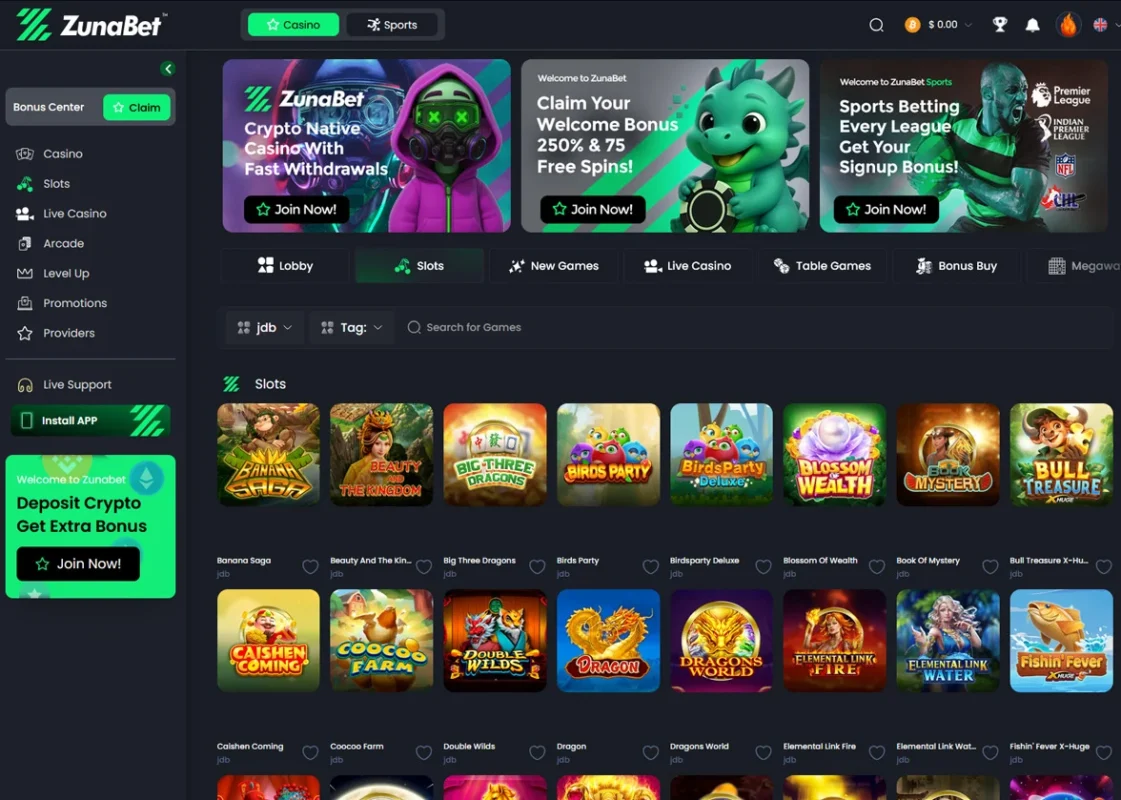
The game library matches that unity of purpose with overwhelming scale. Over 11,000 games from 63 providers — Pragmatic Play, Evolution, Hacksaw Gaming, Yggdrasil, BGaming, and a deep roster of additional studios — cover slots, RNG table games, and live dealer content at a depth that William Hill does not approach. Players raised on content platforms where abundance is the default find in ZunaBet a casino that meets that expectation. William Hill’s more modestly sized library feels like it belongs to a period when a few hundred games was considered generous.
The sportsbook was constructed as a primary product rather than an inherited centrepiece being maintained from an earlier era. Football, basketball, tennis, NHL, combat sports, and virtual sports all receive proper coverage. Esports — CS2, Dota 2, League of Legends, and Valorant — gets dedicated market depth that reflects where betting interest is migrating among younger demographics. William Hill offers some esports betting. ZunaBet offers an esports section that someone who only bets on esports would still find satisfying.
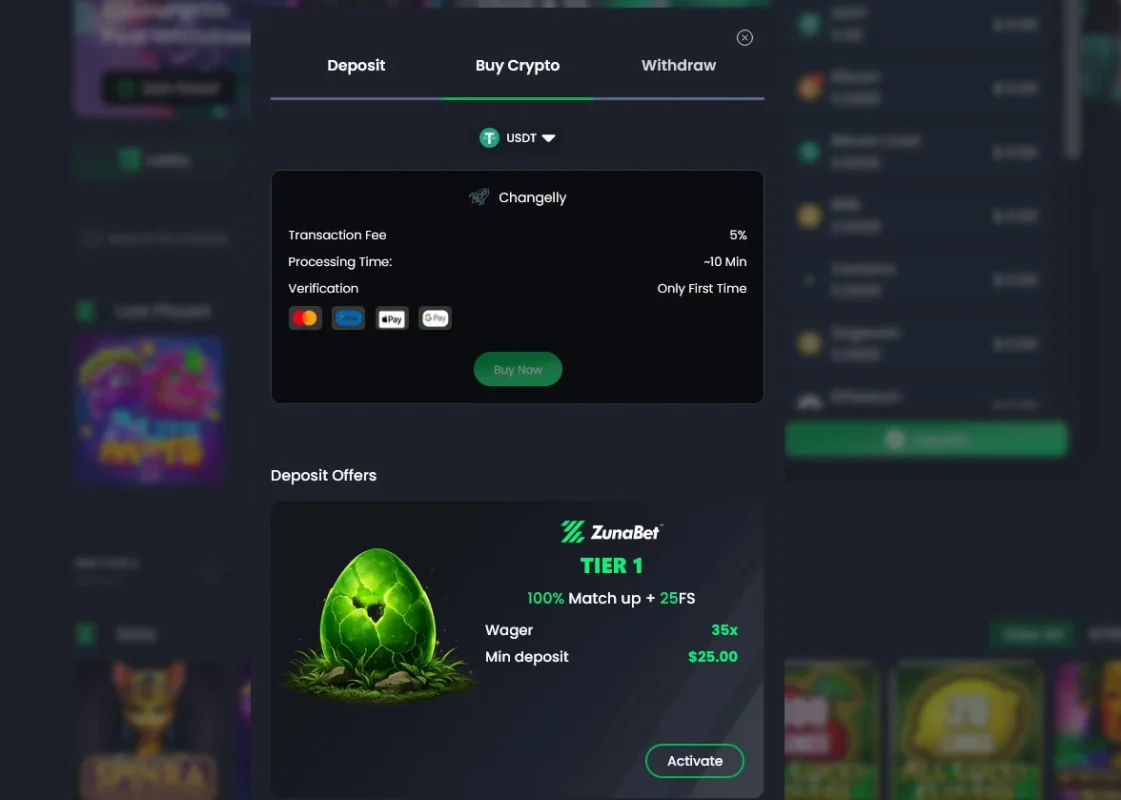
Cryptocurrency powers the entire financial layer. Over 20 coins accepted — BTC, ETH, USDT across several blockchains, SOL, DOGE, ADA, XRP, and more. No platform fees whatsoever. Withdrawals processed on blockchain timelines without banking intermediaries. Where William Hill’s financial experience reflects the speed and cost of a system designed decades ago, ZunaBet’s reflects what becomes possible when you build payment infrastructure in 2026 using the most current technology available.
The welcome bonus reaches up to $5,000 in deposit matches plus 75 free spins over three deposits — 100% up to $2,000 with 25 spins first, 50% up to $1,500 with 25 spins second, and 100% up to $1,500 with 25 spins third. That level of introductory value sits well above what William Hill extends in any of its markets.
Native apps cover iOS, Android, Windows, and MacOS. Live chat support operates continuously.
A Loyalty System You Ignore vs One You Cannot Put Down
The loyalty programme comparison crystallises the modernity gap between these platforms better than any other single feature.
William Hill’s programme runs quietly. Points accumulate through wagering. Promotional offers arrive periodically. Most players could not describe the specifics of how the system works because it never gives them a reason to investigate. It exists as a background process — something the platform does for regulars without making it a meaningful part of their experience. It is loyalty as administration rather than loyalty as engagement.
ZunaBet made loyalty one of the most compelling parts of using the platform. The dragon evolution system follows a mascot named Zuno through six tiers — Squire, Warden, Champion, Divine, Knight, and Ultimate. Rakeback starts at 1% and climbs to 20% at the highest level. Free spins grow to 1,000 at the upper tiers. VIP club access and double wheel spins mark the journey.
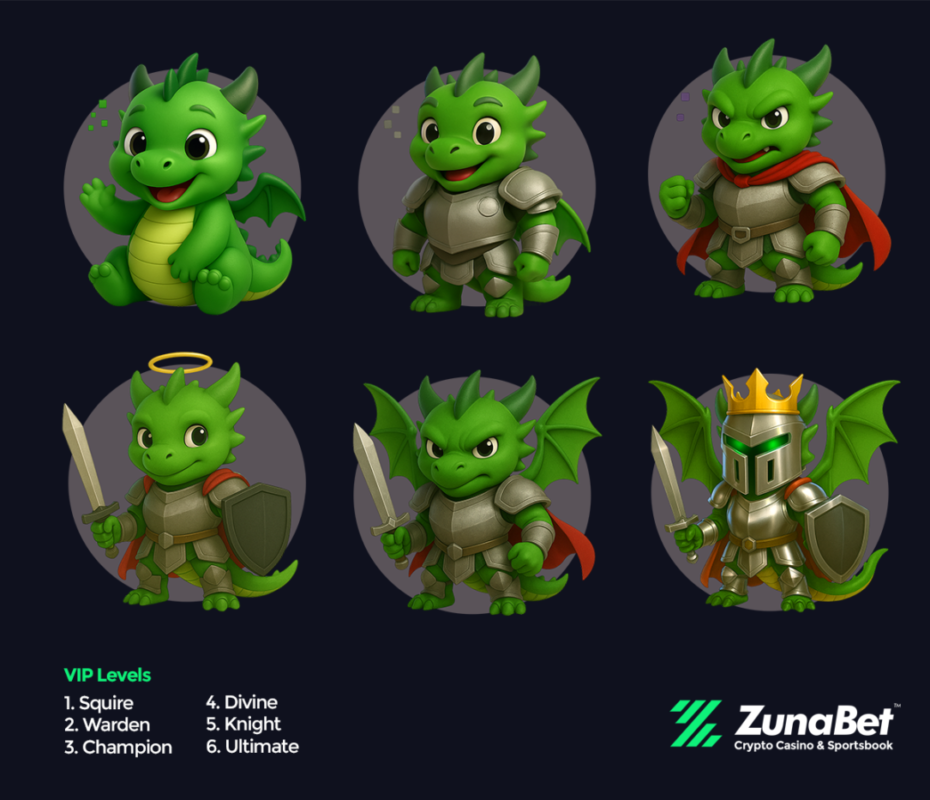
The system is transparent to its core. Every tier publishes requirements and rewards. Progress is visible at all times. The next milestone is always in sight with clear information about what it takes to reach it and what it delivers when you do. The gamified design applies the same principles that keep players engaged in video games — visible levels, defined goals, meaningful rewards, and the persistent pull of the next achievement.
The difference between using these two loyalty systems day to day is the difference between a platform that acknowledges your existence and one that makes your progression feel like part of the entertainment. One runs in the background of your experience. The other shapes the foreground of it. For any player who has engaged with progression mechanics in gaming, social platforms, or fitness apps, ZunaBet’s approach feels instantly recognisable and motivating. William Hill’s feels like it belongs to a time before anyone thought to make loyalty interesting.
The Speed of Money as a Measure of Modernity
A platform can look modern and still feel outdated the moment a player tries to withdraw their winnings. Payment speed is where the experience gap between eras becomes most tangible.
William Hill sends money through banks and processors. Those institutions operate on their own schedules, apply their own policies, and deliver funds on their own timelines. A player requesting a withdrawal enters a process they cannot see, cannot influence, and cannot predict. It might be fast. It might not. The outcome depends on variables that have nothing to do with William Hill or the player — just the institutional machinery sitting between them.
ZunaBet sends money through the blockchain. The player requests a withdrawal and it goes. No institution reviews it. No queue delays it. No calendar restricts it. No fee diminishes it. The transaction travels directly from the platform to the player’s wallet with the speed and consistency that blockchain technology provides regardless of when it happens.
That predictability is what makes the experience feel modern. Not just fast — predictable. Every withdrawal works the same way every time. There is no variable to introduce uncertainty. For players who have used crypto in other areas of their financial lives, this is simply how money should work. For players who experience it for the first time after years of waiting for bank transfers, it redefines what they expect from every platform they use going forward.
The Honest Answer
William Hill has survived and adapted through nine decades of industry upheaval. That track record commands respect. The brand carries weight that no amount of technology can fabricate. For players whose primary consideration is institutional trust built over generations, William Hill delivers something that newer platforms cannot — the comfort of proven longevity.
But longevity and modernity answer different questions. A player asking which platform they can trust has one answer. A player asking which platform feels like it was built for them in 2026 has another.
ZunaBet was designed for that second question. Every feature reflects it. A unified interface with no legacy clutter. Over 11,000 games from 63 providers. Crypto payments across 20-plus coins with zero fees and blockchain speed. A sportsbook that takes esports seriously. A $5,000 welcome package. A loyalty programme that makes progression feel like a game worth playing. Native apps on every device. Support at every hour.
William Hill tells you it has been here for ninety years. ZunaBet shows you what a gambling platform looks like when ninety years of accumulated convention is set aside and someone builds exactly what today’s players are looking for. The gap between those two things is bigger than most people expect until they see them side by side. And once they do, the question of which platform feels more modern answers itself.
Get 3 Free Stock Ebooks
Discover top-performing stocks in AI, Crypto, and Technology with expert analysis.
- Top 10 AI Stocks - Leading AI companies
- Top 10 Crypto Stocks - Blockchain leaders
- Top 10 Tech Stocks - Tech giants


