



TLDR
- Chinese authorities triggered shutdowns affecting up to 500,000 BTC mining rigs, mainly in the Xinjiang region.
- The global Bitcoin hashrate fell by about 5.6%, dropping from 1.2 Zh/s to 869 EH/s.
- CCP investigations followed mining promotions on TikTok and Rednote, prompting rapid facility closures.
- Both legacy and newly upgraded mining farms, including hydro-powered sites, halted operations.
- Bitcoin prices fell below $85,000 during the same period, alongside the sustained hashrate decline.
BTC miners across China have reduced hashrate following renewed investigations by the Chinese Communist Party. The shutdown involves up to 500,000 mining rigs, with major facilities in Xinjiang affected. The network hashrate dropped sharply after December 13, losing more than 5.6% capacity.
CCP Oversight Forces Bitcoin Mining Rigs Offline in China
Chinese Bitcoin mining farms have started closing down operations in the Xinjiang autonomous region. The closures have impacted 400,000 to 500,000 rigs across several provinces. This shutdown marks the steepest decline in mining activity since the 2024 halving.
JUST IN: China BTC miners shut down roughly 1.3 GW in Xinjiang amid CCP scrutiny
BTC miners in China’s Xinjiang province are closing shop amid gov’t scrutiny, taking as much as 100 EH/s offline.
Bitcoin’s hashrate has fallen 5.6% in the fallout.
(Post below) pic.twitter.com/uvCT1wrCMc
— Blockspace (@blockspace) December 15, 2025
Jack Kong, former chairman of Canaan Mining, said the reduction equals 250 Th/s from operational capacity. He confirmed that newer rigs were also affected. “This includes mining farms using the latest S19 XP machines,” Kong added.
Kevin Zhang from Nakamoto Holdings estimated a larger impact based on facility power usage. Zhang said 500,000 rigs were disconnected from 2 GW worth of power. He used the S19 Antminer output to gauge the rig volume. BTC hashrate dropped from 1.2 Zh/s to 869 EH/s in two days. The closures reduced local contributions, particularly from farms based in Xinjiang. The global network registered a 5.6% contraction in hashrate.
Mining Halt Comes After TikTok and Rednote Promotions
The shutdown followed increased online promotions by Chinese miners on platforms like TikTok and Rednote. This drew attention from CCP regulators, prompting rapid closures. Investigators have begun reviewing on-site operations and equipment. Sources cited by Blockspace confirmed inspections began after the videos were posted.
Local operators started closing facilities in response. Some farms were only recently upgraded with modern mining machines. China currently hosts about 1,362 BTC nodes, or 2.5% of the total network. Its mining pools previously ranked among global leaders.

In November 2025, China was still the third-largest hashrate contributor. The closures included hydroelectric-powered operations that previously escaped attention. The crackdown affected both legacy sites and newly built data centers. Facilities operating with renewable energy were not exempt.
Bitcoin Price Market Dips as Hashrate Declines and Trust Erodes
The Bitcoin price fell below $85,000 during the mining outage, mirroring a broader market reaction. A deep analysis at the time of press by CoinMarket reveals that Bitcoin opened its market value at $88,584 during the Asian trading session, followed by an active market throughout the day. The price initially hovered near $88,600 before climbing steadily to just under $90,000 in early afternoon trading. By evening, the trend reversed as Bitcoin experienced a sharp drop below $87,000, continuing to slide further.
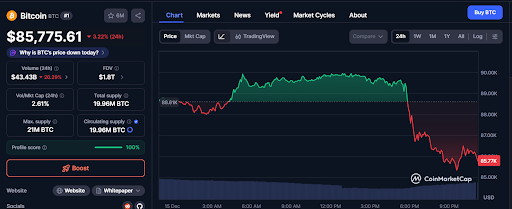
The downward momentum remained strong into late hours, reaching lows near $85,700 before stabilizing at the current level. Throughout the 24 hours, Bitcoin shifted from early gains to steady losses, ending the session in negative territory. This marked a clear intraday reversal, with the steepest fall occurring and persisting. The Bitcoin price fall is related to that of hashrate, as the decline started on December 13 and extended into the following days. Daily mining metrics confirmed consistent reductions.
Reports of closed facilities emerged during this period. Analysts observed that difficulty could adjust as a result of the reduced hashrate. This may favor miners outside China. However, the trust issue may affect industry confidence. Some facilities used the latest-generation rigs but still chose to halt work. Operators feared consequences following CCP oversight. As of now, local authorities have not issued formal shutdown orders.
Get 3 Free Stock Ebooks
Discover top-performing stocks in AI, Crypto, and Technology with expert analysis.
- Top 10 AI Stocks - Leading AI companies
- Top 10 Crypto Stocks - Blockchain leaders
- Top 10 Tech Stocks - Tech giants


