



Key Takeaways
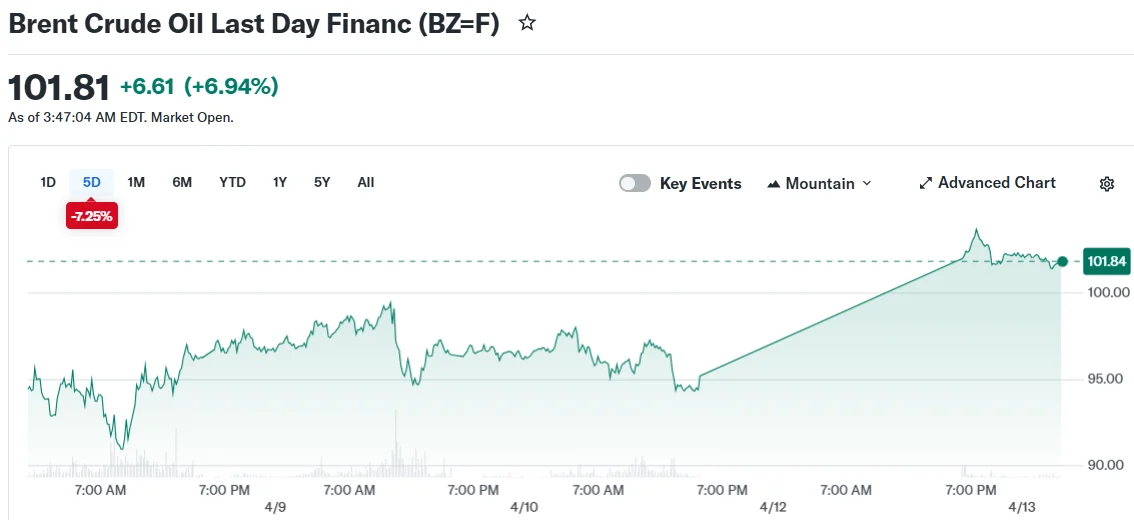
- Brent crude climbed more than 9% to approximately $104 per barrel following Washington’s announcement of an embargo on ships conducting trade with Iran
- The naval enforcement action in the Strait of Hormuz comes after weekend ceasefire negotiations between the US and Iran in Pakistan ended without agreement
- Tehran has declared it “will not allow” the embargo to proceed and has closed the door on future discussions regarding its nuclear program
- The strategic waterway has been functionally shut down since late February when American and Israeli military operations against Iran commenced
- OPEC analysts have cautioned that infrastructure damage to Middle Eastern energy facilities will create lasting supply constraints
Oil prices experienced significant upward momentum on Monday following the US military’s declaration of a blockade targeting all commercial vessels engaged in Iranian trade, propelling Brent crude beyond the $100 threshold for the first time in recent months.
Brent futures climbed as high as 9.1% to approach $104 per barrel. European natural gas contracts surged nearly 18% during peak trading. West Texas Intermediate crude similarly advanced more than 7%.
The embargo encompasses all maritime traffic departing from or arriving at Iranian port facilities. The restriction does not extend to additional vessels seeking passage through the Strait of Hormuz corridor itself.
US Central Command announced implementation would commence at 10 a.m. Eastern time Monday. The directive followed the breakdown of diplomatic negotiations between Washington and Tehran held in Islamabad during the weekend.
Vice President JD Vance headed the American negotiating team and departed Pakistan early Sunday following 21 hours of discussions that yielded no breakthrough. Major obstacles centered on Iran’s nuclear activities, the restoration of normal Hormuz operations, and Tehran’s backing of regional militant organizations including Hezbollah.

Iran characterized US proposals as “excessive.” Tehran indicated no intention to resume nuclear discussions. Trump stated to the press: “I don’t care if they come back or not.”
Mohsen Rezaee, Iran’s military adviser to the supreme leader, declared Iran “will not allow” the American embargo and possessed countermeasures to resist it.
The Strait of Hormuz had already been essentially non-operational since American and Israeli military strikes targeting Iran launched in late February. Iran had been imposing transit charges on selected vessels and maintaining traffic volumes at minimal levels compared to pre-conflict periods, eliminating approximately 20% of the world’s oil supply.
Global Hunt for Available Crude
Refineries and commodity traders worldwide are urgently seeking immediately deliverable crude shipments as physical inventory availability contracts further.
Certain market observers predict additional price appreciation ahead. Jorge Montepeque from Onyx Capital Group stated on Bloomberg TV that current valuations underestimate the actual risk exposure. “It really makes no sense — it should be $140, $150,” he commented.
During Monday morning hours, two petroleum tankers made attempts to exit the Gulf through the Strait by navigating near Iranian territorial waters — marking the initial vessels to attempt transit since the blockade announcement.
Beijing’s Role in the Crisis
Iran continued exporting crude oil and condensate from Persian Gulf terminals throughout March, with China representing the primary importing destination. Several tankers carrying oil destined for Chinese markets are currently affected by the blockade measures.
Former US Ambassador to Saudi Arabia Michael Ratney expressed apprehension about potential scenarios involving US Navy vessels intercepting those ships, cautioning about possible deterioration in US-China diplomatic relations.
The Wall Street Journal indicated that Middle Eastern governments were working to facilitate renewed ceasefire discussions between Washington and Tehran within the next several days.
OPEC is scheduled to release its monthly market analysis report later on Monday.
Get 3 Free Stock Ebooks
Discover top-performing stocks in AI, Crypto, and Technology with expert analysis.
- Top 10 AI Stocks - Leading AI companies
- Top 10 Crypto Stocks - Blockchain leaders
- Top 10 Tech Stocks - Tech giants


