



TLDR
- Brent crude momentarily exceeded $101 per barrel on Thursday before stabilizing near $98, registering a 6.6% daily gain
- Attacks on two oil tankers in Iraqi waters of the Persian Gulf resulted in at least one fatality among crew members
- Oman ordered complete evacuation of vessels from the Mina Al Fahal export facility as a safety measure
- Chinese authorities implemented a prohibition on refined petroleum product exports throughout March to secure domestic reserves
- The International Energy Agency unveiled plans for an unprecedented 400 million barrel strategic reserve deployment to stabilize markets
Global petroleum markets experienced significant volatility on Thursday following fresh tanker incidents and terminal shutdowns that intensified concerns regarding Middle Eastern supply stability.
Brent crude reached an intraday peak of $101.59 per barrel during early trading before retreating to approximately $98. West Texas Intermediate climbed more than 6% to reach $92.61. These benchmarks had previously approached $120 earlier in the week.
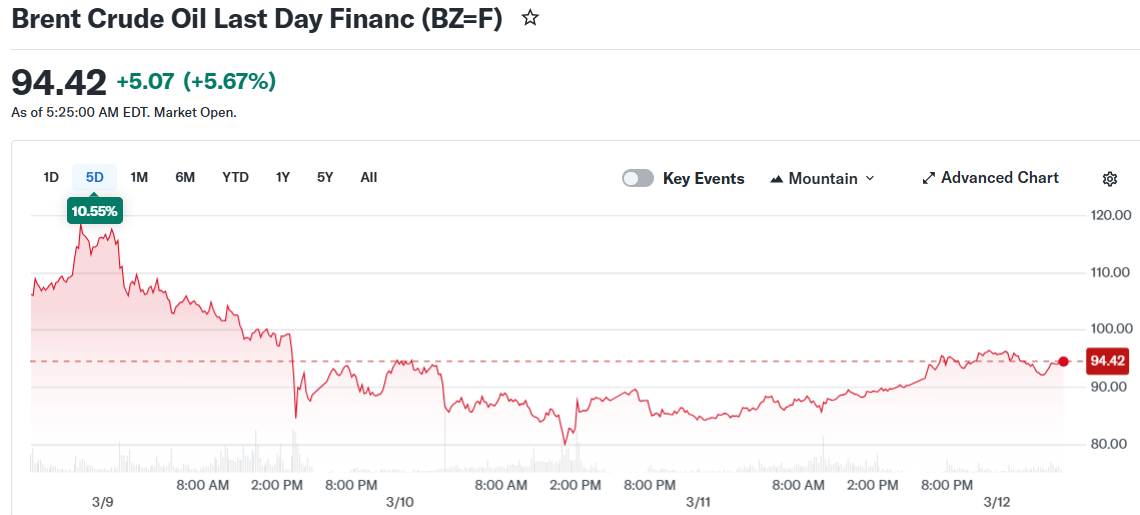
Two commercial oil tankers suffered attacks in the northern Persian Gulf within Iraqi territorial waters. Circulating footage depicted the vessels engulfed in flames. Farhan al-Fartousi, Iraq’s port director, confirmed to The Wall Street Journal that the incidents claimed one sailor’s life while emergency responders worked to extract remaining crew members. Iraqi authorities responded by temporarily suspending operations at all national oil ports.
Meanwhile, Oman implemented a full evacuation of vessels from the Mina Al Fahal export terminal as a preventative measure following the series of regional maritime attacks. This terminal represents one of the limited remaining export channels for Middle Eastern crude to access international markets. Normal operations subsequently resumed at the facility.
The Strait of Hormuz, a critical chokepoint facilitating approximately 20% of worldwide oil transport, remains essentially inaccessible. Iranian officials have declared no crude shipments will traverse the strait. This blockade has compelled Gulf-region producers, including Iraq, Kuwait, and Saudi Arabia, to reduce production levels.

Beijing Implements Stricter Fuel Export Controls
Chinese authorities announced an immediate prohibition on refined petroleum product exports during March. Domestic refiners simultaneously began terminating previously contracted gasoline and diesel export shipments. Major processing facilities had already received instructions to halt new export agreements.
Goldman Sachs issued warnings that oil prices could surpass the 2008 record of $147.50 per barrel should Hormuz passage restrictions persist through March.
ANZ market analysts suggested that current pricing fails to adequately reflect the probable length of supply interruptions. “When conflicts progress beyond initial shock stages, oil markets typically transition from pricing uncertainty toward pricing duration,” their analysis stated.
Strategic Reserve Deployments Provide Marginal Price Relief
The International Energy Agency is coordinating an unprecedented release of 400 million barrels from global strategic petroleum reserves. U.S. President Donald Trump announced Wednesday that America would contribute 172 million barrels from the Strategic Petroleum Reserve.
However, Sanford C. Bernstein analyst Neil Beveridge characterized these reserve releases as “insignificant relative to the 20 million barrels” per day of supply disruption resulting from the Hormuz closure.
The regional conflict reached its thirteenth consecutive day on Thursday with no immediate resolution apparent. Iranian officials stated that any potential ceasefire agreement would necessitate assurances from both Washington and Tel Aviv against future strikes on Iranian territory. The United States has not committed to these conditions.
Speaking to supporters in Kentucky on Wednesday, Trump predicted the conflict would conclude soon, though he emphasized the U.S. “would remain as long as necessary.”
Weekly U.S. petroleum inventory statistics published Wednesday revealed a larger-than-anticipated increase of 3.8 million barrels during the preceding week.
Get 3 Free Stock Ebooks
Discover top-performing stocks in AI, Crypto, and Technology with expert analysis.
- Top 10 AI Stocks - Leading AI companies
- Top 10 Crypto Stocks - Blockchain leaders
- Top 10 Tech Stocks - Tech giants


