



Key Takeaways
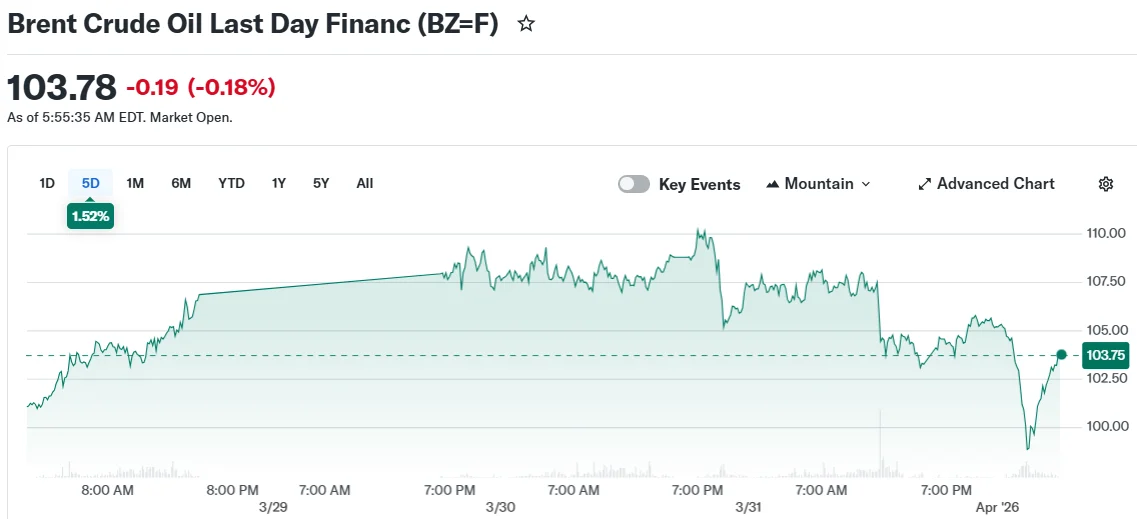
- Brent crude temporarily plunged beneath the $100 per barrel threshold, experiencing a decline exceeding 5% before a modest rebound
- President Trump indicated the United States might withdraw from Iran in a two to three-week timeframe
- Despite the decline, crude prices remain approximately 40% elevated compared to pre-war levels from late February
- The strategically vital Strait of Hormuz, responsible for transporting about 20% of worldwide oil, continues to face severe disruption
- American petroleum stockpiles increased by 10.26 million barrels in the previous week, significantly exceeding analyst projections
Global petroleum markets experienced significant volatility Wednesday following President Donald Trump’s comments suggesting a potential United States withdrawal from the Iran conflict in the coming weeks, causing Brent crude to momentarily drop below the $100 per barrel mark for the first time since hostilities commenced.
Brent crude experienced its steepest decline of over 5% during Wednesday’s trading session before staging a partial recovery. The benchmark was most recently changing hands near $102.25 per barrel. Prior to the outbreak of conflict in late February, Brent had been hovering around $70 per barrel.
West Texas Intermediate crude from the United States similarly declined, falling 2.4% to settle at $98.92 per barrel.
Speaking to journalists at the White House, Trump stated that the United States could depart Iran within “two to three weeks.” He further commented that Iran would not necessarily need to finalize a formal agreement for hostilities to cease.
Iran’s president suggested the nation possesses the “necessary will” to conclude the war provided it receives assurances against future attacks. Iran’s Foreign Minister Abbas Araghchi acknowledged that communications were being transmitted between the US and Iran, though he clarified that formal negotiations had not commenced.

Trump was set to deliver a national address Wednesday evening at 9 p.m. Eastern time, which the White House characterized as an “important update on Iran.”
Despite diplomatic signals pointing toward de-escalation, military actions persisted Wednesday. An oil tanker sustained damage near Qatar, triggering a fire that crews successfully extinguished. Authorities reported no environmental harm resulted from the incident.
Factors Keeping Crude Prices Elevated
Oil prices continue to trade roughly 40% above their pre-March levels. The Strait of Hormuz, a critical maritime corridor facilitating approximately 20% of global petroleum exports, has witnessed tanker movements virtually cease due to Iranian attack threats.
The International Energy Agency characterized the disruption as the most severe supply shock in recorded history. Fuel costs in certain regions have surged past $200 per barrel. American gasoline prices exceeded $4 per gallon this week, marking the first occurrence since August 2022.
Market analysts have cautioned that even a partial restoration of strait operations could require substantial time. Trump has emphasized that US allies would need to contribute to securing the waterway. According to The Wall Street Journal, the United Arab Emirates has encouraged Western and Asian nations to establish a coalition to forcibly reopen the passage.
China and Pakistan released a joint statement Tuesday demanding an immediate ceasefire and the restoration of safe maritime shipping routes.
Inventory Data Suggests Declining Consumption
Recent figures from the American Petroleum Institute revealed US crude stockpiles expanded by 10.26 million barrels during the past week. This represented a dramatic deviation from analyst expectations, which had predicted a drawdown of 1.3 million barrels.
API chief Mike Sommers emphasized that reopening the Strait of Hormuz represented “the critical piece” for stabilizing international markets, cautioning that prices would continue their upward trajectory without restored petroleum flows.
A third US aircraft carrier strike group is currently en route to the Middle East region, maintaining the potential for additional military escalation.
Get 3 Free Stock Ebooks
Discover top-performing stocks in AI, Crypto, and Technology with expert analysis.
- Top 10 AI Stocks - Leading AI companies
- Top 10 Crypto Stocks - Blockchain leaders
- Top 10 Tech Stocks - Tech giants


