



TLDR
- Brent crude surged past $106 per barrel Thursday with a 4% gain, while WTI advanced to $93.66
- Approximately 20% of worldwide oil transport remains blocked as the Strait of Hormuz closure continues
- Tehran dismissed American diplomatic initiatives while lawmakers prepare legislation to impose transit charges on vessels
- BlackRock’s leadership cautioned that crude could reach $150 per barrel regardless of immediate ceasefire developments
- American government analysts are examining economic impacts of potential $200 per barrel scenarios
Energy markets experienced substantial volatility Thursday as diplomatic uncertainty between Washington and Tehran fueled investor anxiety. Brent crude advanced approximately 4% to reach $106.34 per barrel, while West Texas Intermediate increased 3.7% to settle at $93.66.
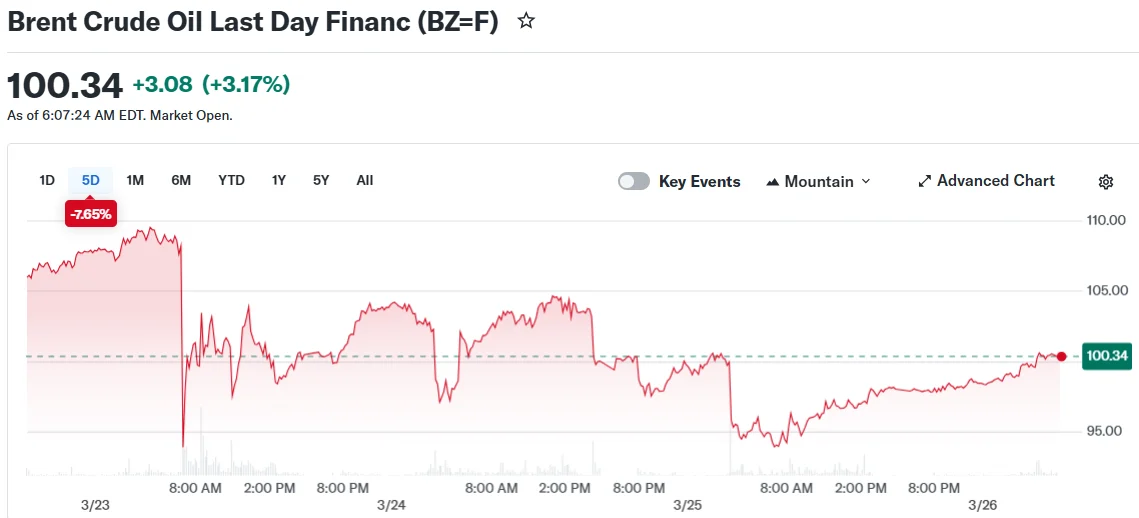
The surge represented a dramatic reversal from Wednesday’s session, which saw prices decline over 2% on tentative hopes surrounding diplomatic engagement. Those expectations quickly dissipated.
Iranian authorities explicitly rejected assertions that direct negotiations with Washington were underway. Tehran officials emphasized substantial disagreements persist and outlined their demands, prominently featuring sovereign authority over the Strait of Hormuz.
Washington disputed Iran’s characterization, maintaining that dialogue continues. During a Wednesday evening fundraising appearance, President Trump asserted that Iran “wants to make a deal so badly, but they’re afraid to say it.”
Legislators in Tehran are advancing proposed legislation that would impose passage fees on vessels transiting the strait in return for security guarantees. The Fars news agency, which has semi-official status, reported the measure could be completed within days.
The Strait of Hormuz represents a critical chokepoint linking the Persian Gulf with international energy markets. Roughly one-fifth of global petroleum shipments traverse this narrow passage. Since hostilities erupted in late February, tanker movement through the waterway has been severely restricted.

Vessels attempting passage under Iranian supervision must submit crew manifests, cargo inventories, and voyage documentation to the Islamic Revolutionary Guard Corps prior to authorization.
Oil at Risk of Further Spikes
BlackRock president Rob Kapito warned that market participants may be overlooking significant risks ahead. During Thursday remarks in Melbourne, Kapito projected crude could surge to $150 per barrel even with an immediate ceasefire announcement, citing the extended timeline required for supply chain restoration.
Administration officials in Washington are conducting confidential assessments of scenarios involving $200 per barrel pricing, according to sources with knowledge of the discussions.
Brent crude is tracking toward its largest monthly percentage increase since 1990. Prices had previously spiked near $120 per barrel earlier this month before retreating.
A drone attack targeted a Turkish-flagged tanker transporting Russian crude near Istanbul in the Black Sea on Wednesday, introducing additional anxiety for traders monitoring multiple regional flashpoints.
Global Pressures Building
Capital Economics analysts cautioned that sustained disruptions could inflict economic damage comparable to the aftermath of Russia’s 2022 Ukraine invasion, potentially forcing central banks to resume interest rate increases.
Asian nations are experiencing immediate consequences. Thailand implemented gasoline price increases reaching 22% on Thursday. The Philippines suspended operations of its wholesale electricity spot market. Agricultural producers in India and China are confronting elevated costs for chemical inputs.
Retail fuel prices throughout the United States have risen consistently since the conflict’s onset.
The White House confirmed Thursday that a planned summit between President Trump and Chinese leader Xi Jinping has been rescheduled for May 14–15 in Beijing
Get 3 Free Stock Ebooks
Discover top-performing stocks in AI, Crypto, and Technology with expert analysis.
- Top 10 AI Stocks - Leading AI companies
- Top 10 Crypto Stocks - Blockchain leaders
- Top 10 Tech Stocks - Tech giants


