



Key Highlights
- Brent crude surged 2.8% to reach $83.8 per barrel while WTI advanced 2.6% to $76.5 in midweek trading
- Iran’s Revolutionary Guard took command of the Strait of Hormuz, issuing warnings about potential missile and drone strikes on vessels
- Iraq suspended operations at multiple major oil production facilities, adding pressure to already constrained global supplies
- President Trump indicated U.S. Navy vessels might provide escort services for tankers navigating the Strait of Hormuz
- Crude benchmarks extended gains for a fourth consecutive session, marking the strongest performance since January 2025
Global crude markets experienced another day of significant gains on Wednesday, driven by dual supply concerns that propelled Brent to its strongest position since the opening month of 2025.
Brent futures advanced 2.8% during early market hours, settling at $83.8 per barrel. Meanwhile, U.S. West Texas Intermediate contracts climbed 2.6%, touching $76.5 per barrel.
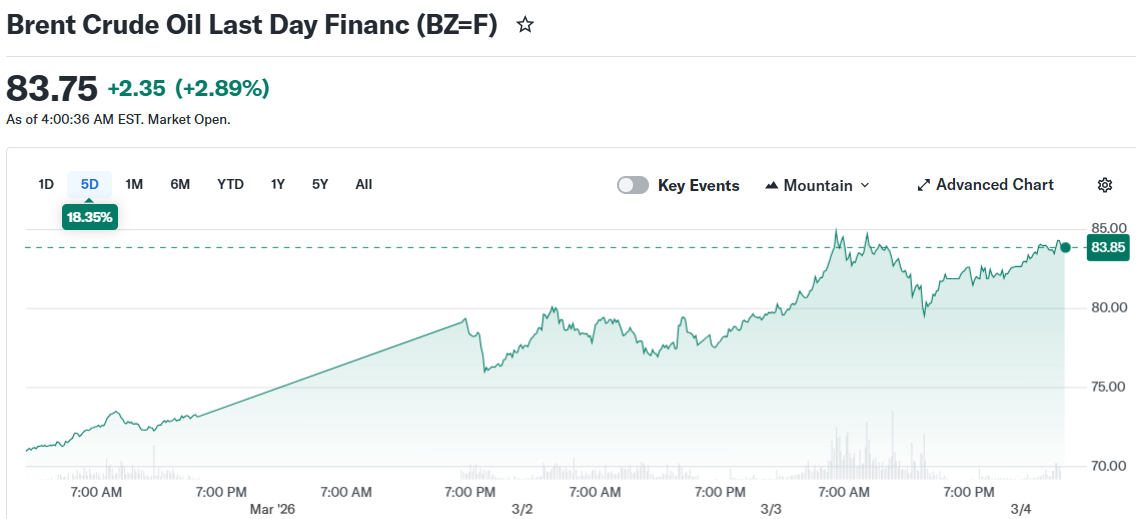
The upward momentum marked the fourth consecutive trading session of price increases for petroleum products. Current trading levels for both primary benchmarks haven’t been witnessed in more than twelve months.
The primary catalyst emerged when Iran’s Islamic Revolutionary Guard Corps declared operational control over the Strait of Hormuz. The military organization issued stern warnings indicating vessels traversing the waterway face potential targeting from missiles and unmanned aerial vehicles.
The Strait of Hormuz represents a critical artery in global energy transportation infrastructure. Approximately one-fifth of the world’s petroleum exports navigate through this strategic chokepoint daily.

Disruptions affecting this vital passage historically trigger rapid increases in oil prices. Market experts suggest valuations may remain elevated should vessel movements face continued restrictions.
The escalating Middle Eastern tensions entered their fifth consecutive day on Wednesday. Iranian forces simultaneously intensified operations targeting American military installations and diplomatic facilities across the region.
Iraqi Production Facilities Go Offline
A secondary factor supporting higher valuations emerged from Iraq. Reports from Bloomberg indicated that Iraqi authorities ordered production cessation at several of the nation’s largest operational facilities.
This decision effectively removes substantial crude volumes from international markets. When combined with the Hormuz situation, traders responded by bidding prices significantly higher.
Earlier in the trading week, valuations experienced temporary softness. Brent declined to $78.40 per barrel following Trump’s social media commentary regarding energy strategy.
The President declared America’s commitment to guaranteeing the “free flow of energy to the world.” According to Deutsche Bank strategist Jim Reid, prices dropped to $78.40 before recovering above the $82 threshold.
Trump further indicated that U.S. Naval forces could potentially begin providing protective escort services for petroleum tankers transiting the Strait of Hormuz when circumstances require. This announcement temporarily eased market anxieties.
Market Sentiment Shifts Despite Presidential Assurances
The period of reduced concern proved fleeting. Valuations rebounded above $82 per barrel within hours and maintained upward trajectory through Wednesday’s session.
The Revolutionary Guard’s explicit warnings regarding missile threats to commercial shipping were identified by Deutsche Bank’s Reid as the primary factor behind the price reversal.
Brent crude touched $83.60 per barrel during Wednesday trading, maintaining proximity to its strongest performance since early 2025. WTI extended its winning streak to three consecutive sessions, reaching $76.45.
The ongoing situation surrounding the Strait of Hormuz represents the dominant concern influencing petroleum markets currently.
Iraq’s decision to suspend operations at critical production infrastructure introduces additional supply uncertainty to markets already experiencing limited spare capacity.
Traders continue monitoring developments in both regions closely as geopolitical tensions show little sign of immediate resolution.
Get 3 Free Stock Ebooks
Discover top-performing stocks in AI, Crypto, and Technology with expert analysis.
- Top 10 AI Stocks - Leading AI companies
- Top 10 Crypto Stocks - Blockchain leaders
- Top 10 Tech Stocks - Tech giants


