



Key Takeaways
- Brent crude declined almost 4% to approximately $100 per barrel following news of a US 15-point ceasefire framework targeting Iran
- WTI crude retreated 4% to $88.70 per barrel, with UK natural gas declining 8%
- President Trump indicated the US is currently “in negotiations” with Iran, though Iranian officials deny discussions are underway
- Israeli military operations continued in Tehran despite diplomatic overtures from Washington
- European equity indexes advanced, with Britain’s FTSE 100, Germany’s DAX, and France’s CAC 40 all posting gains
Brent crude was changing hands near $100.41 per barrel Wednesday morning, marking a decline of nearly 4%, while WTI crude slipped to $88.70.
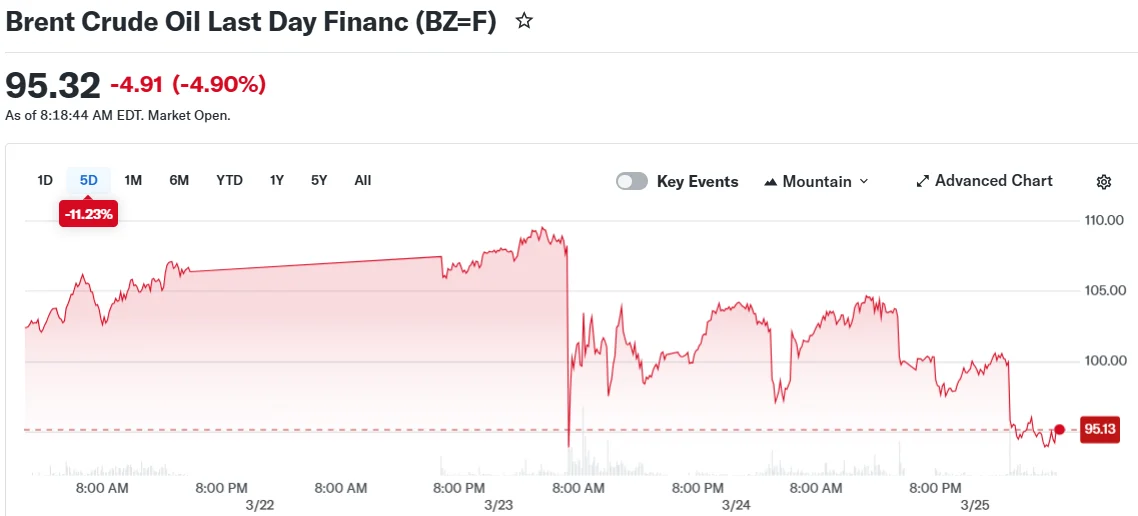
Energy markets experienced significant downward pressure Wednesday following revelations that the Trump administration transmitted a comprehensive 15-point framework to Iran designed to de-escalate tensions across the Middle East. Pakistani intermediaries facilitated the delivery of this proposal and have volunteered to facilitate additional discussions between the two nations.
Trump told reporters the United States is currently “in negotiations” with Iranian officials, adding that Tehran appeared to be “talking sense.” Earlier in the week, he characterized Monday’s discussions as “productive.”
Tehran’s representatives, however, categorically rejected claims of ongoing negotiations — asserting that American officials were merely negotiating among themselves.
This diplomatic disconnect created uncertainty throughout the trading session. Market participants welcomed the potential for reduced conflict but remained cognizant that circumstances could rapidly deteriorate.

Brent crude touched an intraday low of $97.30 before modestly rebounding. WTI crude similarly tumbled, declining 4% to reach $88.70 per barrel. Natural gas prices in the United Kingdom fell 8% in tandem.
Equities Advance as Energy Costs Decline
The pullback in energy prices provided a boost to global stock markets. London’s FTSE 100 advanced more than 1%, climbing 103 points to reach 10,068. Germany’s DAX jumped 1.6% while France’s CAC 40 rose 1.5%. Asian trading sessions had already delivered robust performance during overnight hours.
Matt Britzman, senior equity analyst at Hargreaves Lansdown, noted: “Oil prices have declined on these developments, providing some breathing room for equities that had been pressured by inflation concerns and potential implications for monetary policy.”
Richard Hunter, head of markets at interactive investor, adopted a more measured perspective, observing that the FTSE 100 remains approximately 8% beneath its all-time peak established in late February.
Hormuz Strait Blockage Central to Price Direction
The primary point of concern continues to be the Strait of Hormuz, the vital maritime corridor that has been functionally closed due to Iranian threats against commercial oil vessels. This disruption has propelled prices significantly higher throughout recent weeks.
ING analysts observed: “Despite initial market optimism, substantial uncertainty persists. Volatility continues at elevated levels and geopolitical risk premiums remain embedded in pricing.”
Meanwhile, even as diplomatic communications were transmitted, Israeli forces conducted strikes on Tehran Wednesday — introducing yet another contradictory element to an already complex situation.
The United States military is simultaneously preparing to deploy a minimum of 1,000 additional service members to the region, supplementing the 50,000 already positioned there.
Britzman was unambiguous about the requirements for sustained price reductions: “Social media statements and press briefings can only accomplish so much, and a complete reopening of the Strait of Hormuz will likely be necessary to generate any significant and lasting downward movement from current levels.”
Prices continue to trade well above pre-conflict benchmarks, and the Strait of Hormuz remains closed to shipping.
Get 3 Free Stock Ebooks
Discover top-performing stocks in AI, Crypto, and Technology with expert analysis.
- Top 10 AI Stocks - Leading AI companies
- Top 10 Crypto Stocks - Blockchain leaders
- Top 10 Tech Stocks - Tech giants


