



Quick Overview
- ETH has experienced six straight monthly declines, representing its longest downturn since the 2018 bear market.
- The asset is currently valued below $2,000, hovering near its 2018 cycle top.
- Multiple headwinds including large holder liquidations, futures market dynamics, Layer 2 fee competition, and ETF capital exits are weighing on price.
- Co-founder Vitalik Buterin suggests artificial intelligence may accelerate Ethereum’s technical evolution and enhance protocol security.
- Financial institutions including Standard Chartered and VanEck maintain bullish long-term forecasts of $7,500 and $10,000.
The second-largest cryptocurrency by market capitalization has now posted negative returns for six consecutive months, representing its most extended losing period since the brutal 2018 bear market.
Historical data from CoinGlass reveals that Ethereum’s only comparable drawdown occurred during 2018’s crypto winter, when the asset plummeted beneath $85.
That historic collapse stemmed from the implosion of the Initial Coin Offering phenomenon, as countless blockchain projects had accumulated capital through ERC-20 token sales on Ethereum’s infrastructure.
Today’s prolonged decline stems from an entirely different combination of market pressures.
Market observers identify several contributing factors: systematic distribution by major holders, aggressive short positioning in derivatives markets, broader economic headwinds, sustained withdrawals from spot Ethereum exchange-traded funds, and revenue cannibalization by Ethereum’s expanding Layer 2 ecosystem.

ETH currently trades marginally above its 2018 all-time high, a threshold that once represented a significant psychological barrier.
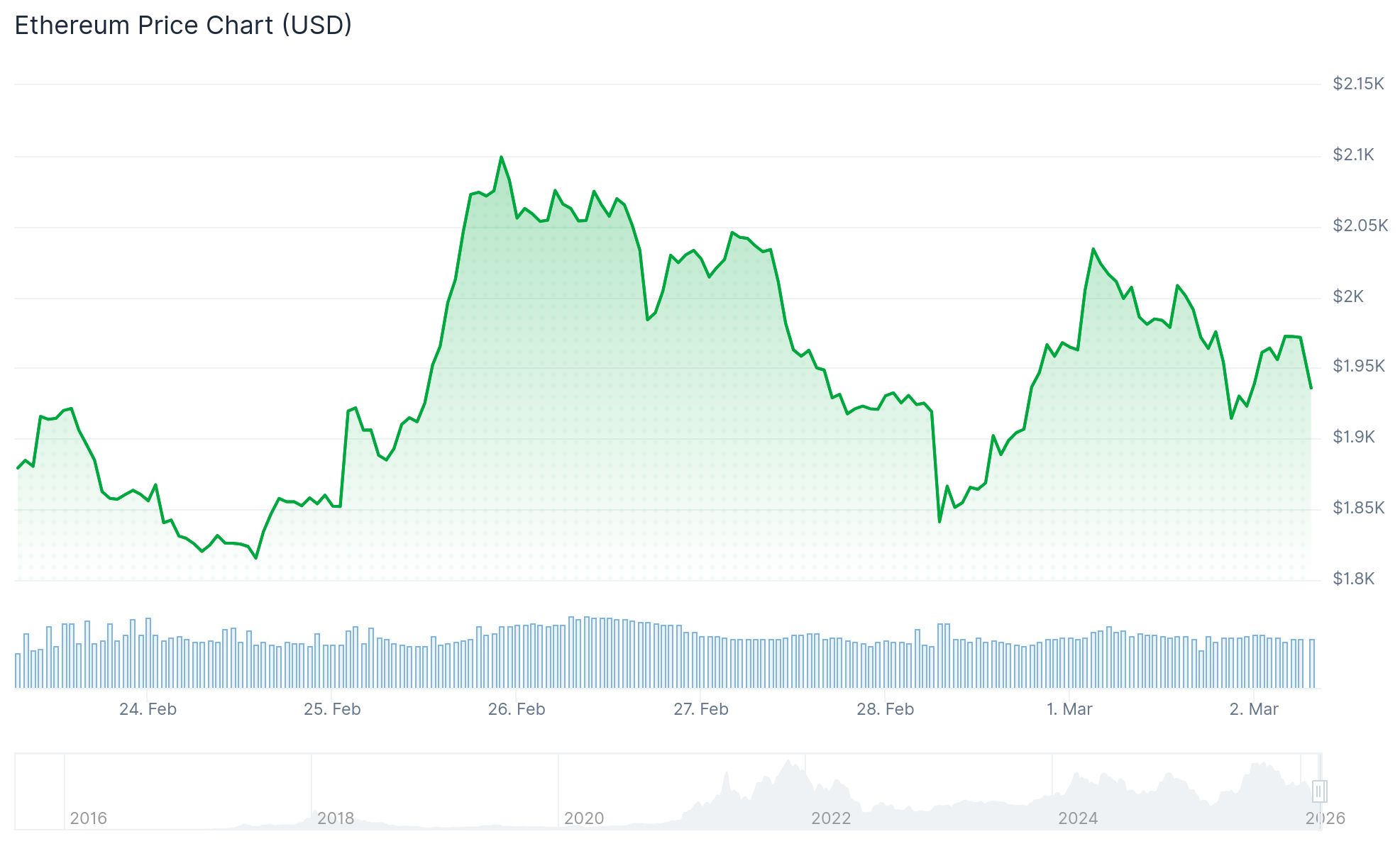
The digital asset recently slipped beneath the $2,000 mark after momentarily touching $2,054. Current trading activity places it below the 100-hour Simple Moving Average.
Critical Support and Resistance Zones
The first resistance barrier stands at $2,000, with additional hurdles positioned at $2,120 and $2,155.
Should ETH successfully breach $2,155, subsequent upside objectives include $2,220 and $2,250.
Regarding downside risk, initial support exists at $1,920, followed by $1,880. A breakdown below $1,880 would likely trigger further selling toward $1,840 or $1,800, with $1,740 representing a critical deeper support threshold.
Buterin Discusses AI’s Role in Ethereum Development
Ethereum co-creator Vitalik Buterin recently highlighted how artificial intelligence technologies could dramatically expedite the network’s technical advancement.
His remarks followed an experiment where AI tools were used to rapidly prototype Ethereum’s complete 2030 development roadmap in just weeks.
Buterin personally experimented with AI-assisted programming, successfully constructing a version of his blogging platform in approximately one hour using only his laptop.
He proposed that approximately half of the efficiency improvements gained through AI adoption should be allocated toward strengthening security measures, including expanded testing protocols and formal code verification processes.
“People should be open to the possibility that the Ethereum roadmap will finish much faster than people expect,” Buterin wrote.
He further emphasized that bug-free smart contract code, previously considered an unrealistic goal, may soon become the baseline standard throughout cryptocurrency development.
Standard Chartered analysts maintain their long-term ETH valuation of $7,500, predicting growth driven by stablecoin adoption, decentralized finance expansion, and real-world asset tokenization.
VanEck projects an even more ambitious $10,000 price target, pointing to forthcoming Pectra and Glamsterdam network upgrades expected to enable throughput of 100,000 transactions per second.
ETH currently maintains position above the $1,900 support threshold following its recent retreat from the $2,054 local peak.
Get 3 Free Stock Ebooks
Discover top-performing stocks in AI, Crypto, and Technology with expert analysis.
- Top 10 AI Stocks - Leading AI companies
- Top 10 Crypto Stocks - Blockchain leaders
- Top 10 Tech Stocks - Tech giants


