


Key Takeaways
- Federal Reserve maintained interest rates at 3.50%–3.75% in a split decision on March 18, 2026
- Bitcoin declined approximately 4% to roughly $71,600 after the announcement
- Both Nasdaq and S&P 500 indexes retreated 0.55% during trading
- Fed officials revised their 2026 inflation outlook upward to 2.7% from 2.4% due to Middle Eastern tensions
- CME Group data indicates zero probability of an April rate reduction
The Federal Reserve opted to maintain its key interest rate at the current 3.50%–3.75% range during Wednesday’s March 18, 2026 policy meeting. The outcome aligned with market expectations.
The decision passed with an 11-1 margin. Stephen Miran cast the sole dissenting vote, advocating for a quarter-point reduction.
Central bank officials pointed to escalating tensions surrounding the U.S.-Iran situation as a primary consideration in their policy stance. Crude oil valuations have surged toward the $100 per barrel threshold, climbing from below $60 earlier in the calendar year.
“The implications of events in the Middle East for the US economy are uncertain in the near term,” Fed Chair Jerome Powell stated. “Higher energy prices will push up overall inflation, but it is too soon to know the scope and duration of the potential effects.”
Powell noted that economic expansion continues at a robust rate. Household consumption maintains its strength while corporate capital expenditures show ongoing growth. However, residential real estate activity remains sluggish and employment conditions are showing signs of cooling.
The central bank adjusted its inflation projection for 2026 upward to 2.7%, revising from the previous 2.4% estimate. Price pressures are anticipated to moderate to 2.2% by 2027.

Financial Markets Respond to Policy Decision and Geopolitical Tensions
[[LINK_START_1]]Bitcoin[[LINK_END_1]] experienced significant downward pressure before the policy statement. Following the announcement, the cryptocurrency traded around $71,600—representing a nearly 4% intraday decline. The sell-off followed rising energy costs and disappointing inflation figures released earlier in the trading session.The Nasdaq Composite and S&P 500 each shed 0.55% during the session. The benchmark 10-year Treasury note yield climbed modestly to 4.21%.
Reduced interest rates generally benefit speculative assets such as Bitcoin and equities by making bonds less attractive. Conversely, elevated rates tend to channel investment toward more conservative holdings.
The Federal Reserve’s forward-looking “dot plot” projection continues to indicate just a single quarter-point reduction anticipated for 2026, followed by another in 2027. This guidance remained unchanged.
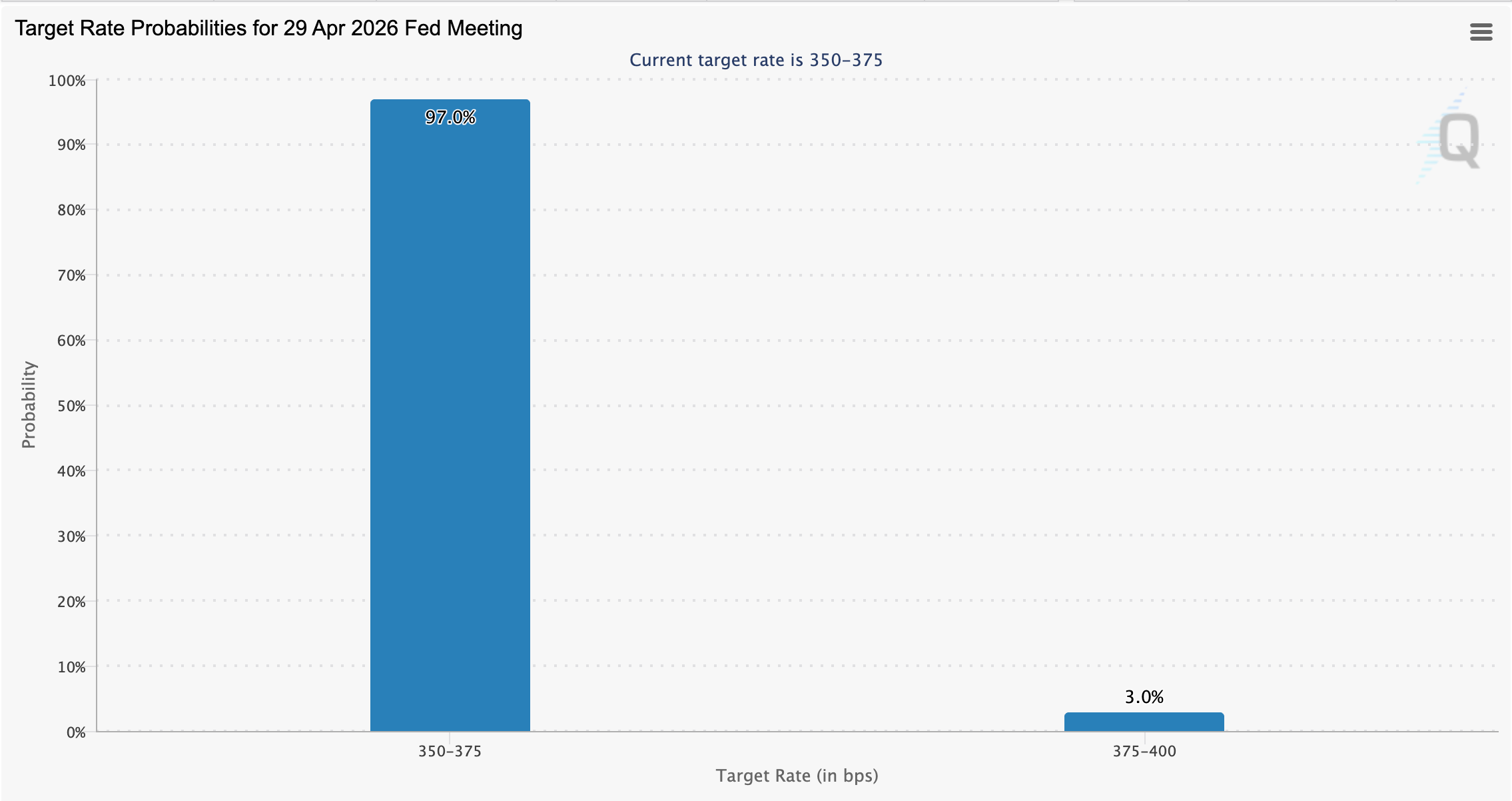
Based on CME Group futures pricing, 97% of market participants anticipate no policy adjustment at the April 2026 Federal Open Market Committee gathering. Only 3% foresee a 25-basis-point increase, which would elevate the range to 3.75%–4.00%.
Expert Perspectives on Fed Policy Path
BitMEX co-founder Arthur Hayes indicated he’s postponing additional Bitcoin acquisitions until the Federal Reserve pivots toward rate cuts. He also speculated that the Iran conflict might eventually compel the Fed toward accommodative policy to support defense expenditures.
Macroeconomist Lyn Alden characterized the current Fed approach as a “gradual print” phase, where monetary expansion occurs steadily, incrementally inflating asset valuations over extended periods.
The Federal Reserve’s twin objectives—maintaining price stability while supporting full employment—face mounting challenges. Inflation persists above the 2% threshold even as labor market indicators demonstrate weakening momentum.
Powell acknowledged that the magnitude and timeline of economic consequences stemming from Middle Eastern instability remain unclear. The central bank will maintain its vigilant assessment of evolving conditions before implementing subsequent policy adjustments.
Get 3 Free Stock Ebooks
Discover top-performing stocks in AI, Crypto, and Technology with expert analysis.
- Top 10 AI Stocks - Leading AI companies
- Top 10 Crypto Stocks - Blockchain leaders
- Top 10 Tech Stocks - Tech giants


