


TLDR
- Mark Karpelès, who led Mt. Gox before its collapse, has unveiled a Bitcoin hard fork concept aimed at retrieving approximately 80,000 BTC taken during a 2011 security breach, currently valued at more than $5.2 billion.
- His plan would enable the stolen cryptocurrency to be transferred without access to the missing private key, through implementing a special consensus mechanism for one specific wallet.
- The concept was posted on GitHub as a conversation piece rather than an official Bitcoin Improvement Proposal.
- Detractors claim this approach could undermine Bitcoin’s fundamental characteristic of unchangeable transactions.
- These stolen assets exist separately from the approximately 200,000 BTC currently undergoing distribution to Mt. Gox claimants, with the payout process scheduled through October 2026.
Mark Karpelès, who formerly ran the ill-fated Mt. Gox Bitcoin exchange, has unveiled a draft plan advocating for a Bitcoin hard fork. His objective centers on retrieving approximately 79,956 BTC that disappeared during a security breach over 15 years ago.
These digital assets, which remain dormant in one particular wallet, hold a current market value exceeding $5.2 billion. The funds have stayed untouched since their theft in June 2011.
Bitcoin’s existing protocol requires the original private key to authorize any transaction. That crucial key was never found.
Karpelès posted his concept to GitHub last Friday. His vision introduces a fresh consensus mechanism enabling transfer of these assets to a designated recovery wallet without requiring the lost key.
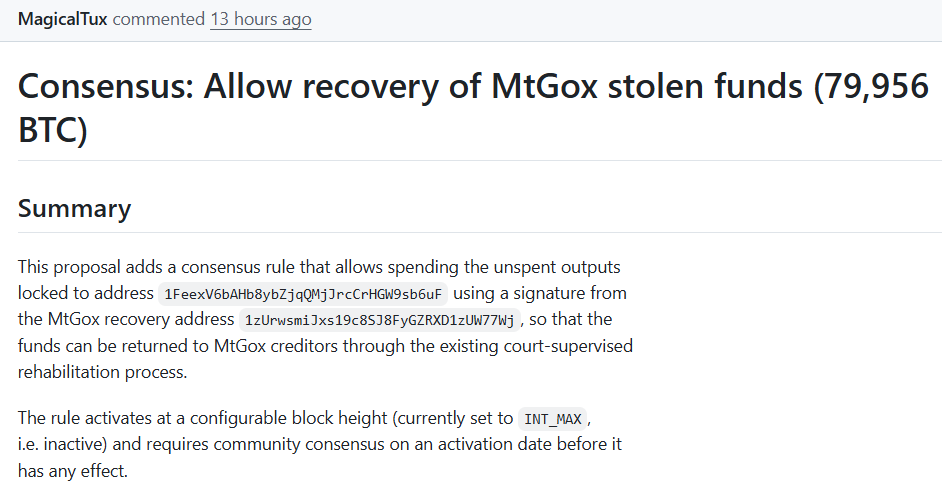
This mechanism would target exclusively that particular wallet address. Network-wide adoption would trigger activation at a predetermined future block height.

Karpelès made no attempt to soften his message. “I want to be upfront: this is a hard fork,” he stated clearly.
He positioned his submission as a solution to an ongoing impasse. Nobuaki Kobayashi, the Mt. Gox trustee overseeing the bankruptcy, has refused to pursue blockchain-based recovery strategies without guaranteed community acceptance of protocol modifications.
Why Critics Are Pushing Back
The concept has triggered considerable opposition, primarily focused on Bitcoin’s irreversibility principle. Bitcoin operates on the foundation that confirmed transactions cannot be undone or altered.
Numerous Bitcoin advocates maintain that modifying ownership protocols for any single address, regardless of clear theft circumstances, establishes dangerous precedent. Discussion participants on Bitcointalk cautioned that approval could invite comparable requests following subsequent breaches.
The draft itself recognizes this concern. It notes: “If it can be done once, the argument goes, it can be done again.”
Governance concerns also emerge. Bitcoin lacks established procedures for determining which historical thefts merit protocol-level intervention.
Successful implementation of any hard fork demands extensive backing from mining operations, node administrators, and trading platforms. History shows that achieving Bitcoin consensus around divisive modifications proves extraordinarily difficult.
How This Fits Into Broader Mt. Gox Repayments
The 80,000 BTC held in the compromised wallet exist independently from assets currently flowing to creditors. Those distributions originate from a distinct reserve of roughly 200,000 BTC salvaged following the platform’s 2014 failure.
Creditor distributions commenced during mid-2024, with authorities extending the final deadline to October 2026. The stolen cryptocurrency remains completely beyond trustee jurisdiction.
Mt. Gox initiated bankruptcy proceedings in Tokyo on February 28, 2014, following the disappearance of approximately 750,000 customer bitcoins. During its height, the platform processed 70% of worldwide Bitcoin trading volume.
Certain creditors have expressed approval for the initiative. One individual identifying as a creditor mentioned recovering roughly 15% of their Bitcoin through bankruptcy channels and would endorse legal action to secure the remaining stolen assets.
The concept exists currently as a preliminary discussion document without formal endorsement or implementation schedule.
Get 3 Free Stock Ebooks
Discover top-performing stocks in AI, Crypto, and Technology with expert analysis.
- Top 10 AI Stocks - Leading AI companies
- Top 10 Crypto Stocks - Blockchain leaders
- Top 10 Tech Stocks - Tech giants


