


TLDR
- Gold prices stayed near $4,240 per ounce on Monday, close to a six-week peak, supported by dollar weakness and Federal Reserve rate cut speculation
- Silver hit an all-time record of $57.86 per ounce, marking the sixth consecutive day of gains and a 100% increase for the year
- Federal Reserve rate cut probability stands at 87% for December, based on weak economic data and declining inflation signals
- Global silver supply shortages continue with Shanghai inventories at near-decade lows and elevated borrowing costs
- Trump announced he has selected his Federal Reserve Chair nominee without revealing the candidate’s identity
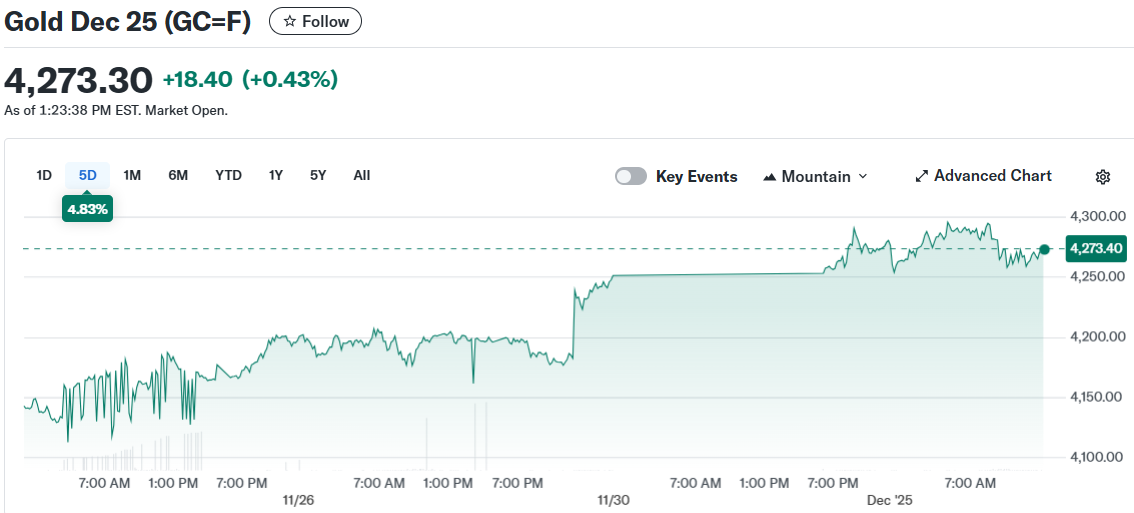
Gold remained near its highest level in six weeks on Monday, trading at $4,240.55 per ounce after touching $4,256.20 earlier in the day. The metal posted a gain of more than 4% during the previous week.
A weaker US Dollar Index, which fell to a two-week low, made gold more affordable for buyers using other currencies. Safe-haven demand also contributed to the metal’s stability as broader financial markets showed signs of risk aversion.
Interest rate cut expectations have grown stronger over recent days. Market data indicates an 87% probability that the Federal Reserve will reduce rates by 25 basis points at its December policy meeting.
Softer US economic indicators and evidence of cooling inflation have fueled these expectations. The extended government shutdown delayed official data releases, creating additional uncertainty for market participants.
Federal Reserve officials have provided varying commentary on monetary policy direction. This mixed messaging has kept investors cautious while maintaining focus on precious metals as protective assets.
Silver Sets New Record on Supply Deficit
Silver surged past gold in performance, climbing to $57.86 per ounce and establishing a new all-time high. The metal has rallied for six sessions in a row and has doubled in value since the start of 2025.

Gold has gained approximately 60% during the same period, making silver the stronger performer. Supply issues have been the main catalyst for the white metal’s impressive run.
London received record silver volumes in October to address a severe market squeeze. However, this influx created pressure at other major trading hubs around the world.
Inventories at Shanghai Futures Exchange warehouses dropped to their lowest point in nearly ten years. One-month silver borrowing costs remain high, reflecting continued market tightness.
ANZ Group Holdings strategist Daniel Hynes explained that shortages stemming from the London situation are still affecting global markets. BNP Paribas strategist David Wilson characterized the recent price action as speculation-driven, with momentum attracting more short-term traders.
Policy Uncertainty and Critical Minerals Status
President Donald Trump said on Sunday he knows who will be his Federal Reserve Chair nominee. The president did not share the candidate’s name with the public.
Market observers have mentioned Kevin Hassett, Kevin Warsh, and Christopher Waller as possible selections. The eventual choice will likely shape expectations about future monetary policy and the trajectory of interest rate adjustments.
Silver received designation as a critical mineral by the US Geological Survey in November. Traders are monitoring potential tariff implementation on the metal, which could restrict exports and worsen existing supply problems.
Physical silver exchange-traded funds saw increased inflows during November after investors took profits in October. Mining companies benefited from the rally, with Sun Silver gaining 21% and Silver Mines climbing 13% in Australian trading.
The gold-silver ratio has moved closer to 70, indicating the relative value between the two metals. Investors use this metric to assess whether silver appears expensive compared to gold.
Chinese manufacturing data released Monday showed factory activity contracted for the eighth month in a row. Platinum gained 0.7% to reach $1,700.60 per ounce, while copper prices held steady across major exchanges.
Get 3 Free Stock Ebooks
Discover top-performing stocks in AI, Crypto, and Technology with expert analysis.
- Top 10 AI Stocks - Leading AI companies
- Top 10 Crypto Stocks - Blockchain leaders
- Top 10 Tech Stocks - Tech giants


