


TLDR
- Gold futures climbed to approximately $5,025 per ounce Tuesday, gaining about 0.5% during trading.
- S&P 500 futures declined 0.3% as Brent crude jumped 3.3% to reach $103.53 per barrel.
- The US-Israeli military operation against Iran has substantially closed the Strait of Hormuz, driving oil past $100.
- The Federal Reserve commences its two-day policy meeting Tuesday with expectations to maintain rates at 3.5%–3.75%.
- Futures markets now indicate 26 basis points of potential rate reductions by December, slightly higher than previous estimates.
Precious metal prices advanced Tuesday morning as market participants monitored two significant developments simultaneously: the continuing US-Israeli military campaign against Iran and the commencement of the Federal Reserve’s two-day policy deliberations.
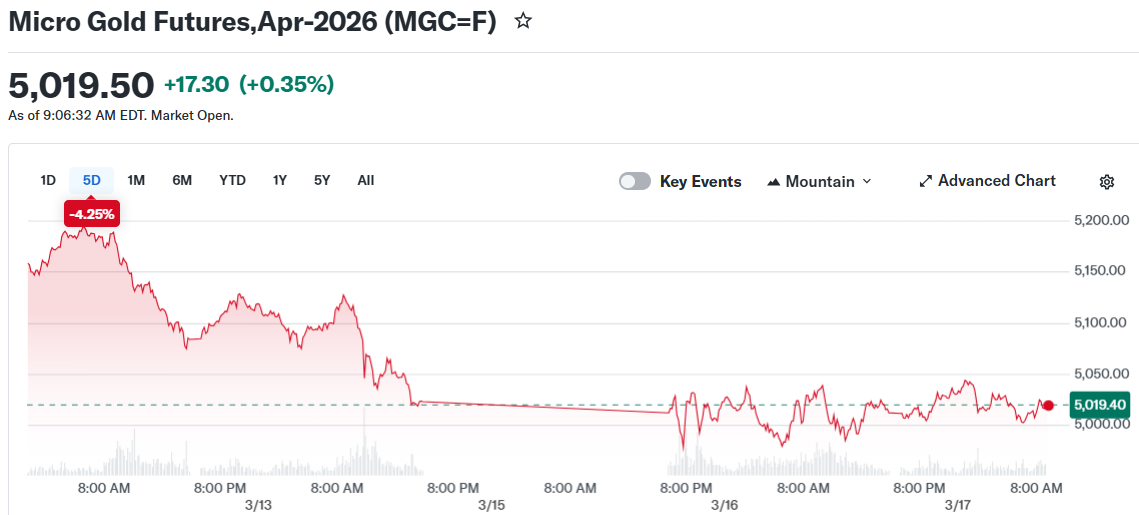
Gold futures advanced 0.5% to reach $5,025.10 per troy ounce. Spot gold increased 0.7% to $5,023.53. During earlier trading hours, continuous gold futures showed a more moderate 0.2% gain at $5,010.41 per ounce.
Meanwhile, S&P 500 futures dropped 0.3%, reflecting investor hesitation in equity markets. Brent crude futures surged 3.3% to $103.53 per barrel, maintaining oil prices well above the psychologically significant $100 threshold.
The surge in oil prices is directly connected to the military conflict. The US-Israeli military operations against Iran have substantially closed the Strait of Hormuz, disrupting one of the world’s most critical oil shipping corridors.
Gold experienced a challenging beginning to the week. Prices retreated during Monday’s initial trading hours following remarks from Iran’s foreign minister that markets interpreted as constructive. Equities rallied, yields declined, and the dollar surrendered some recent strength.

“That seems to echo the markets’ positive response to Iran’s foreign minister’s comments,” said Ilya Spivak, head of global macro at Tastylive. “Crude oil pulled back, yields ticked lower, and the US dollar gave back some recent gains as stocks rose.”
However, oil remained above $100, and gold recovered its momentum by Tuesday morning.
Fed Meeting in Focus
The Federal Reserve begins its two-day policy meeting on Tuesday. Analysts broadly anticipate the central bank will maintain interest rates unchanged within the 3.5% to 3.75% range for a second straight meeting, with an announcement scheduled for Wednesday.
Futures markets currently reflect 26 basis points of anticipated rate reductions by the December meeting, an increase of 2.4 basis points from the previous day, according to Deutsche Bank strategist Jim Reid.
Gold is a non-interest-bearing asset, meaning it typically performs better when interest rate expectations decline. Lower rate projections diminish the opportunity cost of holding gold relative to interest-generating investments.
Gold’s Role as a Safe Haven
Since hostilities with Iran commenced, gold has actually decreased 6.1%, based on FactSet data. This decline prompted questions about whether gold maintained its safe-haven status.
Tuesday’s price increases may indicate the metal is beginning to reassert that traditional role. Market observers are monitoring developments closely.
“Gold may weaken if the central bank strikes a relatively hawkish tone,” Spivak warned. The Fed’s tone on Wednesday could move prices in either direction.
The US Federal Reserve is anticipated to keep rates steady, though any unexpected hawkish language regarding future rate increases could pressure gold once more.
Gold futures were quoted at $5,021.10 as of Tuesday morning, representing an $18.90 daily increase.
Get 3 Free Stock Ebooks
Discover top-performing stocks in AI, Crypto, and Technology with expert analysis.
- Top 10 AI Stocks - Leading AI companies
- Top 10 Crypto Stocks - Blockchain leaders
- Top 10 Tech Stocks - Tech giants


