



Key Takeaways
- Gold futures declined 0.4%, settling at $4,666.70 per troy ounce amid geopolitical uncertainty
- President Trump issued an ultimatum to Iran requiring reopening of the Strait of Hormuz by 8 p.m. ET Tuesday or face military action
- The strategic waterway handles approximately 20% of the world’s oil transportation
- The People’s Bank of China extended its gold purchasing streak to 17 consecutive months, now holding 74.38 million troy ounces
- The U.S. dollar index reached 100.03, climbing approximately 0.8% in the past month and weighing on gold valuations
Precious metal markets displayed divergent behavior on Tuesday across different trading venues. New York futures contracts retreated 0.4%, closing at $4,666.70 per troy ounce, while the spot market showed resilience with a 0.8% advance to $4,685.54 per ounce during early trading hours. Meanwhile, June delivery gold futures climbed 0.6% to reach $4,710.84 per ounce.
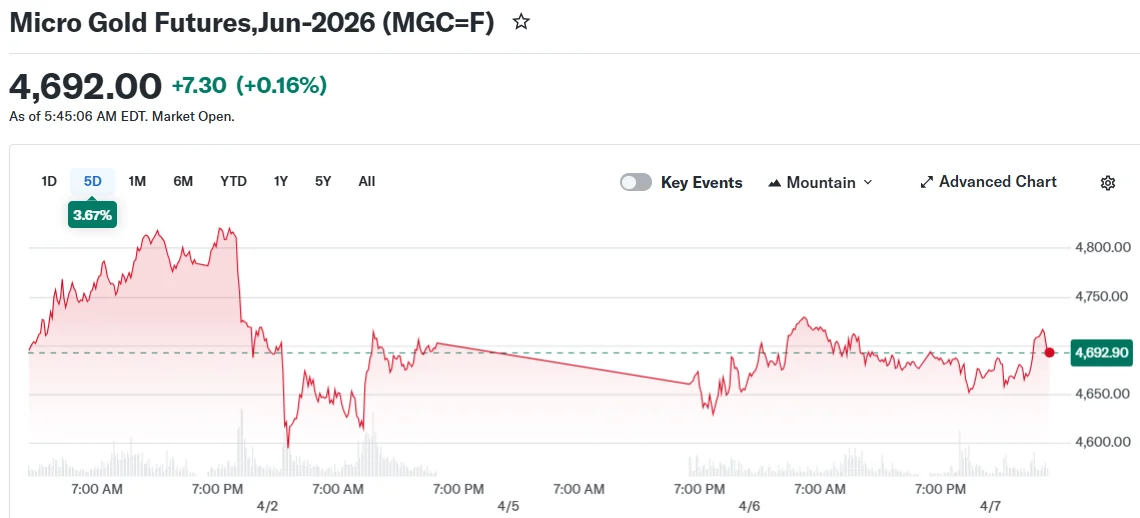
The divergent price action reflects market participants’ cautious positioning ahead of President Donald Trump’s deadline for Iran regarding the strategically vital Strait of Hormuz. The administration has demanded Iran agree to reopen the waterway by 8 p.m. Eastern Time Tuesday or risk military strikes targeting its energy sector infrastructure.
Trump delivered stark warnings about the potential consequences, threatening to obliterate “every bridge” and “power plant” throughout Iran should negotiations fail. He emphasized that reconstruction efforts following such attacks would require Iran “100 years to rebuild.”
The Strait of Hormuz represents a critical chokepoint for global energy markets. This narrow waterway along Iran’s southern coastline facilitates the passage of roughly one-fifth of the planet’s oil supply.
Tehran has outlined its conditions for a lasting agreement, including comprehensive sanctions removal, security assurances, and financial restitution for past damages. Intelligence suggests the current administration views these demands as unacceptable.

Despite the aggressive rhetoric, Trump acknowledged that diplomatic channels remain open and a peaceful resolution hasn’t been completely ruled out. The current confrontation traces back to coordinated U.S. and Israeli military operations against Iran launched in late February.
Energy Markets and Currency Dynamics Influence Bullion
Brent crude maintained its position above the $110 per barrel threshold as the deadline loomed. Elevated oil prices fuel concerns about persistent inflation, potentially forcing monetary authorities to maintain restrictive interest rate policies for extended periods.
This dynamic carries significant implications for precious metals. Since gold generates no yield, its attractiveness diminishes when expectations shift toward prolonged elevated interest rates. Analysts from ANZ noted that Trump’s aggressive posturing “impacted risk appetite,” driving both the U.S. dollar and Treasury yields upward.
The U.S. dollar index registered at 100.03, experiencing a modest 0.2% decline during Tuesday’s session. However, the broader monthly trend shows a 0.8% appreciation. Throughout this same timeframe, spot gold has surrendered more than 8% of its value.
A robust dollar increases the cost of gold for international buyers transacting in alternative currencies, thereby dampening global demand.
Chinese Central Bank Extends Accumulation Campaign
One bullish factor supporting gold originated from Beijing. The People’s Bank of China maintained its uninterrupted acquisition pattern, marking the 17th consecutive month of reserve expansion. Official holdings reached 74.38 million fine troy ounces by March’s conclusion, advancing from February’s 74.22 million ounces.
Persistent central bank accumulation provides a fundamental demand floor for the precious metal.
As Tuesday progressed, financial markets maintained heightened vigilance approaching the 8 p.m. Eastern Time threshold, monitoring for any diplomatic developments or Iranian response to the administration’s demands.
Get 3 Free Stock Ebooks
Discover top-performing stocks in AI, Crypto, and Technology with expert analysis.
- Top 10 AI Stocks - Leading AI companies
- Top 10 Crypto Stocks - Blockchain leaders
- Top 10 Tech Stocks - Tech giants


