


Key Takeaways
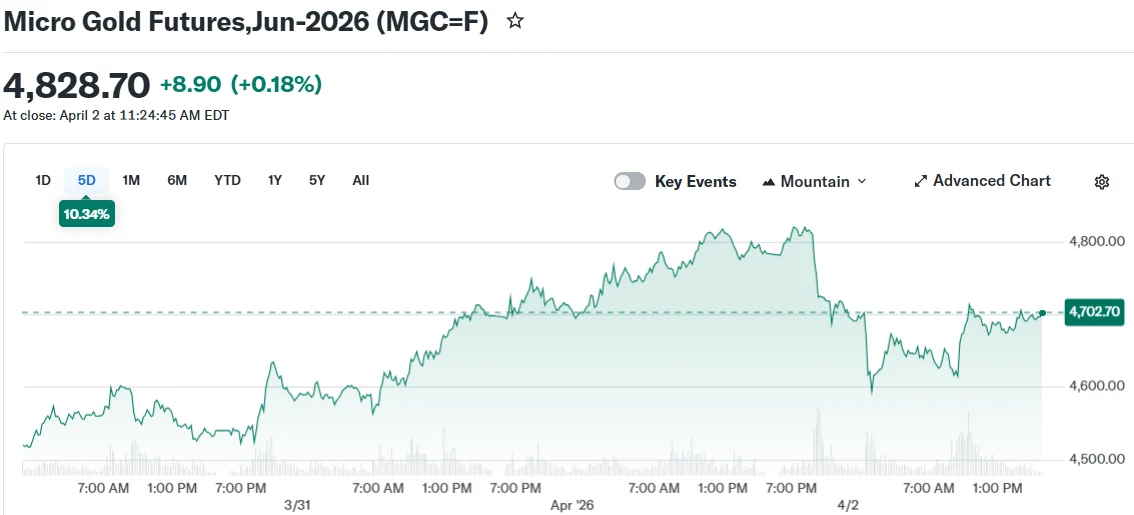
- Spot gold declined 2% to $4,664 per ounce following President Trump’s announcement of imminent military action against Iran within the next two to three weeks
- The decline ended a four-session rally in precious metals futures
- Crude oil prices jumped to $108 per barrel, increasing inflation concerns and boosting dollar strength
- UBS revised its 2026 average gold price projection downward from $5,200 to $5,000, while maintaining its year-end estimate at $5,600
- Silver tumbled more than 4%, and new metals tariffs drove aluminum to nearly four-year peak levels
Precious metals experienced a significant selloff on April 2 following President Donald Trump’s evening announcement regarding planned military intensification against Iran.
Spot gold retreated 2% to settle at $4,664.39 per ounce, breaking a four-session advance. Gold futures for U.S. delivery declined 2.5% to $4,691.10 per ounce.
During his address, Trump declared the United States would strike Iran “extremely hard over the next two to three weeks.” He specifically mentioned Iran’s electrical infrastructure and petroleum facilities as potential targets if diplomatic negotiations failed.
“We’re going to bring them back to the stone ages, where they belong,” Trump said during the White House address on April 1.
Investors had anticipated a more measured approach. Gold had been mounting a comeback following its steepest monthly decline since October 2008 during March.
The president’s remarks immediately halted that momentum. Dow futures declined over 260 points in the aftermath of Trump’s speech. Futures tied to the S&P 500 retreated 0.7% while Nasdaq 100 futures lost 0.8%.

The Counterintuitive Market Response
The precious metals retreat caught many market participants off guard. Rising geopolitical uncertainty typically drives investment flows toward gold as a protective asset. However, this Middle East crisis has defied conventional market behavior.
Trump’s aggressive stance triggered a sharp rally in energy markets. Brent crude advanced 7.1% to reach $108.29 per barrel. West Texas Intermediate rocketed from approximately $97 to exceed $113 within mere hours.
Rising oil prices amplify inflation concerns. This dynamic pushes government bond yields and the U.S. dollar higher. Gold, which generates no interest or dividends, becomes less attractive when the greenback appreciates.
Iran’s Foreign Ministry issued a response the following day. “We are absolutely determined and resolute to continue our defense against this aggression,” a spokesperson stated.
Silver plummeted 4.6% to $71.67 per ounce. Platinum decreased 2.5% to $1,914.61, while palladium shed 1.4% to finish at $1,451.92.
Investment Bank Revises Gold Outlook
UBS lowered its 2026 average gold price projection to $5,000 from a previous $5,200 estimate, reflecting first-quarter market developments.
UBS strategist Joni Teves indicated the upcoming period may witness “choppy price action” as financial markets repeatedly reevaluate geopolitical threat levels.
Teves maintained the firm’s year-end gold projection unchanged at $5,600.
Regarding industrial metals, Trump issued an executive order implementing a 50% tariff on products manufactured entirely from aluminum, steel, or copper. Products substantially composed of these metals will face a 25% tariff assessment.
Aluminum valuations recently approached four-year highs amid supply chain disruptions connected to Middle Eastern hostilities.
Benchmark copper on the London Metal Exchange closed 0.8% higher at $12,434.50 per ton on Thursday.
Get 3 Free Stock Ebooks
Discover top-performing stocks in AI, Crypto, and Technology with expert analysis.
- Top 10 AI Stocks - Leading AI companies
- Top 10 Crypto Stocks - Blockchain leaders
- Top 10 Tech Stocks - Tech giants


