


Key Takeaways
- Gold trading remains flat at $4,715.45 per ounce while markets monitor the unstable U.S.-Iran peace agreement
- The precious metal has declined over 10% since Middle East hostilities erupted on February 28
- Israeli military operations in Lebanon intensified, resulting in hundreds of casualties and escalating regional tensions
- Minutes from the Federal Reserve’s March meeting revealed increasing support among officials for rate increases to combat inflation
- Critical U.S. PCE inflation figures scheduled for release Thursday at 1230 GMT, followed by CPI data on Friday
Precious metal markets showed minimal movement on Thursday as traders maintained focus on the tenuous U.S.-Iran peace agreement while anticipating important U.S. inflation statistics scheduled for later in the trading session.
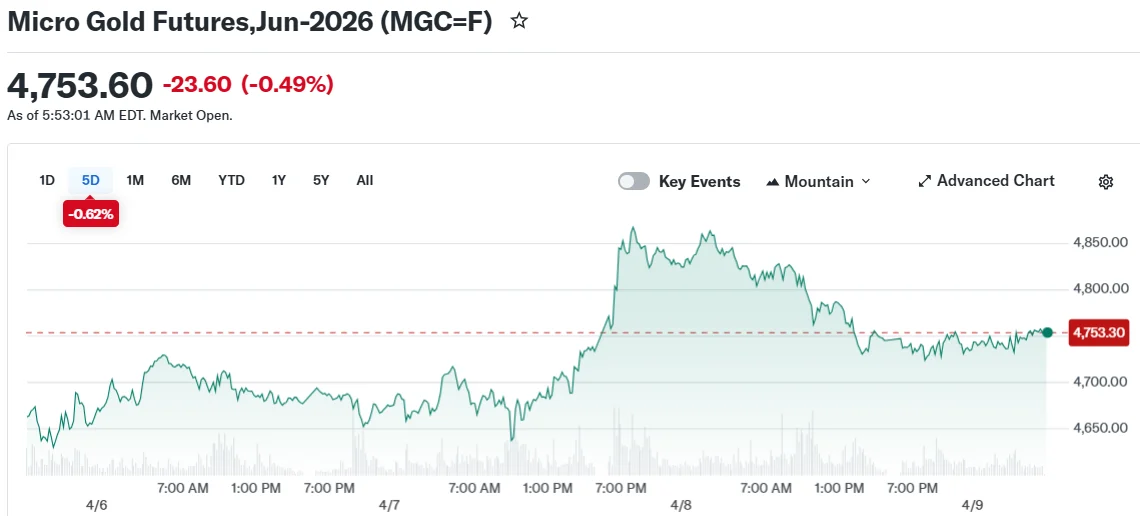
Spot gold demonstrated little variation, holding at $4,715.45 per ounce at 0716 GMT. June-delivery U.S. gold futures contracts declined 0.8%, settling at $4,739.40.
According to Brian Lan, Managing Director at GoldSilver Central, the precious metal shows little indication of significant directional movement in the current environment. He highlighted continued market uncertainty regarding developments following the ceasefire announcement.
Lan anticipates gold will trade within a range of $4,607 to $4,860 over the coming weeks.
The peace agreement between Washington and Tehran remains precarious. President Donald Trump announced his intention to maintain American military presence throughout the Middle East pending completion of a comprehensive peace agreement.

Trump additionally cautioned about potential major military escalation should Iran breach the ceasefire conditions.
Meanwhile, Israel executed its most intensive military strikes against Lebanon on Wednesday, causing hundreds of fatalities and prompting Iranian threats of counter-action.
Precious Metal Decline Since Conflict Eruption
Spot gold values have fallen more than 10% since hostilities commenced on February 28. Elevated energy costs have intensified inflation worries, leading markets to reduce expectations for monetary policy easing.
Interest rate reductions typically support gold valuations since the metal generates no interest income. When rates are projected to remain elevated for extended periods, gold’s appeal to investors diminishes.
Oil prices increased Thursday amid concerns that Middle Eastern supply may not fully normalize. Questions persist about the sustainability of the two-week ceasefire arrangement.
Federal Reserve Documents Indicate Potential Rate Increases
Documentation from the Federal Reserve’s March 17-18 policy meeting revealed mounting sentiment among committee members favoring interest rate increases. Inflation metrics have persistently exceeded the central bank’s 2% objective.
This development creates additional headwinds for gold, which typically underperforms during periods of elevated interest rates.
The U.S. Personal Consumption Expenditures index for February is scheduled for release at 1230 GMT Thursday. Consumer price index data for March will be published Friday.
Both economic reports may provide enhanced clarity regarding the Federal Reserve’s upcoming monetary policy decisions.
Standard Chartered noted in Wednesday research that despite short-term liquidity considerations, the bank anticipates gold will recover its losses in subsequent months driven by elevated geopolitical uncertainties.
Regarding other precious metals, spot silver decreased 0.3% to $73.93 per ounce. Platinum declined 1.2% to $2,005.71, while palladium gained 0.3% to $1,558.68.
Get 3 Free Stock Ebooks
Discover top-performing stocks in AI, Crypto, and Technology with expert analysis.
- Top 10 AI Stocks - Leading AI companies
- Top 10 Crypto Stocks - Blockchain leaders
- Top 10 Tech Stocks - Tech giants


