


TLDR
- Gold approached $5,000 per ounce on Friday and is headed for its best week since 2020, gaining 13% year-to-date
- Silver broke through $100 per troy ounce for the first time in history, rising 29% year-to-date and outperforming gold
- Goldman Sachs raised its year-end 2026 gold price target to $5,400 per ounce
- Analysts cite weaker US dollar, Federal Reserve easing expectations, fiscal deficits, and geopolitical tensions as key drivers
- China has been hoarding silver and restricting exports since the start of the year for domestic industrial use
Gold and silver prices reached historic levels on Friday as precious metals continued their strong start to 2026. Gold rose close to $5,000 per ounce while silver touched $100 per troy ounce for the first time ever.
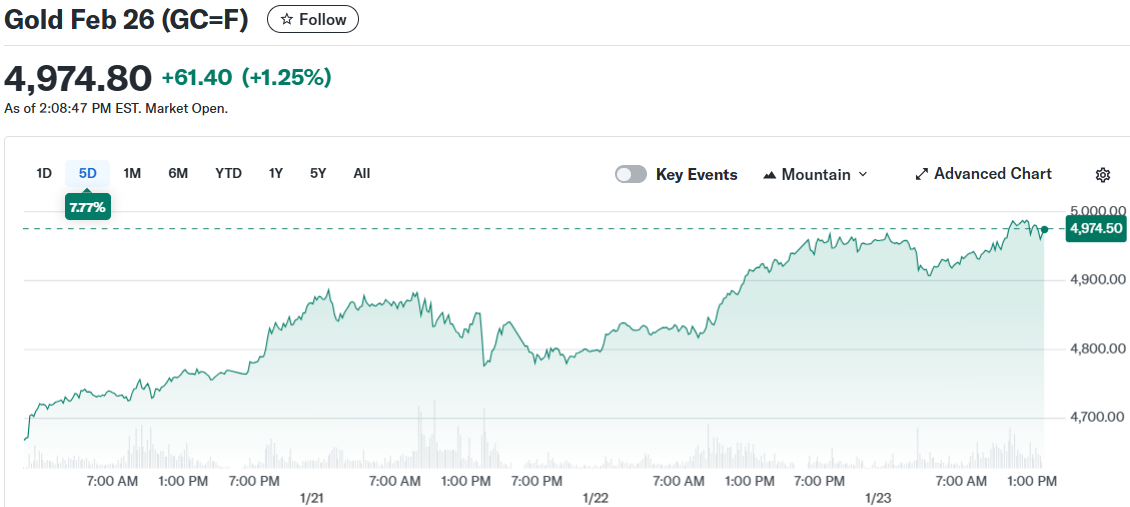
Bullion is headed toward its best week since 2020, gaining 13% year-to-date. Silver futures have had an even bigger run, up 29% year-to-date.
Most active silver futures rose 4.6% to $100.85, marking a record high. The price of gold was 1.4% higher at $4,980.80.
Platinum also extended its start to the year, trading at a record $2,738.60, up 6.3%. So far in 2026, platinum has risen by 32%.
The gains far outpace the S&P 500, which is sporting a 1.2% gain for the year. Investors have piled into safe-haven assets amid ramping uncertainty.
Central Banks and Private Investors Drive Demand
Goldman Sachs noted private sector investors have been getting in on the rally in addition to central banks’ accumulation of gold. The bank raised its year-end 2026 price target for gold to $5,400 per ounce earlier this week.

“We assume private sector diversification buyers, whose purchases hedge global policy risks and have driven the upside surprise to our price forecast, don’t liquidate their gold holdings in 2026,” the bank said in a note. This effectively lifts the starting point of their price forecast.
Strategists cite multiple factors driving the rally. These include a weaker US dollar, expectations of Federal Reserve easing, large fiscal deficits, and fading demand for government debt.
Ole Sloth Hansen, head of commodity strategy at Saxo Bank, wrote that fiscal discipline erosion in the United States is a key reason gold has been accumulated for months. He added it is likely to remain in demand.
Earlier this week a Danish pension fund said it would exit US Treasurys amid President Trump’s pursuit for Greenland. Reuters reported that big Northern European investors are also assessing US assets in the face of geopolitical tensions.
Silver’s Industrial Demand Adds Fuel
Much of silver’s supply is used for industrial purposes. This has contributed to its outperformance relative to gold this year.
China has been hoarding silver for its own domestic use, restricting exports since the start of the year. This has tightened global supply and pushed prices higher.
“Silver prices have already overshot our forecasted averages, though calling a top is close to impossible in markets displaying near-parabolic price momentum,” JPMorgan analysts noted last week. The rapid price movements have drawn comparisons to historical rallies.
Mike McGlone, senior commodity strategist at Bloomberg, sees parallels with rapid price moves in 1979 and 1980 that were followed by a crash. “Momentum is on pace for $100, but if the commodity lives up to its reputation as the ‘devil’s metal,’ silver can rapidly retrace toward $50,” McGlone said.
Giovanni Staunovo, a commodities strategist at UBS, noted that lower US interest rates, a weaker US dollar in the first half of the year, and continued fiscal deficits in major economies should sustain demand. Ongoing US-Europe tensions and concerns over Federal Reserve independence have also contributed to precious metals’ ascent.
Get 3 Free Stock Ebooks
Discover top-performing stocks in AI, Crypto, and Technology with expert analysis.
- Top 10 AI Stocks - Leading AI companies
- Top 10 Crypto Stocks - Blockchain leaders
- Top 10 Tech Stocks - Tech giants


