


Key Takeaways
- Spot gold plunged 4.3%, snapping a four-session rally following Trump’s Middle East policy address
- President Trump announced plans to strike Iran “extremely hard” within the next two to three weeks
- Silver tumbled 7%, with platinum and palladium posting losses as well
- UBS continues to project gold averaging $5,000 per ounce throughout 2026
- The bank sees dips toward $4,000 as attractive entry points for investors
Precious metals experienced a brutal session Thursday following President Donald Trump’s primetime speech addressing the escalating Middle East crisis, which created fresh uncertainty across global markets.
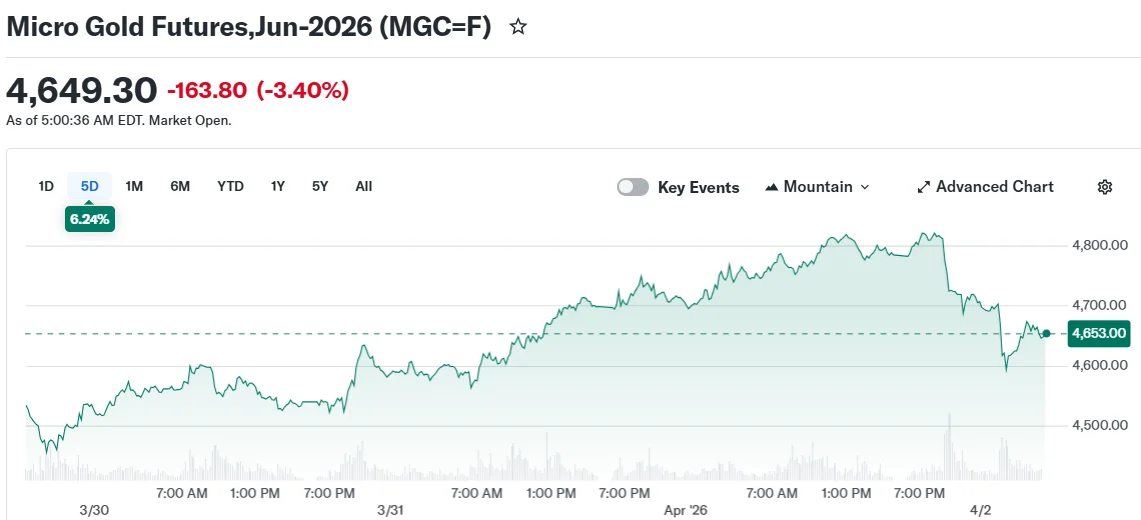
Spot gold tumbled as much as 4.3%, halting its four-session advance. The yellow metal traded at $4,562.88 per ounce as of 2:12 p.m. Singapore time. Silver suffered even steeper losses, plummeting 7% to $69.86, while both platinum and palladium recorded declines.
During his address, Trump indicated the conflict was approaching its conclusion while simultaneously warning of imminent and severe military action against Iran within a two-to-three-week timeframe. He emphasized that military objectives were nearly accomplished and called on Middle East oil-dependent allies to contribute toward resolving the near-blockade of the Strait of Hormuz.
The Strait of Hormuz previously facilitated approximately one-fifth of global oil and liquefied natural gas shipments before the current crisis. Anxiety over potential disruptions to energy transport through this critical waterway has driven crude oil prices higher.
The US dollar index climbed 0.4% in the wake of Trump’s remarks. Equity markets declined as investors pulled back from riskier assets.

Christopher Wong, a strategist at Oversea-Chinese Banking Corp, explained that Trump’s address “essentially positioned the conflict as a military victory, rather than signaling any ceasefire.” He observed that gold touched an intra-day peak of $4,800 earlier, though momentum appeared to be fading amid concerns over a potential US ground invasion of Iran.
Gold already endured a challenging March, declining nearly 12% during the month—its worst monthly showing since October 2008. Surging oil prices sparked inflation worries, diminishing expectations for monetary policy easing and pressuring gold prices.
Prior to the presidential address, market participants had anticipated the Federal Reserve might implement rate cuts to bolster economic activity if the conflict became prolonged. Those expectations shifted dramatically after Trump’s hawkish tone.
With financial markets shuttered for the Good Friday holiday, Wong suggested that risk reduction ahead of the extended weekend was also influencing trading behavior.
UBS Maintains Optimistic Gold Outlook
Notwithstanding the sharp selloff, UBS remains firmly bullish on gold’s prospects. Strategist Joni Teves stated in a Thursday research note that the firm views the recent decline as an attractive accumulation opportunity.
UBS modestly adjusted its 2026 gold projection to $5,000 per ounce from $5,200, accounting for the recent retreat from January’s record high. The firm’s forecasts for 2027 and 2028 remain unchanged at $4,800 and $4,250 respectively.
Teves highlighted that speculative positioning has been flushed out while ETF redemptions have been limited, creating space for investors to rebuild exposure. Chinese gold ETFs continue experiencing net inflows, and physical demand within the mainland remains robust.
UBS indicated that any decline approaching the $4,000 threshold would present an opportunity to establish positions.
Silver Forecast Reduced
UBS lowered its 2026 silver projection to $91.9 per ounce from $105. Teves pointed out that silver’s dual nature as an industrial metal increases its vulnerability to potential global economic deceleration.
Spot silver was last quoted at $69.86 on Thursday.
Get 3 Free Stock Ebooks
Discover top-performing stocks in AI, Crypto, and Technology with expert analysis.
- Top 10 AI Stocks - Leading AI companies
- Top 10 Crypto Stocks - Blockchain leaders
- Top 10 Tech Stocks - Tech giants


