


TLDR
- The yellow metal traded down a modest 0.1% to approximately $5,187 per ounce mid-week, maintaining solid support above the $5,000 threshold
- Crude oil’s upward trajectory, fueled by escalating U.S.-Israel-Iran hostilities, is sparking renewed inflation concerns
- The critical Strait of Hormuz waterway has been essentially blockaded, putting approximately 20% of worldwide oil and gas supplies at risk
- February’s U.S. Consumer Price Index registered 2.4% annually, meeting expectations but reflecting data before the Iran escalation
- Financial markets anticipate the Federal Reserve will maintain current interest rates at its upcoming March 18 policy announcement
The precious metal market displayed relative stability on Wednesday as opposing market dynamics created a narrow trading band. The spot price for gold declined a marginal 0.1% to settle near $5,187 per ounce, with April futures contracts sliding 0.9% to approximately $5,194.
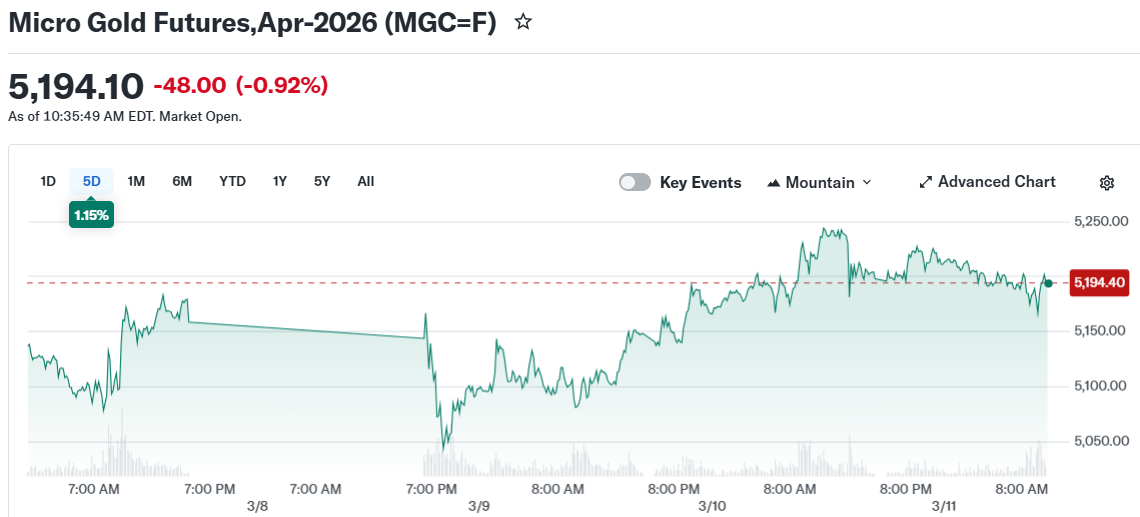
The commodity has experienced significant price swings since reaching a peak just below $5,600 per ounce during the final days of January. Despite the subsequent correction, the metal has maintained firm support above the psychologically important $5,000 level.
The military engagement involving the United States, Israel, and Iran reached its twelfth consecutive day on Wednesday, with aerial bombardments persisting across all three participants. President Trump indicated Monday evening that hostilities were nearing conclusion, yet combat operations demonstrated little evidence of de-escalation.
The ongoing confrontation has resulted in the practical closure of the Strait of Hormuz, a critical maritime corridor responsible for transporting approximately twenty percent of global petroleum and liquefied natural gas supplies.
Oil prices surged again Wednesday following market skepticism regarding the International Energy Agency’s proposal to deploy unprecedented strategic reserve volumes to counterbalance potential Middle Eastern supply shortfalls.

Elevating crude oil valuations are amplifying inflationary pressures. This development weighs on gold because it diminishes expectations for Federal Reserve monetary easing. Since the precious metal generates no yield, it loses relative appeal during periods of elevated or ascending interest rates.
An appreciating U.S. dollar combined with climbing Treasury yields compounds the headwinds facing gold. Dollar strength increases the metal’s cost for international purchasers.
U.S. Inflation Data Meets Expectations
The Department of Labor disclosed Wednesday that American consumer prices advanced 2.4% during the twelve-month period ending February, aligning with both the previous month’s figure and economist projections.
On a monthly basis, prices climbed 0.3%, accelerating from January’s 0.2% gain. Energy and grocery expenses registered increases. The core CPI metric, which excludes volatile food and energy components, registered 2.5% year-over-year, matching January’s measurement.
Nevertheless, the February data predominantly reflects conditions before the Iran crisis intensified in late February. Market observers anticipate March statistics will reveal more pronounced inflationary acceleration.
Federal Reserve Meeting and PCE Report on the Horizon
Market participants are closely monitoring two critical forthcoming data releases. The Personal Consumption Expenditures index covering January arrives Friday, with economists projecting an annual rate of 3.1%.
The PCE represents the Federal Reserve’s favored inflation gauge and has consistently registered higher readings than CPI in recent periods.
The Federal Reserve’s two-day policy session wraps up on March 18. Market consensus overwhelmingly expects officials to keep benchmark rates unchanged.
Swissquote analyst Carlo Alberto De Casa noted that investors seem to be expanding their allocation to gold as a defensive asset considering the persistent geopolitical tensions.
Spot gold was quoted at $5,187 per ounce during Wednesday’s European trading session.
Get 3 Free Stock Ebooks
Discover top-performing stocks in AI, Crypto, and Technology with expert analysis.
- Top 10 AI Stocks - Leading AI companies
- Top 10 Crypto Stocks - Blockchain leaders
- Top 10 Tech Stocks - Tech giants


