



Key Takeaways
- Goldman Sachs reaffirms $5,400 per troy ounce gold forecast through end-2026
- March sees gold tumble 13–15%, marking the sharpest monthly decline since 2009
- Middle East tensions and inflation concerns have eliminated expectations for Fed rate reductions
- Analysts anticipate renewed central bank demand to bolster pricing
- Bear case scenario places gold floor at $3,800 under extreme circumstances
Goldman Sachs continues to project that gold will climb to $5,400 per troy ounce before 2026 concludes. This projection was reaffirmed in analyst commentary released Monday, March 31, 2026.
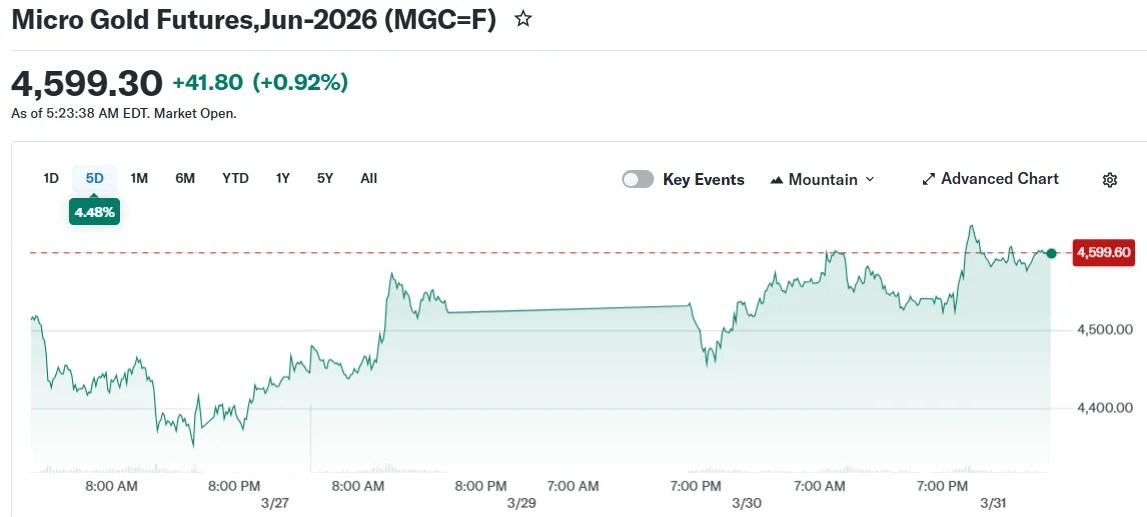
March has proven brutal for precious metals investors. Gold has shed approximately 13% during the month, hovering around $4,500 on Tuesday. This represents the most significant monthly decline the commodity has experienced in seventeen years. After touching record highs near $5,500 on January 29, gold entered a sharp correction phase.
The primary catalyst behind this downturn stems from escalating military operations in the Middle East. The ongoing conflict has compromised energy distribution networks and intensified inflationary pressures, prompting financial markets to eliminate Federal Reserve rate cut expectations for 2026.
Analysts Lina Thomas and Daan Struyven from Goldman estimate gold’s intrinsic value at approximately $4,550 based on prevailing macroeconomic conditions. This valuation presumes that existing policy hedges continue unchanged.
The research team emphasizes that gold hasn’t abandoned its traditional role as a crisis hedge. They explain that gold’s response varies based on inflation’s underlying cause. Supply-shock inflation, such as the current situation, typically benefits broader commodity markets. Conversely, gold excels when inflation anxieties stem from questions about monetary authority commitment.

“Similar to 2022 dynamics, gold generally lags initially during supply disruption events,” the research note explained. Rising yields increase the carrying cost of non-yielding assets like gold, while equity market declines can trigger forced liquidations related to margin requirements.
Three Pillars Supporting Goldman’s Bullish Outlook
The investment bank’s optimistic forecast relies on three fundamental assumptions. The first involves normalized speculative positioning returning to Comex futures markets, which analysts value at approximately $195 per troy ounce.
The second component centers on Goldman’s economics team maintaining expectations for two Federal Reserve interest rate reductions during 2026, which would theoretically contribute around $120 per ounce to gold prices.
The third pillar involves central bank purchasing activity rebounding to roughly 60 tonnes monthly. According to Goldman’s modeling, this factor alone could contribute $535 per troy ounce to valuation.
Speculative net positions on Comex have declined to the 39th percentile. Goldman characterizes current market conditions as “cleaner” and presenting a “more attractive entry point” for investors.
Potential Downside Scenarios
While maintaining bullish conviction, Goldman acknowledges material downside possibilities. Extended disruption to Strait of Hormuz shipping lanes, coupled with sustained equity market deterioration, could potentially drive gold toward $3,800 in an extreme case.
The research team discounted speculation regarding potential gold sales from Gulf Cooperation Council central banks. These nations maintain proportionally smaller gold allocations compared to Turkey, which liquidated approximately 52 tonnes. Given their dollar-pegged currency frameworks, these countries would more likely reduce U.S. Treasury holdings rather than precious metals reserves.
Looking beyond the base case, Goldman identifies upside potential exceeding $5,400. Intensifying geopolitical disruptions combined with mounting concerns over Western government fiscal trajectories could propel gold to $5,700, with possibilities extending to $6,100 if hedging demand accelerates further.
The Iranian conflict has now entered its second month without meaningful diplomatic progress. President Trump has publicly indicated readiness to strike Iran’s energy facilities should the Strait of Hormuz remain obstructed.
Get 3 Free Stock Ebooks
Discover top-performing stocks in AI, Crypto, and Technology with expert analysis.
- Top 10 AI Stocks - Leading AI companies
- Top 10 Crypto Stocks - Blockchain leaders
- Top 10 Tech Stocks - Tech giants


