


Quick Summary
- Nvidia delivered Q4 fiscal revenue of $68 billion, surpassing forecasts, and issued Q1 guidance of $78 billion
- The chip giant’s “physical AI” segment generated $6 billion in fiscal 2026, driven by robotaxis and humanoid robots
- Tesla relies on Nvidia’s AI infrastructure for developing Optimus humanoid robots and autonomous robotaxi technology
- If Tesla hits 1 million Optimus units annually at ~$25k each, the robot alone could generate $25 billion in yearly revenue
- Over the last year, Tesla shares climbed 44% while Nvidia gained 49%
Tesla $TSLA slipped slightly in early Thursday trading, declining 0.5%, despite Nvidia $NVDA delivering impressive fiscal fourth-quarter earnings that exceeded analyst projections.
Nvidia posted quarterly revenue of $68 billion, a significant jump from $39 billion in the same period last year. The figure topped analyst consensus of $66 billion and exceeded Nvidia’s own guidance band of $63.7 to $66.3 billion.
For the current quarter, Nvidia projected $78 billion in revenue, comfortably ahead of the $73 billion Wall Street had penciled in. Yet despite the strong performance, Nvidia shares gained only around 1% in premarket action.
What’s the Tesla connection?

Tesla counts itself among Nvidia’s key customers. The automaker leverages Nvidia’s advanced computing systems to build what’s known as “physical AI”—artificial intelligence designed to function in the physical world, including autonomous vehicles and humanoid robots.
During the earnings call, Nvidia CFO Colette Kress disclosed that physical AI brought in $6 billion during fiscal 2026, which concluded in January. She highlighted Tesla and Alphabet’s Waymo as prominent robotaxi developers utilizing Nvidia’s technology.
Kress emphasized that training physical AI systems like robotaxis and robots demands significantly more computational resources than developing conversational AI models. This positions Nvidia favorably as the sector expands.
CEO Jensen Huang described AI-powered robotics as a “wonderful opportunity” for Nvidia. The partnership between the two companies has become mutually beneficial—Nvidia requires real-world AI applications to drive growth, while Tesla depends on Nvidia’s computing muscle to bring its vision to life.
The Optimus Vision
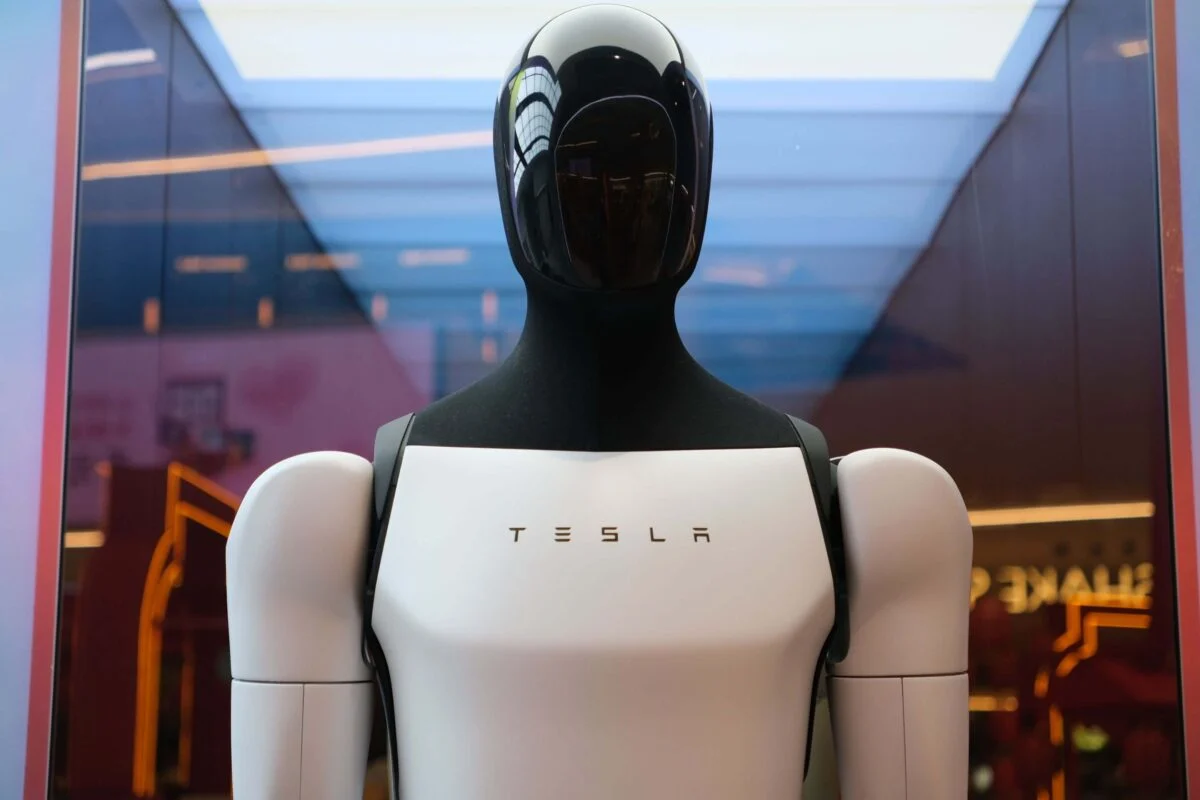
Tesla CEO Elon Musk has characterized the robotics market as a multi-trillion-dollar frontier. The company’s Optimus humanoid robot is slated for initial commercial sales in 2026, with long-term ambitions to scale production to one million units annually.
With an estimated price around $25,000 per robot, achieving that production milestone would inject approximately $25 billion in new annual revenue. To put that in perspective, Tesla recorded $94.83 billion in total revenue during 2025.
This revenue stream would function as an independent growth driver—supplementing rather than cannibalizing the company’s automotive business.
Challenges Remain
Musk cautioned last month that initial robot manufacturing would be “agonisingly slow” before ramping to scale. Manufacturing challenges and supply chain issues pose legitimate concerns.
Tesla also faces stiff competition in robotics. Chinese manufacturers are pouring resources into the sector, and if rivals dominate the lower-priced market segments, Tesla’s profit margins could face downward pressure.
Tesla shares have already surged 44% over the trailing twelve months, leading some market watchers to suggest that current valuations may already incorporate considerable optimism regarding Optimus and robotaxi prospects.
Nvidia stock has climbed 49% during the same timeframe.
As of Thursday’s open, both companies were trading near their 12-month peaks, with investors closely monitoring how physical AI demand evolves throughout 2026.
Get 3 Free Stock Ebooks
Discover top-performing stocks in AI, Crypto, and Technology with expert analysis.
- Top 10 AI Stocks - Leading AI companies
- Top 10 Crypto Stocks - Blockchain leaders
- Top 10 Tech Stocks - Tech giants


