



Key Takeaways
- Maelstrom’s Arthur Hayes revealed HYPE as the fund’s biggest altcoin holding with a $150 price objective
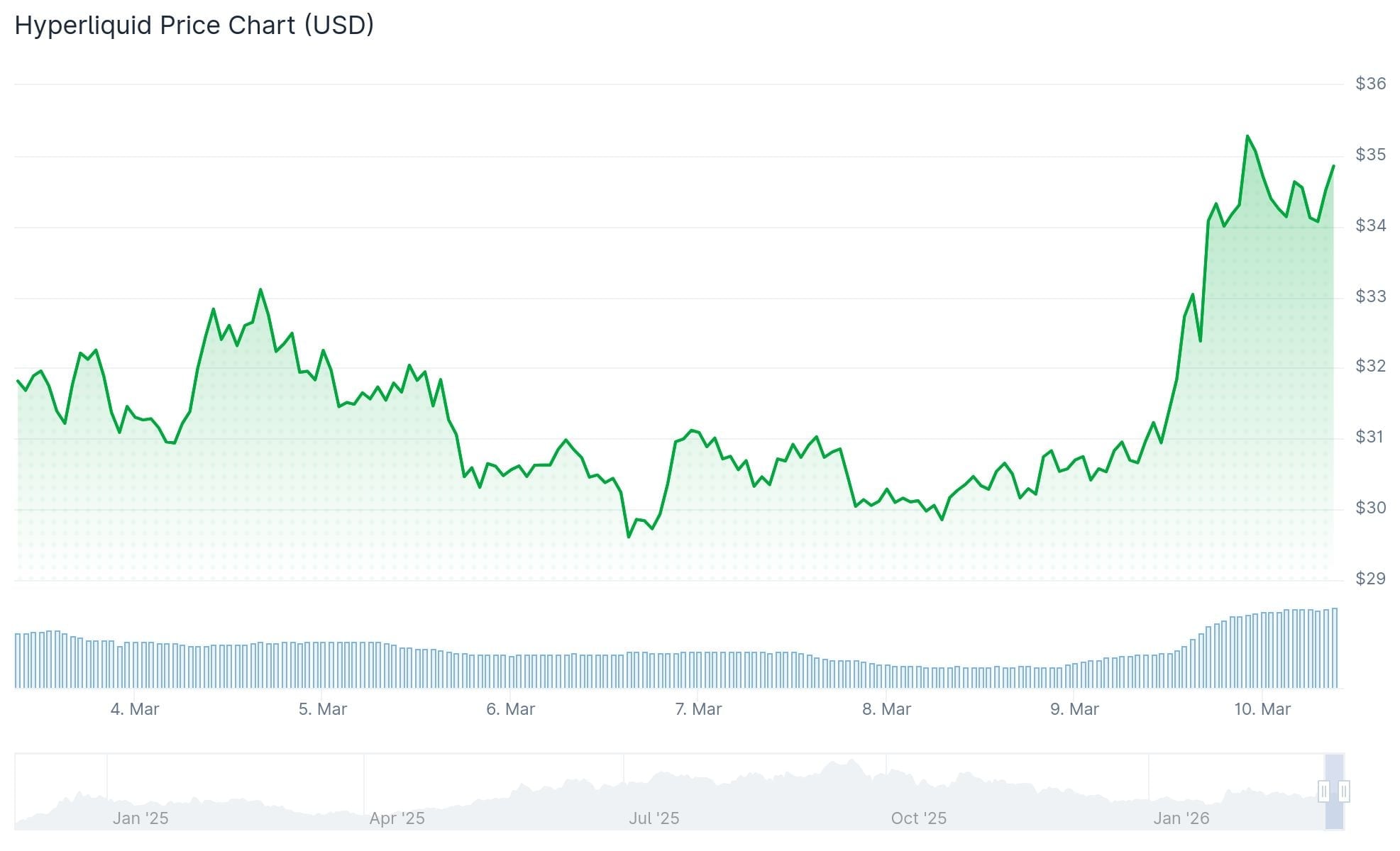
- The token jumped 11.3% over 24 hours to approximately $35, significantly outpacing Bitcoin’s 3.1% increase
- According to Hayes, Hyperliquid allocates 97% of platform revenue toward HYPE token buybacks
- Achieving the $150 target requires annualized revenue of $1.4 billion — a threshold the platform already touched in August 2025
- Hayes’ conservative valuation scenario still places HYPE around $58, representing roughly 75% upside from current prices
The Hyperliquid native token HYPE experienced an impressive rally exceeding 11% on Monday following an announcement by Arthur Hayes, Maelstrom’s chief investment officer, that the asset now represents the firm’s biggest altcoin allocation.
In a comprehensive analysis, Hayes outlined his rationale for a $150 HYPE price objective, highlighting Hyperliquid’s position as the leading decentralized exchange for perpetuals contracts.
HYPE reached approximately $35 during the past day’s trading session. Meanwhile, Bitcoin registered a more modest 3.1% gain over the identical timeframe, momentarily challenging the $70,000 threshold before retreating.
Over the trailing twelve months, HYPE has delivered returns exceeding 100%. Bitcoin, conversely, has declined nearly 15% during the same window. The token currently trades more than 40% beneath its peak of $59, established in September 2025.
Hayes’ Investment Thesis for HYPE
According to Hayes, Hyperliquid stands as the highest revenue-producing cryptocurrency project outside the stablecoin sector. He highlights that 97% of protocol earnings flow directly into market repurchases of HYPE tokens.

“No other project in all of crypto hands as much money back to token holders as Hyperliquid,” Hayes stated in his Substack publication.
Reaching his $150 projection demands that Hyperliquid expand its 30-day annualized revenue to $1.4 billion — a benchmark the exchange already achieved in August 2025. The forecast also incorporates a market revaluation from approximately 12x earnings to around 25x.
Hayes contends that Hyperliquid doesn’t require expansion in the broader crypto derivatives sector to accomplish this goal. Capturing an additional 3.97 percentage points of market share from centralized platforms would suffice.
HIP-3 Framework and Expanding Revenue Streams
Hayes identifies HIP-3, Hyperliquid’s permissionless perpetuals listing mechanism, as a critical expansion catalyst. Market participants who stake 500,000 HYPE tokens gain the ability to create new trading markets utilizing the platform’s infrastructure.
Initial offerings encompass precious metals like silver and gold, alongside equity indices including the Nasdaq 100 and S&P 500. Hayes reports that HIP-3 trading volumes now contribute nearly 10% of total Hyperliquid revenue just four months post-launch.
His financial model projects 160% revenue expansion from HIP-3 over a six-month horizon. Additionally, he identifies HIP-4, an upcoming permissionless prediction market function, as a potential growth accelerator not reflected in his baseline projections.
Addressing token dilution concerns, Hayes observes that the development team released approximately 20% of allocated tokens during November and December 2025, subsequently reducing distributions to roughly 1% in January and February 2026.
Under a conservative valuation framework — applying only a 12x earnings multiple — Hayes calculates HYPE’s fair value at approximately $58. The token was trading at $33.24 at publication time.
Get 3 Free Stock Ebooks
Discover top-performing stocks in AI, Crypto, and Technology with expert analysis.
- Top 10 AI Stocks - Leading AI companies
- Top 10 Crypto Stocks - Blockchain leaders
- Top 10 Tech Stocks - Tech giants


