


TLDRs;
- Instacart shares rose 1.6% Monday after posting Q3 revenue of $939 million, up 10% year-over-year.
- Net income climbed to $144 million, supported by strong enterprise partnerships and higher ad spending.
- Average order value fell 4%, but order volume rose 14%, driving more engagement and retail media impressions.
- A new $1.5 billion share buyback signals confidence as Instacart eyes steady Q4 growth amid rising competition.
Instacart (NASDAQ: CART) shares edged higher on Monday after the online grocery delivery company reported stronger-than-expected third-quarter results, signaling resilience amid stiff competition and shifting consumer behavior.
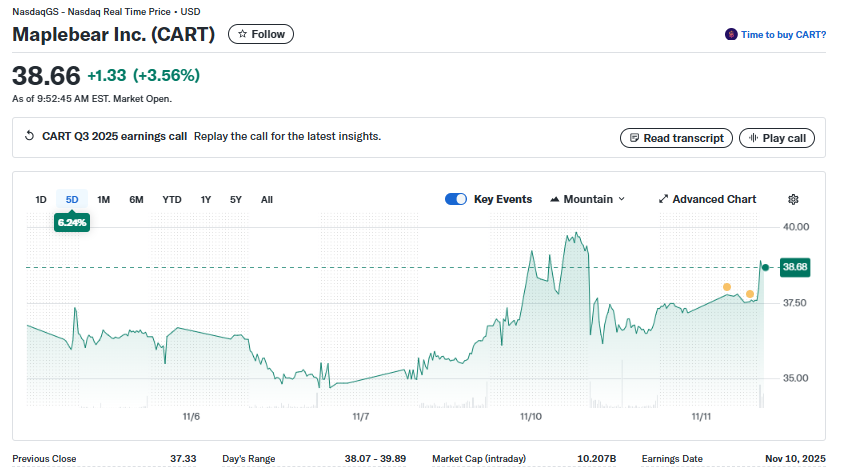
The stock rose 1.6% in after-hours trading following the release of its financial report, buoyed by revenue growth, expanding enterprise partnerships, and a substantial new share buyback program.
Instacart posted Q3 revenue of $939 million, representing a 10% year-over-year increase and surpassing analyst expectations. Net income reached $144 million, or $0.51 per share, up from $118 million a year earlier. The company also reported a gross transaction value (GTV) of $9.2 billion, mirroring the 10% rise in revenue, driven by a 14% growth in order volume to 83.4 million orders. However, the average order value (AOV) slipped by 4%, reflecting a shift in consumer habits toward smaller, more frequent purchases rather than large, weekly stock-ups.
Smaller Baskets, More Sessions
The decline in AOV underscores a key behavioral change among online shoppers, an increasing tendency to make smaller “top-up” grocery runs instead of bulk orders. This pattern, while boosting engagement and repeat visits, can compress margins per order and raise delivery costs.
Yet, Instacart has found a potential advantage in this shift of retail media growth. More frequent, smaller purchases mean more browsing sessions, which in turn create more advertising opportunities. Instacart’s retail media network benefits directly, as every new session provides additional ad impressions.
In fact, ad spend across Instacart Ads grew by 12% quarter-over-quarter in late 2024, according to ecommerce analytics firm Pacvue. That growth reflects increasing interest from brands looking to reach engaged, habitual online grocery shoppers through sponsored placements and personalized promotions.
https://x.com/AlphaSenseInc/status/1987861431081979993

Enterprise Partnerships Fuel Expansion
Instacart’s enterprise partnerships have emerged as a major growth driver, expanding its retail media footprint beyond its core app. These collaborations allow external retailers and grocery chains to leverage Instacart’s technology stack, including its ad tools, delivery logistics, and data analytics, under their own branding.
Such partnerships not only diversify Instacart’s revenue sources but also open new advertising inventory for media agencies and adtech companies. Measurement providers that quantify marketing performance now use Instacart’s platform to compare cost-per-thousand impressions (CPM) and return on ad spend (ROAS) with rival giants like Amazon and Walmart.
Brands such as BUILT, a consumer goods label, reportedly achieved triple-digit growth after using Instacart Ads to reach “new-to-brand” customers. With 83.4 million orders processed in Q3 alone, Instacart continues to offer advertisers a rich ecosystem for targeting, attribution, and performance measurement, critical elements in today’s competitive digital marketing landscape.
Share Buyback Plan Adds Investor Confidence
In a sign of confidence in its financial health, Instacart announced a $1.5 billion share repurchase program alongside a $250 million accelerated buyback.
The move is expected to bolster shareholder returns and stabilize the company’s post-IPO performance, which has been volatile amid competition from Amazon Fresh and DoorDash.
Looking ahead, Instacart forecasted Q4 gross transaction value between $9.5 billion and $9.6 billion, with adjusted EBITDA projected at $285 million to $295 million. These estimates suggest that despite short-term margin pressures, management remains optimistic about maintaining profitable growth through enterprise expansion and ad monetization.
Get 3 Free Stock Ebooks
Discover top-performing stocks in AI, Crypto, and Technology with expert analysis.
- Top 10 AI Stocks - Leading AI companies
- Top 10 Crypto Stocks - Blockchain leaders
- Top 10 Tech Stocks - Tech giants


