



Key Highlights
- Two-week ceasefire deal reached between U.S. and Iran, with Strait of Hormuz to reopen
- Dow futures soared more than 1,300 points; Nasdaq 100 futures climbed as much as 3.5%
- Crude oil prices plummeted, with Brent falling nearly 15% and WTI tumbling approximately 17%
- Bitcoin broke through $70,000; Ethereum and XRP posted strong gains alongside the rally
- Gold prices surged 3.3% amid reduced inflation concerns
President Trump revealed late Tuesday evening that the United States would halt military operations against Iran for a fourteen-day period, contingent upon Iran’s commitment to reopen the crucial Strait of Hormuz shipping channel. Iranian Foreign Minister Seyed Abbas Araghchi quickly verified that Tehran would permit safe maritime transit through the strategic waterway once hostilities ceased.
In a Truth Social post published shortly after midnight, Trump indicated the U.S. would assist in managing vessel traffic congestion in the strait. Iran’s Supreme National Security Council subsequently ratified the agreement.
Global financial markets responded explosively to the announcement. Risk assets experienced a surge as investors who had retreated to safety rapidly repositioned their portfolios.
Dow Jones futures advanced 1,306 points, representing approximately 2.8%. S&P 500 futures increased 2.8%. Nasdaq 100 futures posted the strongest performance with a 3.5% climb.
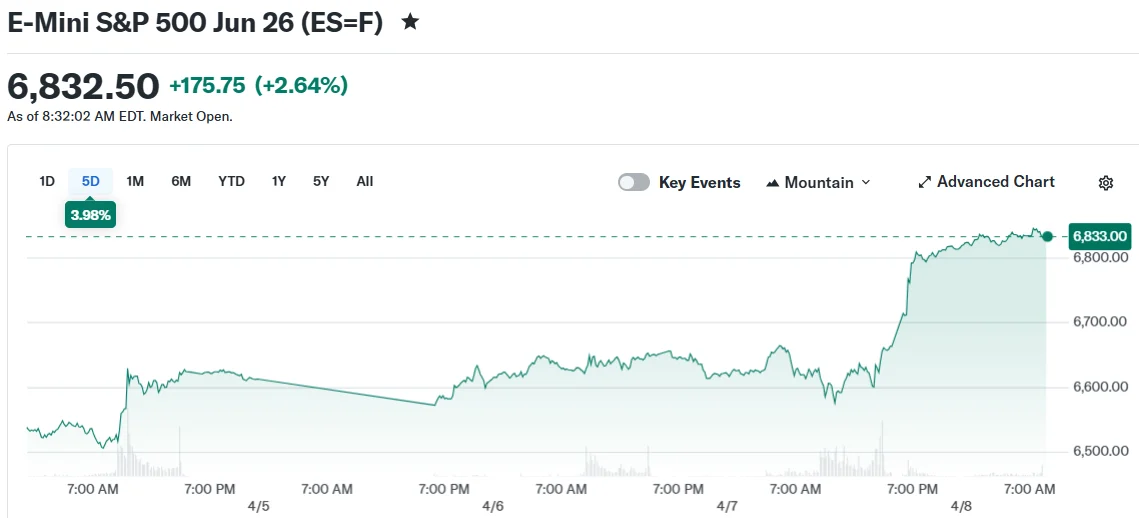
The three primary indices had exhibited uncertainty during the previous trading session, as market participants remained anxious about Trump’s warnings of potential attacks on Iranian critical infrastructure, including transportation networks and electrical facilities.

Energy Markets Experience Dramatic Selloff
Oil prices experienced a steep decline following the ceasefire announcement. Brent crude futures tumbled nearly 15% to settle around $94.69 per barrel. West Texas Intermediate plunged roughly 17% to approximately $96.22 per barrel.
The Strait of Hormuz represents a critical 21-mile-wide passage that facilitates the movement of a substantial portion of the world’s petroleum supply. The prospect of its reopening eliminated a significant geopolitical risk premium from energy markets.
The collapse in crude prices strengthened speculation that the Federal Reserve might continue with interest rate reductions. Declining energy costs alleviate inflationary pressures, providing the central bank with greater flexibility for monetary policy adjustments.
Fed meeting minutes from March were scheduled for publication Wednesday and were anticipated to reveal policymakers’ assessment of the Iran situation’s economic ramifications.
Cryptocurrency and Precious Metals Rally
Bitcoin pushed above the $70,000 threshold. Ethereum and XRP similarly advanced as cryptocurrency markets participated in the widespread risk-on movement.
Gold futures soared 3.3% to reach $4,840 per ounce. Diminished interest rate expectations typically support gold valuations, as the precious metal gains appeal when fixed-income yields decline.
The U.S. dollar weakened 1% versus a basket of major global currencies. The benchmark 10-year Treasury note yield decreased 6 basis points to settle at 4.24%.
Airline Sector Under Scrutiny
Delta Air Lines was set to publish quarterly financial results before Wednesday’s opening bell. Market observers were paying close attention following widespread flight cancellations and elevated aviation fuel expenses during the Middle East tensions.
Robert Edwards, chief investment officer at Edwards Asset Management, noted the ceasefire news proved sufficient to alter market psychology. “Just the scent of thawing tensions is enough for forward-looking stocks to keep climbing the wall of worry,” he stated.
Iran’s Foreign Minister verified on X that secure navigation through the Strait of Hormuz would be achievable “via coordination with Iran’s Armed Forces” throughout the two-week timeframe.
Get 3 Free Stock Ebooks
Discover top-performing stocks in AI, Crypto, and Technology with expert analysis.
- Top 10 AI Stocks - Leading AI companies
- Top 10 Crypto Stocks - Blockchain leaders
- Top 10 Tech Stocks - Tech giants


