



Is Bitunix good? The answer is overall positive, but your research should question what you want from a crypto exchange so that it matches your experience level, supports your funding options, and gives you the tools you actually plan to use. This guide explains what Bitunix offers for new and experienced traders, and what to check before you commit real money.
Here’s a quick feature map to help you see where Bitunix tends to fit best.
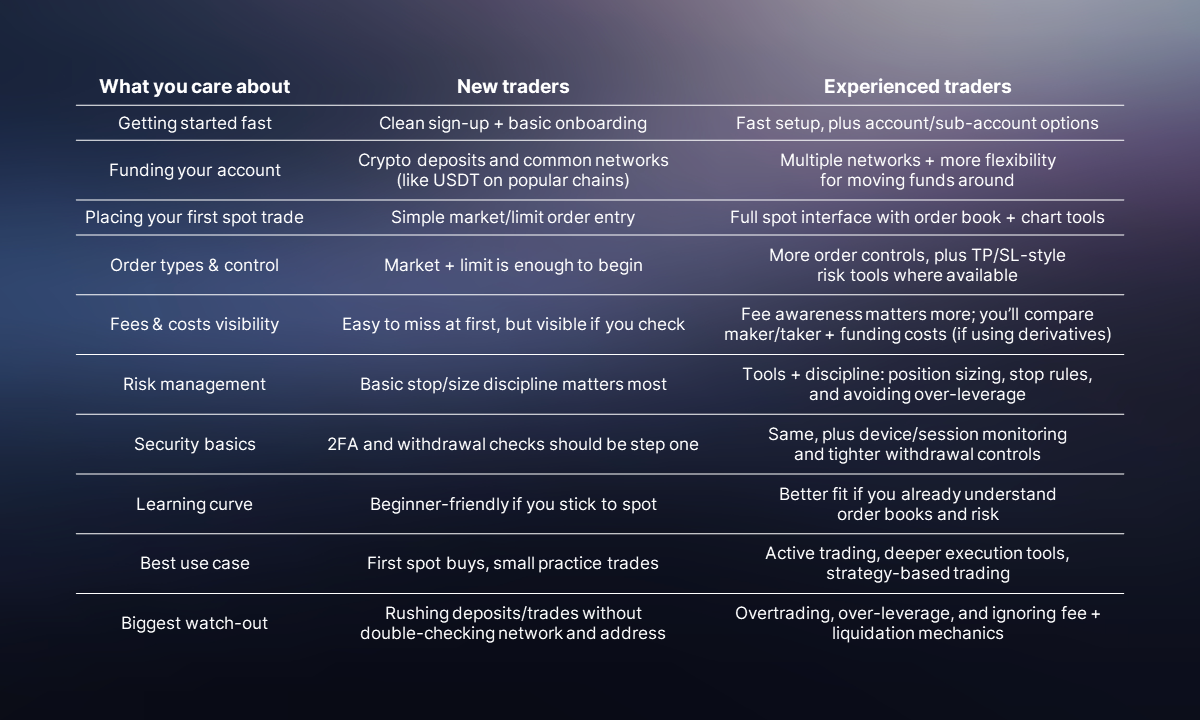
What Feels Beginner-Friendly on Bitunix
If you’re brand new and asking if Bitunix is good for a straightforward start, the simplest path is spot trading with small position sizes. Focus on learning how orders fill, how balances move between wallets, and how fees show up after a trade.
One feature that can help beginners stay consistent is Spot Auto-Invest. It lets you schedule recurring buys for a fixed amount, using a dollar-cost averaging approach. That reduces decision pressure and helps you avoid making every purchase a high-stress moment.
What Experienced Traders Usually Care About
Experienced traders usually look for control and execution. That includes order book visibility, charting, fast order entry, and enough settings to manage risk without extra friction.

Costs also matter more when you trade often. Maker and taker fees are one part. If you use derivatives, funding rates and liquidation mechanics can matter just as much over time. The more active you are, the more small costs add up.
Bitunix offers multiple product areas beyond spot on its main site. If you already understand order books and risk management, that range can be useful. If you don’t, it can add unnecessary complexity.
Fees and Costs: What to Check Before You Judge
If you’re a beginner, focus on the fees you’ll hit by default. Most first trades are spot trades, and many beginners use market orders because they’re simple. Market orders usually behave like takers, so your cost tends to sit closer to the taker rate than the maker rate. On Bitunix, VIP 0 spot fees are listed at 0.0800% (maker) / 0.1000% (taker), so even small practice trades have a real cost you should expect and track.
Beginners should also think about withdrawal costs early, not after they’ve built a balance. Deposits are often free, but withdrawals usually include a network fee, and that fee can feel big when you withdraw small amounts.
Bitunix explains that on-chain withdrawal fees vary by blockchain and network conditions, and the most reliable number is what you see on the withdrawal page at the moment you withdraw. So if you plan to move funds often, do one small test withdrawal first and note the fee and minimum withdrawal amount for your coin and network.
If you’re an experienced trader, fees become part of your execution strategy. Maker vs taker matters more when you trade frequently or in size, because the difference compounds across many fills. It also becomes worth tracking VIP tiers, since Bitunix states VIP levels are based on the previous 30 days of spot volume, contract volume, and current holdings. It reviews those metrics daily at 00:00 UTC and updates your tier automatically, which can change your fee rate without you doing anything special beyond trading and holding.
And if you trade derivatives, separate trading fees from funding costs. Bitunix lists VIP 0 futures fees at 0.0200% (maker) / 0.0600% (taker), but the bigger “expert check” is how funding affects your strategy while you hold positions. Trading fees hit on entry and exit.
Funding can charge you repeatedly if you hold through multiple intervals, so your true cost depends on time-in-trade. Track both the fee rate and the funding you actually pay per position, then compare total cost by strategy.
Safety Basics That Matter at Any Skill Level
Security starts with account access. Set up Google Authenticator 2FA as soon as you create your account, and keep your backup key somewhere offline. Bitunix also supports passkeys, which reduce the risk of password-based attacks because you can sign in with your device authentication instead of typing a password. Add an anti-phishing code too, so you can spot fake emails that do not include your code.
Then lock down anything related to withdrawals. Bitunix ties withdrawal limits to your security setup and KYC tier. In practice, that means your limits can be lower if you only have one security item enabled, and higher once you add 2FA and complete verification.
Finally, look for platform-level controls you can verify. Bitunix states it uses Proof of Reserves with a Merkle tree so users can verify assets on chain, and it references custody and risk infrastructure through providers like Fireblocks and Cobo, plus security testing by Hacken. That does not remove risk, but it gives you specific things to check instead of guessing.
Bottom Line
If you’re still asking if Bitunix is good for your situation, judge it in two layers.
First, check platform fit. Make sure the features you plan to use are easy to access and easy to control. If you’re new, stick to spot and consider a scheduled approach like auto-invest to reduce emotional trading. If you’re experienced, focus on execution comfort and cost visibility.
Second, check process fit. Test deposits and withdrawals with small amounts. Track fees and, if you trade derivatives, track funding and liquidation risk. Most problems come from rushed actions and oversized positions, not from missing one extra feature on an exchange.
Get 3 Free Stock Ebooks
Discover top-performing stocks in AI, Crypto, and Technology with expert analysis.
- Top 10 AI Stocks - Leading AI companies
- Top 10 Crypto Stocks - Blockchain leaders
- Top 10 Tech Stocks - Tech giants


