


Key Takeaways
- JPMorgan’s global market intelligence chief adopted a “tactically bearish” stance on American equities this week
- The S&P 500 could decline to approximately 6,270 points if a 10% correction from recent highs materializes
- Crude oil prices have surpassed the $100 per barrel threshold amid escalating Middle East conflict and attacks on energy facilities
- Morgan Stanley takes an opposing view, maintaining its bullish outlook and suggesting the market’s “rolling correction” is nearing completion
- JPMorgan’s commodity traders believe the recent surge in petroleum product prices is only beginning
JPMorgan Chase has issued a cautionary forecast suggesting the S&P 500 may experience a 10% pullback from recent highs as the Iran conflict drives crude oil beyond the $100 per barrel threshold.
Andrew Tyler, who leads global market intelligence at JPMorgan, shifted his positioning to “tactically bearish” on American equities this week. The intensifying Middle East crisis serves as the primary catalyst for this outlook adjustment.
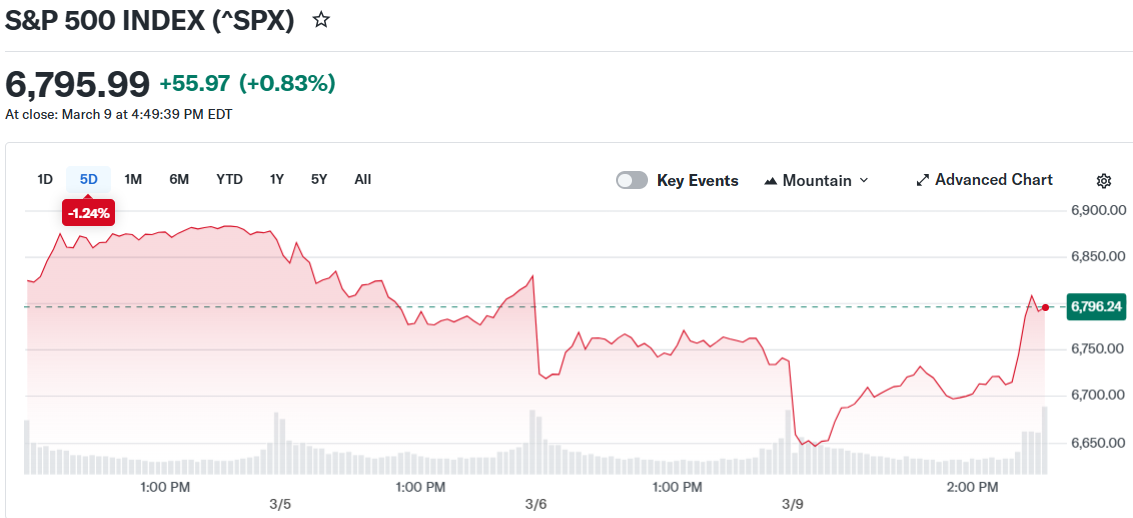
Should a 10% correction materialize from the index’s recent peak, the S&P 500 would settle near 6,270 points. This represents roughly a 7% decline from Friday’s closing level.
JPMorgan’s commodities division highlighted that energy infrastructure on both sides of the conflict has sustained damage. According to the team, this development establishes a concerning new pattern, and they caution that the recent petroleum product price increases are merely beginning.
“The precedent of oil infrastructure under attack has officially begun,” the desk wrote.
Oil breaching the $100 per barrel mark creates significant economic stress. Elevated energy expenses ripple through numerous industries, potentially constraining corporate profitability.

Morgan Stanley’s Contrarian Perspective
Wall Street analysts aren’t unified in their assessment. Morgan Stanley’s chief investment officer, Mike Wilson, maintains the firm’s constructive view on equities for the coming six to twelve months, diverging from JPMorgan’s cautious stance.
Wilson characterizes the market as experiencing a “rolling correction” since last October, with performance remaining range-bound despite solid earnings reports. He contends this corrective phase is approaching its conclusion.
Both financial institutions are analyzing identical market conditions yet reaching opposite conclusions. JPMorgan identifies immediate downside vulnerability, whereas Morgan Stanley anticipates the market will soon establish a stable foundation.
Understanding a 10% Market Correction
A 10% pullback in the S&P 500 constitutes a conventional market correction. These periodic adjustments are routine market behavior, with notable examples occurring in 2018, 2020, and 2022, each followed by eventual recoveries.
Investors holding retirement portfolios and index-tracking mutual funds would experience temporary value reduction. Investment professionals typically advocate maintaining positions rather than engaging in emotionally-driven selling.
JPMorgan’s cautionary outlook stems specifically from the Iran conflict escalation and attacks on energy infrastructure. The firm hasn’t identified any particular domestic economic catalyst.
Crude oil exceeding $100 creates challenges for consumer discretionary spending and business operational costs. Energy sector companies stand to gain from elevated prices, while airlines and manufacturers may encounter profitability pressures.
The S&P 500 comprises 500 of America’s largest publicly listed corporations. It ranks among the world’s most extensively monitored equity benchmarks.
JPMorgan manages $4.8 trillion in assets, positioning it among the planet’s most substantial financial institutions. Investment professionals and individual investors closely monitor its market perspectives.
As of this week, the institution modified its U.S. equity stance from neutral to tactically bearish, prompted by the deteriorating Middle East situation.
Get 3 Free Stock Ebooks
Discover top-performing stocks in AI, Crypto, and Technology with expert analysis.
- Top 10 AI Stocks - Leading AI companies
- Top 10 Crypto Stocks - Blockchain leaders
- Top 10 Tech Stocks - Tech giants


