


Key Takeaways
- JPMorgan revised its year-end 2026 S&P 500 forecast downward from 7,500 to 7,200
- Crude oil has jumped more than 40%, with production disruptions reaching 8 million barrels daily
- Market participants are hedging positions while maintaining near-record gross leverage levels
- Sustained oil prices around $110 could reduce S&P 500 earnings projections by 2–5%
- The firm recommends overweight positions in Defense, Energy, Utilities, and Cybersecurity
The investment banking giant has slashed its S&P 500 price projection for year-end 2026 to 7,200 from a previous estimate of 7,500. JPMorgan analysts warn that financial markets are underestimating dangers posed by Middle Eastern instability, crude oil volatility, and excessive investor complacency.
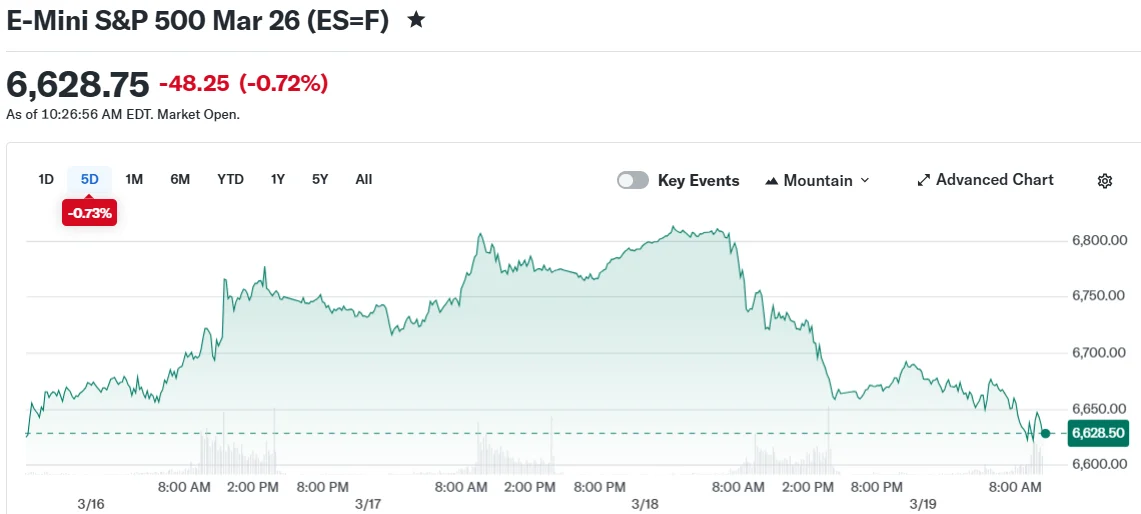
The research report comes from Dubravko Lakos-Bujas, a senior analyst at the firm. He observed that the benchmark equity index has declined merely 3% despite crude petroleum prices soaring over 40%.
Lakos-Bujas attributes this market stability to capital flows seeking safe-haven status in American financial instruments. However, he cautioned that this apparent resilience could be deceptive.
According to the analyst, market participants have primarily deployed hedging strategies instead of meaningful risk reduction. Gross leverage metrics currently sit near the 95th percentile of historical ranges, representing a significant vulnerability.
The bank’s research suggests equity markets are betting on a rapid resolution to Middle Eastern hostilities and the swift reopening of critical shipping lanes. JPMorgan characterizes this expectation as overly optimistic and dangerous.

Historical patterns demonstrate an inverse correlation between oil and equity valuations once petroleum prices surge beyond 30%. That critical threshold has already been breached.
Production Disruptions Reach Unprecedented Levels
Oil supply interruptions have hit 8 million barrels daily, marking an all-time high. JPMorgan’s analysis suggests disruptions could escalate to 12 million barrels per day, representing approximately 11% of worldwide production capacity.
The institution emphasizes that inflation isn’t the primary concern. Instead, the more significant danger involves extended supply disruptions that suppress economic demand, ultimately dragging down GDP growth, corporate revenues, and bottom-line earnings through what analysts term “forced demand destruction.”
Should crude petroleum stabilize near $110 per barrel, the bank projects Wall Street’s consensus earnings estimates for the S&P 500 could face reductions between 2% and 5%.
Additional challenges compound the outlook. Lakos-Bujas identified strain within private credit markets, weakening sentiment surrounding artificial intelligence investments, and deteriorating consumer purchasing power.
Critical Levels Under JPMorgan’s Surveillance
Should the S&P 500 breach its 200-day moving average, JPMorgan identifies minimal technical support until the 6,000–6,200 zone. Such a decline would constitute a substantial retreat from present valuations.
While not forecasting a market collapse, the bank advocates a defensive posture. Its strategists recommend portfolio rotation toward Low Volatility equities and Quality Growth names.
Sector recommendations outlined in the research include Defense contractors, Energy producers, Utilities, Materials, Cybersecurity firms, and Hyperscaler technology companies.
Though cryptocurrency markets weren’t explicitly addressed, elevated crude prices and broader macroeconomic uncertainty have traditionally pressured speculative risk assets including Bitcoin and alternative digital tokens.
JPMorgan’s adjusted forecast of 7,200 represents the firm’s most current public guidance issued March 19, 2026.
Get 3 Free Stock Ebooks
Discover top-performing stocks in AI, Crypto, and Technology with expert analysis.
- Top 10 AI Stocks - Leading AI companies
- Top 10 Crypto Stocks - Blockchain leaders
- Top 10 Tech Stocks - Tech giants


