



Key Takeaways
- Bitcoin bounced back from sub-$65,200 levels to stabilize near $67,500, while major altcoins declined 3–8% over seven days
- President Trump informed advisers he’s considering ending U.S. military operations against Iran, regardless of Strait of Hormuz access
- S&P 500 futures surged 0.8% following the news; crude oil retreated from $107 to approximately $103
- The S&P 500 faces its most extended losing run since 2022; MSCI Asia Pacific approaches its steepest monthly decline since 2008
- Total cryptocurrency market capitalization remains at $2.32 trillion, holding steady week-over-week, while the Nasdaq 100 shed approximately 5%
Bitcoin was changing hands at $67,545 Tuesday morning following a rebound from Monday’s dip beneath $65,200. The previous session’s low marked its weakest price point since the U.S.-Israeli military operations against Iran commenced in late February.
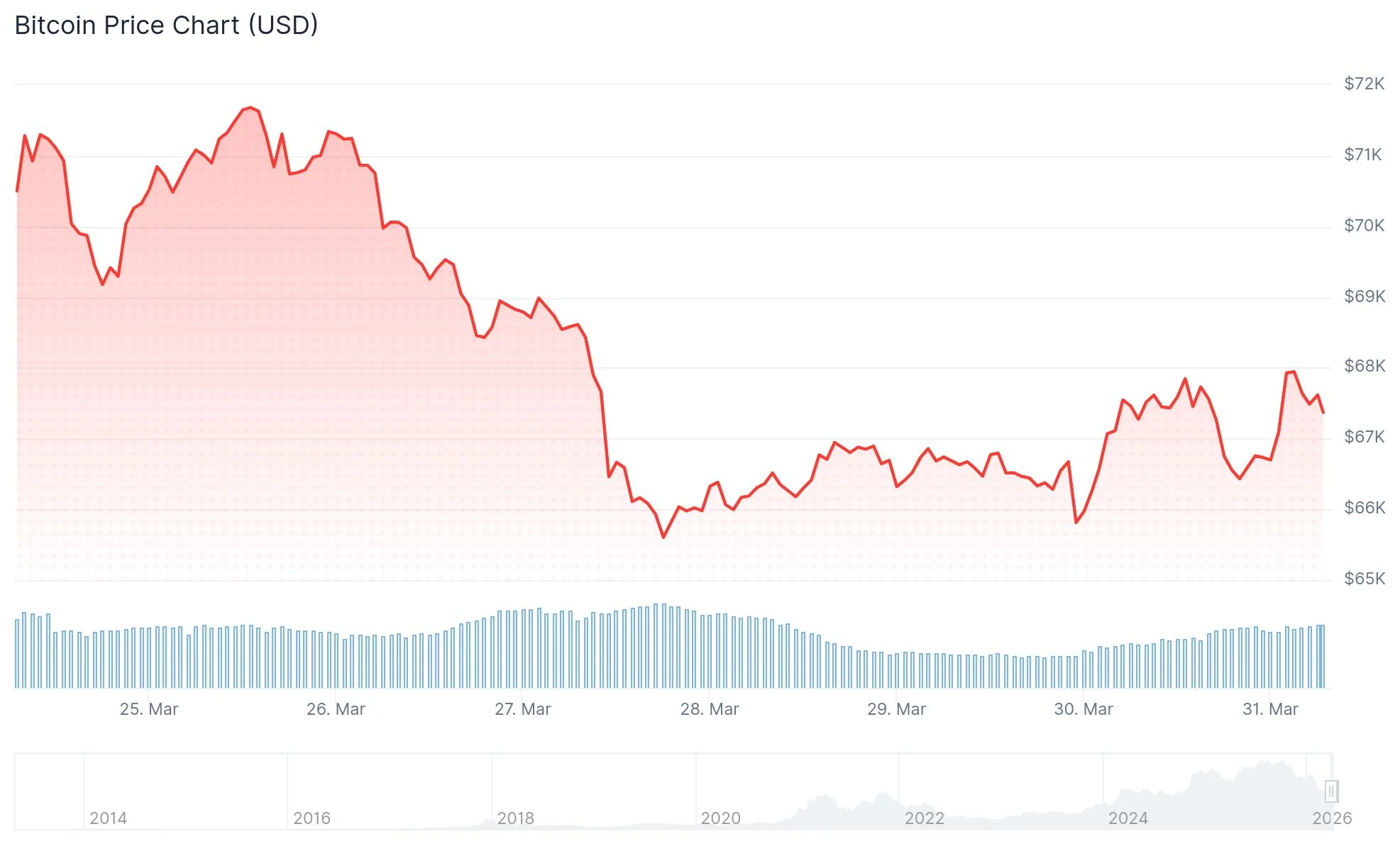
Ether maintained its position above the $2,000 threshold at $2,062, registering a 0.4% daily gain. Solana decreased 0.9% to $83.07, XRP retreated 2.2% to $1.32, and dogecoin declined 2.1% to $0.09. Among the top 10 cryptocurrencies, Solana and XRP experienced the steepest weekly declines, falling 8% and 6.4% respectively.
The aggregate cryptocurrency market valuation stands at $2.32 trillion, essentially unchanged from a week earlier. During this timeframe, the Nasdaq 100 experienced approximately a 5% decline.
According to a Wall Street Journal report Monday, President Trump informed his advisers of his willingness to conclude military operations against Iran, even if the Strait of Hormuz continues operating under significant restrictions. Sources indicated that attempting to fully reopen the waterway would extend the conflict beyond his preferred four-to-six week timeframe.
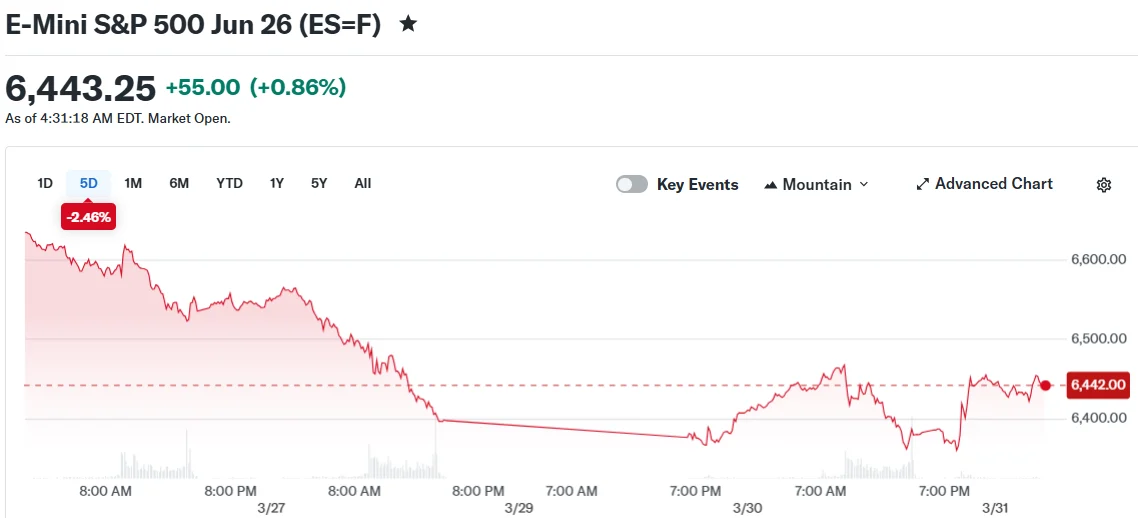
Equity futures responded dramatically to this development. S&P 500 futures advanced 0.8%, Nasdaq 100 futures gained 0.7%, and Dow Jones futures jumped 0.9%.

Oil prices retreated following the disclosure. West Texas Intermediate crude had surged to $107 earlier before falling back toward $103. The pullback occurred after Iran targeted a Kuwaiti crude carrier in Dubai during morning trading.
Equity Markets Face Sustained Pressure
The S&P 500 continues experiencing its most prolonged consecutive daily decline since 2022. The MSCI Asia Pacific index is positioned for its most severe monthly loss since the 2008 global financial meltdown. The CBOE Volatility Index has remained elevated above 30, traditionally indicating heightened market uncertainty.
Treasury securities continued their advance while the dollar softened against the majority of G10 currencies throughout trading.
Federal Reserve Chairman Jerome Powell stated that private credit markets show minimal contagion risk and indicated no urgent need for additional interest rate increases. He suggested current inflation trends remain manageable based on available data.
Market participants are closely monitoring Tuesday’s March consumer confidence data and February’s Job Openings and Labor Turnover Survey for additional economic insights.
Cryptocurrency Markets Demonstrate Relative Strength Versus Equities
JPMorgan analysts observed that Bitcoin is demonstrating better resilience during the Iran crisis compared to traditional safe havens like gold and silver. Gold has experienced an uncommon losing pattern during an active military conflict.
Alex Kuptsikevich, chief market analyst at FxPro, stated: “Crypto has pulled back, but appears stronger than stocks.”
He further explained that cryptocurrency markets are establishing support levels near February lows and displaying horizontal consolidation patterns, while equity markets continue forming distinct downward trajectories.
Bitcoin has maintained a trading range between approximately $65,000 and $73,000 throughout the entire conflict period. Monday’s brief drop below $65,200 followed by a swift recovery above $67,000 demonstrated substantial buying interest at lower price levels.
WTI crude oil settled above the $100 mark for the first time since 2022 as the military conflict entered its fifth week.
Get 3 Free Stock Ebooks
Discover top-performing stocks in AI, Crypto, and Technology with expert analysis.
- Top 10 AI Stocks - Leading AI companies
- Top 10 Crypto Stocks - Blockchain leaders
- Top 10 Tech Stocks - Tech giants


