


Key Takeaways
- Morgan Stanley’s Michael Wilson believes the S&P 500 has reached its bottom and further declines are improbable
- A “barbell” investment approach is advised: combining cyclical sectors with premium growth equities including the Magnificent 7
- Crude oil pricing has emerged as the dominant market force, notes Morgan Stanley’s Serena Tang
- Analysts present three potential oil trajectories: de-escalation ($80–$90), sustained pressure ($100–$110), or critical disruption ($150+)
- The 10-year Treasury yield hitting 4.50% represents a crucial threshold for stock market stability
Morgan Stanley analysts are signaling to market participants that the S&P 500 has likely established its floor — provided that oil prices remain contained.
On Monday, strategist Michael Wilson articulated his view that the S&P 500 is improbable to establish significant new lows. According to Wilson, the benchmark index is forming a foundational support level, presenting opportunities for investors to selectively increase their equity positions.
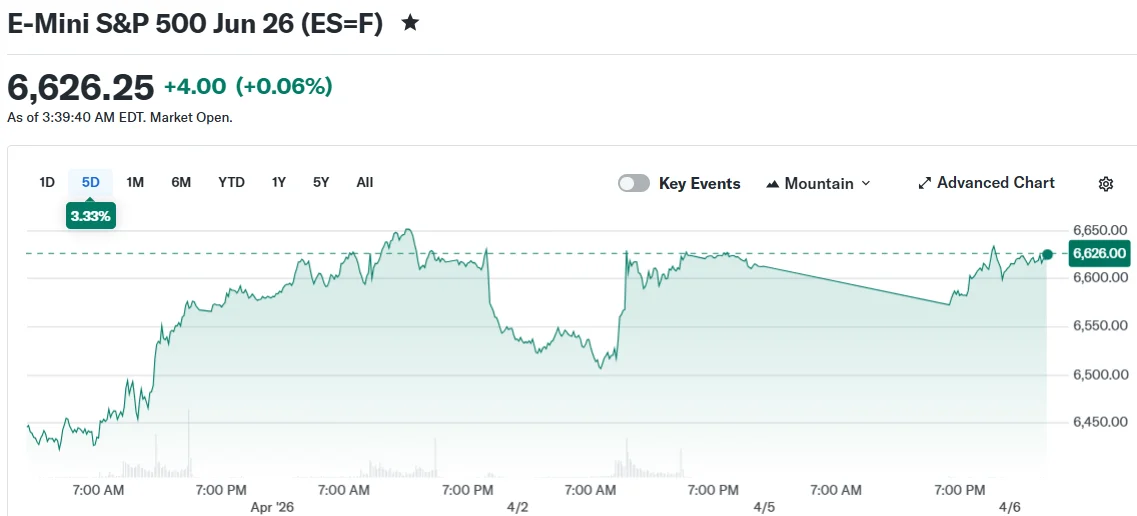
Wilson highlighted the index’s rebound from previously identified support zones between 6,300 and 6,500.
According to Wilson, the United States remains within a bull market framework that commenced last April, subsequent to what he characterizes as a “rolling recession” spanning from 2022 through 2025.
The forward price-to-earnings ratio for the S&P 500 has contracted 18% from its zenith during the preceding six-month period. Wilson observed that such valuation compression typically occurs exclusively during recessionary periods or Federal Reserve monetary tightening phases — neither of which aligns with Morgan Stanley’s baseline projection.
Morgan Stanley’s Current Investment Recommendations
Wilson advocates for a dual-pronged investment strategy. One component emphasizes cyclical market segments including Financials, Consumer Discretionary, and short-cycle Industrial companies. The counterbalance focuses on high-quality growth enterprises, particularly the hyperscale technology leaders.

The Magnificent 7 currently commands approximately 24x forward earnings — comparable to Consumer Staples at 22x — while delivering over three times the earnings expansion. Wilson notes the cohort currently sits at the 2nd percentile of its valuation spectrum since 2023.
He identified the 4.50% level on the 10-year Treasury yield as a critical inflection point. Historical patterns demonstrate that breaches above this threshold typically exert downward pressure on equity valuations.
Concrete economic indicators are beginning to validate the recovery narrative. The March ISM Manufacturing PMI registered 52.7, surpassing analyst expectations, while U.S. hotel revenue per available room climbed 8% during the past half-year period.
Crude Oil Emerges as Primary Market Catalyst
In parallel analysis, Morgan Stanley’s Chief Cross-Asset Strategist Serena Tang identified oil as the pivotal factor currently influencing market dynamics — fundamentally affecting investor perspectives on economic expansion, inflation trajectories, monetary policy decisions, and overall risk appetite.
Tang presented three distinct scenarios. Under a de-escalation framework, crude stabilizes within the $80–$90 per barrel range. This environment favors equities, suppresses bond yields, and elevates cyclical sectors. Tang characterizes this as a “classic risk-on environment.”
Should oil persist within the $100–$110 band, markets can accommodate the pressure, albeit with increased volatility. The S&P 500 would likely establish a broad trading range, favoring quality enterprises with robust balance sheets, while credit markets experience heightened stress.
Under the most extreme scenario — crude exceeding $150 — Tang indicates investors would pivot toward recession-oriented positioning, gravitating toward government securities, cash equivalents, and defensive market segments.
Goldman Sachs has characterized the ongoing Strait of Hormuz disruption as “the largest supply shock in the history of the global crude market” and cautioned that sustained elevated prices could compel central banks to postpone interest rate reductions.
Tang emphasized that during oil-driven shocks, equities and bonds can decline simultaneously, undermining the traditional diversification benefits of 60/40 portfolio construction. Throughout the past month, equity valuations have contracted approximately 15% on a forward price-to-earnings measurement.
Get 3 Free Stock Ebooks
Discover top-performing stocks in AI, Crypto, and Technology with expert analysis.
- Top 10 AI Stocks - Leading AI companies
- Top 10 Crypto Stocks - Blockchain leaders
- Top 10 Tech Stocks - Tech giants


