


Key Takeaways
- Memory chip stocks experienced a roughly 10% decline last month, with Micron and Sandisk dropping over 10% post-Google’s TurboQuant reveal
- Google’s TurboQuant technology promises to cut AI memory requirements by up to 6x, triggering investor concerns
- Morgan Stanley views the recent pullback as a normal market correction rather than fundamental deterioration
- Memory capacity has emerged as the primary constraint for AI expansion, surpassing GPU limitations
- The investment bank maintains Overweight recommendations on Micron and Sandisk with targets of $520 and $690 respectively
Morgan Stanley remains firmly committed to its bullish stance on memory semiconductor manufacturers despite recent market turbulence that shook investor confidence in late March.
The iShares Semiconductor ETF experienced approximately 10% depreciation during the past month. Multiple factors contributed to the decline, including valuation concerns, demand uncertainty, and emerging AI innovations.
Google unveiled its compression technology TurboQuant on March 24, touting its ability to slash memory requirements for AI model operations by as much as six-fold. The announcement triggered immediate investor anxiety.
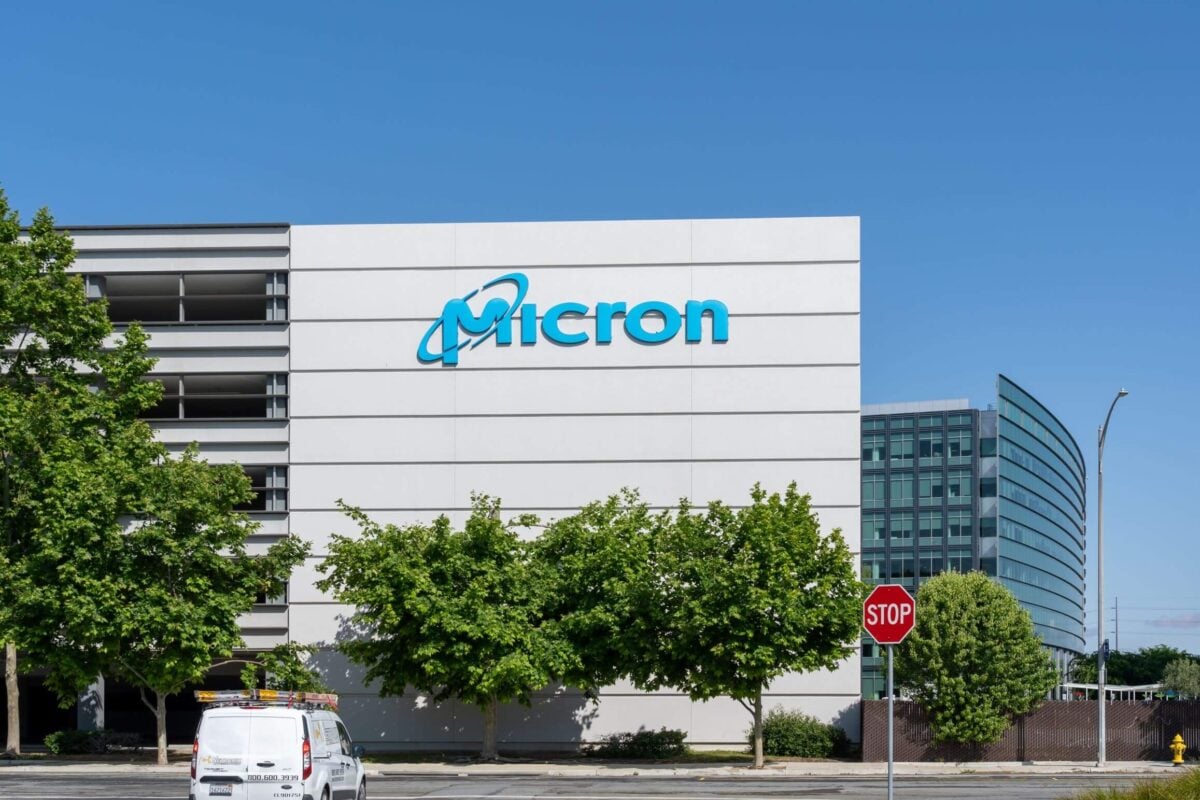
Both Micron and Sandisk witnessed declines exceeding 10% in the trading sessions that followed. Micron shares settled at $357 on March 27, though the stock maintained a 25% gain for the year.

Morgan Stanley’s Joseph Moore challenged the negative sentiment in a client note distributed on March 26.
Moore maintained Overweight classifications for both Micron and Sandisk, keeping price targets unchanged at $520 and $690.
According to Moore, the selloff represents “a healthy pricing in of durability concerns” instead of indicating genuine demand deterioration. The firm believes memory manufacturers’ fundamental strength is “more durable than the market thinks.”
Memory Capacity Emerges as Primary AI Constraint
Throughout the previous two years, Nvidia’s graphics processing units dominated discussions as the critical component driving AI infrastructure investments. While that remains accurate, Morgan Stanley argues that memory has now become the primary limitation.
“Memory is a bottleneck, increasingly the bottleneck, to AI builds,” the research team stated. They highlighted that clients are now making advance payments for substantial volume commitments, demonstrating how constrained supply has become.
According to Moore, DRAM capacity slack has completely disappeared. “Everywhere we look we see indications that it is a true bottleneck,” he observed.
AI could represent “well north of 50%” of total semiconductor expenditure, the bank projected. Supply expansion is unlikely to match such robust demand levels.
Morgan Stanley’s Assessment of TurboQuant Impact
Morgan Stanley specifically examined Google’s TurboQuant announcement, arguing that market participants misinterpreted its significance.
The compression technique applies exclusively to KV Cache memory, not total memory consumption. “They are just talking about KV Cache memory, not memory overall,” the analysts clarified.
KV Cache utilizes high-bandwidth memory, which represents a specific and constrained memory category. Morgan Stanley characterized TurboQuant as “normal course productivity improvement,” rather than a development that would destroy demand.
The bank acknowledges that gross margins approaching 81% won’t persist indefinitely. However, it identifies limited catalysts for near-term margin compression.
Morgan Stanley additionally emphasized robust free cash flow generation prospects for memory producers. The firm stressed that “duration is all that matters,” and by that measure, all indicators “all appear positive.”
As of March 26, 2026, Micron and Sandisk retained their Overweight ratings from the investment bank.
Get 3 Free Stock Ebooks
Discover top-performing stocks in AI, Crypto, and Technology with expert analysis.
- Top 10 AI Stocks - Leading AI companies
- Top 10 Crypto Stocks - Blockchain leaders
- Top 10 Tech Stocks - Tech giants


