



Key Takeaways
- Wall Street firm downgrades global stocks from “overweight” to “equal weight” while boosting cash and Treasury allocations
- Brent crude oil skyrocketed more than 59% this month, surpassing $116 per barrel in the largest monthly increase on record
- Over half of Russell 3000 constituents have declined 20% or more from their 52-week peak levels
- Strategic analysts at the firm believe the S&P 500 selloff is approaching its conclusion
- Year-end S&P 500 price objective of 7,800 remains unchanged, based on no-recession scenario
Morgan Stanley has adopted a more defensive posture on international equities while simultaneously suggesting that the ongoing U.S. market correction could be approaching its bottom.
The prominent investment bank reduced its rating on global stocks from “overweight” to “equal weight” last Friday. Concurrently, the firm elevated both U.S. government bonds and cash positions to “overweight” status, reflecting a flight-to-quality sentiment among market participants.
This strategic shift follows an unprecedented surge in Brent crude prices, which jumped over 59% within a single month—marking the sharpest monthly advance ever recorded, eclipsing even the spike during the 1990 Gulf War. On Monday, futures contracts climbed beyond the $116 per barrel threshold.
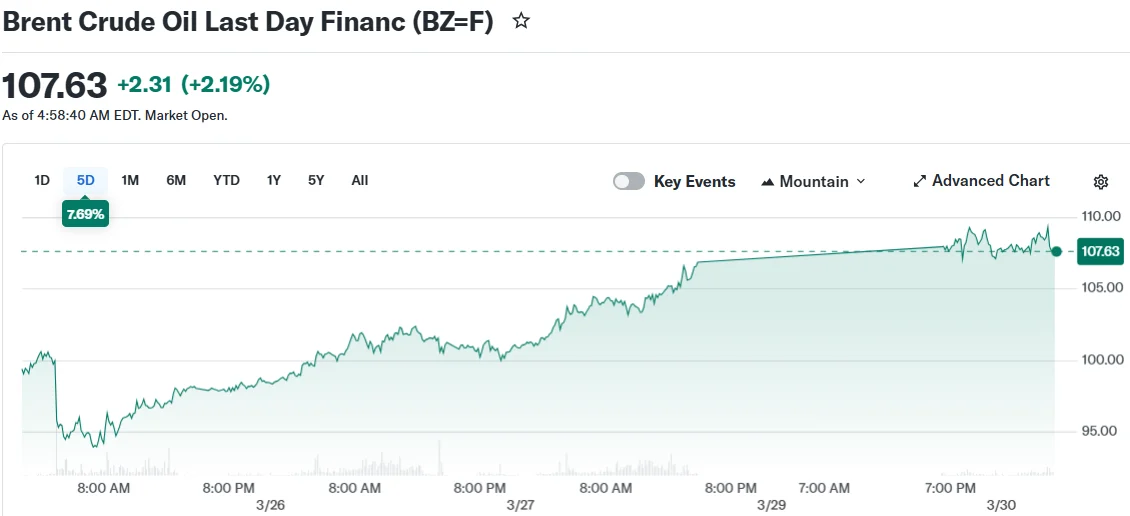
The dramatic rise in oil prices stems from escalating Middle East tensions, particularly surrounding potential disruptions to the Strait of Hormuz, a critical chokepoint for worldwide petroleum transport. Morgan Stanley cautioned that sustained oil prices in the $150-$180 range could trigger a nearly 25% compression in global stock valuations.
The bank downgraded both American and Japanese equities to “equal weight” from their previous “overweight” status. Japan faces particular vulnerability due to its exposure to supply chain interruptions and heightened recession risk should the strategic strait remain inaccessible.

Nevertheless, Morgan Stanley expressed a preference for U.S. equities relative to other geographical markets, citing superior earnings-per-share expansion.
Indicators Point to Potential End of Market Downturn
Despite adopting a more conservative overall stance, Morgan Stanley’s equity strategists, under the leadership of Michael Wilson, identified multiple signals suggesting the S&P 500 correction may be in its final stages.
More than 50% of Russell 3000 components have experienced declines of at least 20% from their 52-week highs. Additionally, the S&P 500’s forward price-to-earnings valuation has contracted by 17%, consistent with previous growth slowdown episodes that ultimately didn’t result in economic recessions.
Wilson emphasized that present circumstances differ substantially from historical oil-shock-induced market declines. Corporate earnings are currently expanding at a 14% year-over-year rate with accelerating momentum, whereas previous downturns saw earnings already contracting.
The annual percentage increase in crude prices is also approximately half the magnitude witnessed during earlier comparable episodes.
Defensive market segments such as Consumer Staples have actually lagged the broader market since the conflict erupted, which Morgan Stanley interprets as evidence that investors have already absorbed much of the oil price shock into current valuations.
Interest Rate Concerns and Technology Sector Dynamics
Wilson identified rising interest rates as the more immediate concern for equity markets. The 10-year Treasury yield is nearing the 4.50% threshold, a level that has historically created headwinds for stock performance.
The correlation between stock prices and bond yields has shifted decisively negative, indicating heightened equity sensitivity to interest rate movements.
Current market pricing reflects expectations for a partial rate increase this year, which contradicts Morgan Stanley’s internal economic forecasts that still anticipate rate reductions.
Regarding artificial intelligence-related equities, Wilson observed that semiconductor memory stocks maintain elevated institutional ownership levels while hyperscaler positioning remains subdued. He highlighted Google’s recent memory compression technology announcement as a potential catalyst for unwinding overcrowded investment positions.
The Magnificent 7 technology stocks currently command price-to-earnings multiples comparable to Consumer Staples companies, despite delivering earnings growth rates exceeding them by more than three times.
Morgan Stanley reaffirmed its year-end S&P 500 price target of 7,800, predicated on the United States successfully avoiding an economic recession.
Get 3 Free Stock Ebooks
Discover top-performing stocks in AI, Crypto, and Technology with expert analysis.
- Top 10 AI Stocks - Leading AI companies
- Top 10 Crypto Stocks - Blockchain leaders
- Top 10 Tech Stocks - Tech giants


