


TLDRs;
- Nokia stock surged 23% after Nvidia announced a $1 billion investment for a 2.9% stake in the company.
- The deal will see joint development of AI and 6G networking technologies, with first trials set for 2026.
- Nokia’s AI-RAN technology could tap into a $200 billion market by 2030, boosting growth prospects.
- The move signals Nokia’s transformation from telecom vendor to AI infrastructure innovator in the global tech race.
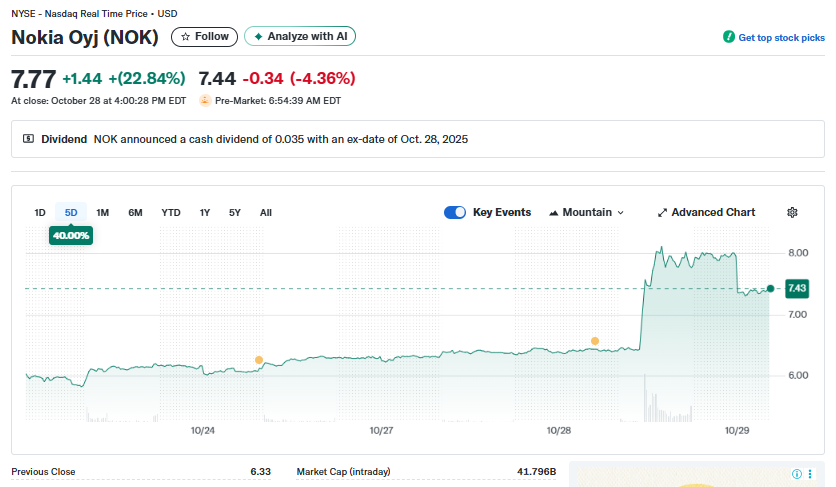
Nokia Oyj (NYSE: NOK) surged nearly 23% on Monday, closing at $7.77, after Nvidia announced a $1 billion investment for a 2.9% stake in the Finnish telecom giant.
The deal marks a major turning point for Nokia, which has been seeking to reposition itself as a key player in next-generation AI and networking infrastructure.
The stock’s sharp rise reflects renewed investor confidence in Nokia’s long-term vision to integrate artificial intelligence into its data center and 6G strategies. Nvidia, now Nokia’s second-largest shareholder, will subscribe to over 166 million new shares at $6 each, according to a company statement.
AI and 6G Take Center Stage
Under the agreement, Nvidia and Nokia will co-develop AI networking and data center technologies, potentially merging Nokia’s telecom-grade hardware with Nvidia’s GPU-based compute infrastructure. The collaboration will also include joint work with T-Mobile US to develop AI-enhanced radio technologies for 6G, with pilot trials expected to begin in 2026.
Nokia’s Chief Executive Officer, Pekka Lundmark, described the partnership as “a long-term bet on the intelligent networks of the future.” He added that the first revenue impact from the collaboration is expected in 2027, signaling a multi-year innovation roadmap that could help Nokia reclaim relevance in a sector increasingly defined by AI efficiency and automation.
Industry analysts view this move as a strategic bridge between AI computing and telecom networks, where real-time processing, low latency, and scalability are critical.

AI-RAN Market Could Hit $200 Billion by 2030
Nokia’s deeper play into AI-RAN (Artificial Intelligence, Enhanced Radio Access Network) technology positions it in a fast-growing market segment projected to exceed $200 billion by 2030, according to research firm Omdia.
AI-RAN systems use AI algorithms to optimize radio scheduling, reduce interference, and improve energy efficiency in telecom networks, crucial gains as operators manage ballooning data traffic and energy costs.
For Nokia, success in AI-RAN depends on its ability to optimize software for Nvidia’s CUDA and ARC-Pro platforms, which provide the backbone for parallel GPU computing and high-speed networking. The challenge lies in achieving ultra-low latency and reliability standards that telecom networks demand.
Analysts caution that timing and execution will be key, as global carriers are still digesting heavy 5G investments, even as they explore AI upgrades. However, early trials with T-Mobile and Nvidia could offer Nokia a first-mover advantage if performance benchmarks deliver on energy and cost efficiency.
Strategic Implications for AI Infrastructure
Beyond telecom networks, this alliance also resonates across the broader AI infrastructure and data center ecosystem. Nvidia’s Spectrum X Ethernet platform, recently adopted by Meta and Oracle for large AI clusters, opens opportunities for Nokia and other networking vendors to provide optical transport and long-distance fiber solutions that connect massive AI data centers.
Cisco has already integrated Spectrum X silicon into its switch lineup, underscoring a shift toward AI-optimized networking hardware. Nokia’s experience in optical transport and edge networking may position it to capture part of this growing market, particularly in Europe and Asia.
Observers believe this partnership could help Nokia pivot from a legacy telecom supplier to a next-generation AI infrastructure player, leveraging Nvidia’s dominance in AI chips to expand into high-value software and services.
Get 3 Free Stock Ebooks
Discover top-performing stocks in AI, Crypto, and Technology with expert analysis.
- Top 10 AI Stocks - Leading AI companies
- Top 10 Crypto Stocks - Blockchain leaders
- Top 10 Tech Stocks - Tech giants


