



TLDRs:
- Opendoor shares jump after JPMorgan sets $8 price target and announces warrant dividend.
- Special three-tranche warrants reward shareholders, complicate short-selling strategies.
- CEO Kaz Nejatian’s Opendoor 2.0 plan drives optimism for 2026 breakeven.
- Equity sale and convertible repurchases reshape balance sheet, reducing dilution risk.
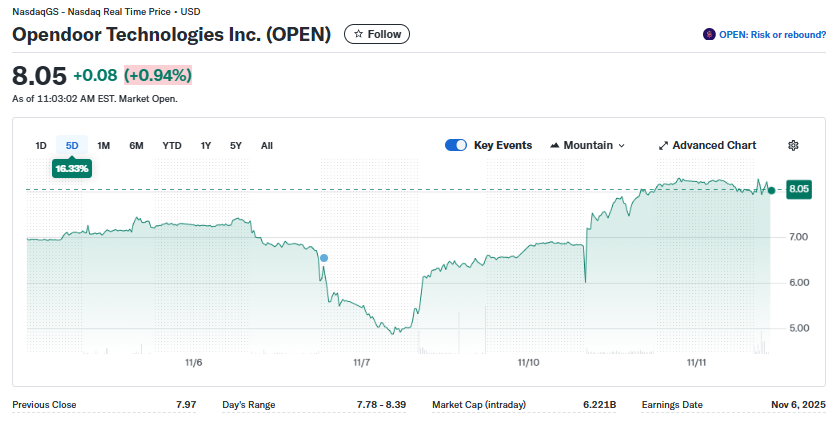
Opendoor Technologies Inc. (NASDAQ: OPEN) extended its market rally on Tuesday, following a dramatic ~20% surge on Monday.
The uptick came after JPMorgan set a Street-high $8 price target on OPEN shares while affirming its Overweight rating. Analysts praised the company’s leadership reset and operational restructuring, describing the changes as a “major transformation” that has positioned Opendoor among the market’s most actively traded names.
The bullish sentiment from JPMorgan fueled strong buying interest into Tuesday, with pre-market and intraday trading reflecting continued momentum. Retail and institutional investors alike appear drawn to the company’s twin catalysts, a high-profile analyst endorsement and the launch of a special warrant dividend.
Special Warrant Dividend Announcement
A key driver behind Tuesday’s gains is Opendoor’s announcement of a special dividend distributing tradable stock warrants to existing shareholders.
Those on record by 5:00 p.m. ET on Nov. 18, 2025, will receive one Series K (OPENW), one Series A (OPENL), and one Series Z (OPENZ) warrant for every 30 shares held. The exercise prices are set at $9, $13, and $17, with scheduled expiry on Nov. 20, 2026. Early expiration triggers apply if the common stock’s VWAP exceeds threshold levels for 20 of 30 trading days.
The three-tranche structure is designed to align shareholder and management incentives while creating additional tradeable upside for investors. Market commentary has noted that the dividend may also complicate short-selling activity, as lenders and shorts must navigate the warrants’ record and distribution dates.

Strategic Balance Sheet Moves
Beyond the warrant dividend, Opendoor has undertaken significant capital maneuvers to strengthen its financial position.
On Nov. 6, the company entered registered direct agreements to sell roughly 180.6 million shares at $6.56 per share. Proceeds from the $1.18 billion gross sale are earmarked to repurchase about $264 million principal of 2030 convertible notes. These cross-conditional transactions are expected to close on Nov. 13, reshaping the balance sheet and reducing potential future dilution pressure from in-the-money convertibles.
Such moves reflect management’s broader strategy under CEO Kaz Nejatian, who has been leading an “Opendoor 2.0” refounding effort. The focus is on software and AI-driven operations, with tightened unit economics, selective acquisitions, and a target of breakeven adjusted net income by the end of 2026.
Fundamentals and Market Context
Opendoor’s Q3 2025 results provide context for the rally. The company reported $915 million in revenue alongside a $90 million net loss. It sold 2,568 homes and purchased 1,169 during the quarter, signaling a disciplined approach to inventory and margins.
Analysts see the combination of operational discipline, a clear roadmap toward profitability, and shareholder-friendly initiatives like the warrant dividend as major tailwinds for OPEN shares.
Looking ahead, market watchers will be closely monitoring how the warrants trade on Nasdaq, how the stock responds to JPMorgan’s price target, and whether Opendoor can execute its strategic plan effectively. For investors, the dual catalysts of analyst optimism and innovative dividend structure have made Opendoor one of the most discussed mid-cap stocks in the NASDAQ universe this week.
Get 3 Free Stock Ebooks
Discover top-performing stocks in AI, Crypto, and Technology with expert analysis.
- Top 10 AI Stocks - Leading AI companies
- Top 10 Crypto Stocks - Blockchain leaders
- Top 10 Tech Stocks - Tech giants


