


TLDR
- Gold tumbled 10% on Monday after recording its largest single-day decline in more than ten years on Friday
- Silver plummeted 16% in Monday trading, eliminating all profits accumulated during 2026
- Kevin Warsh’s Federal Reserve nomination by President Trump sparked the precious metals collapse
- Gold peaked at $5,626.80 per ounce while silver reached $121.79 before the dramatic price reversal
- Market observers attribute the crash to overcrowded positions and rapid profit-taking by investors
Precious metals markets suffered a dramatic collapse on Monday as gold and silver prices tumbled from record highs. The sharp reversal caught many traders off guard after weeks of steady gains.
Gold fell 10% during Monday’s session. The precious metal now trades nearly 20% below its recent all-time high. Prices settled at $4,536.46 per ounce in Singapore afternoon trading.
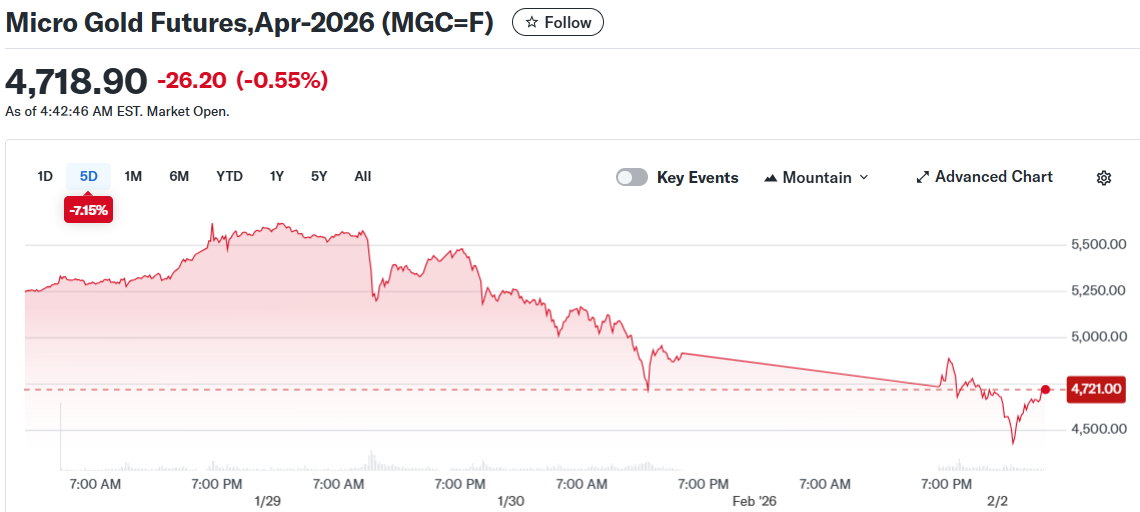
Silver’s losses exceeded gold’s decline. The white metal dropped 16% on Monday following Friday’s historic intraday plunge. Silver prices fell to $72.68 per ounce, below the $71.66 level where 2025 ended.
Last week saw both metals reach unprecedented highs. Gold touched $5,626.80 per ounce while silver climbed to $121.79. January’s rally was driven by geopolitical tensions and Federal Reserve policy uncertainty.
Chinese market participants amplified the price surge. Speculators rushed into precious metals as protective assets. The one-sided positioning created vulnerability when sentiment shifted.
Federal Reserve Nomination Changes Market Dynamics
President Trump’s selection of Kevin Warsh to lead the Federal Reserve sparked Friday’s initial selloff. The announcement boosted the U.S. dollar immediately. Higher dollar values reduce international demand for dollar-denominated commodities.

Warsh carries a reputation as an aggressive inflation fighter. His potential leadership signals stricter monetary policy ahead. Gold prices typically decline when interest rates increase and currency values strengthen.
The nomination removed some policy uncertainty from markets. This change reduced investor appetite for safe-haven assets. Many had purchased precious metals to protect against potential dollar devaluation.
Former JPMorgan Chase trader Robert Gottlieb described the positioning as “way too crowded.” Profitable traders stood ready to sell quickly. The exits created a cascade effect as prices declined.
Leveraged Bets Unwind Rapidly
Exchange-traded fund selling and derivatives unwinding intensified the decline. Shanghai Soochow Jiuying Investment Management’s Jia Zheng said profit-takers had prepared exit strategies. The selling pressure overwhelmed available buying interest.
Unprecedented call option activity had accelerated January’s rally. Goldman Sachs noted that option writers bought additional gold to hedge positions. This mechanism reversed when prices turned lower.
Increasing price swings exceeded many traders’ risk parameters. Saxo Bank’s Ole Sloth Hansen characterized the movement as a “wholesale exit.” China’s upcoming Lunar New Year holiday encouraged position reductions.
Chinese markets will remain closed from February 16 for more than a week. Weekend shoppers packed Shenzhen’s main gold marketplace. Consumers purchased jewelry and bullion bars before holiday celebrations begin.
Shanghai gold maintained a premium over international quotes despite Monday’s decline. Jinrui Futures analyst Zijie Wu expects lower prices will attract Chinese retail buyers. Peak holiday season typically drives strong physical demand.
Monday’s settlement showed gold futures at $4,886 per ounce. Silver futures closed at $78.4 per ounce. Platinum and palladium prices also retreated. The Bloomberg Dollar Spot Index added 0.1% following Friday’s 0.9% advance.
Deutsche Bank analysts maintain their $6,000 gold price target despite current weakness. They argue underlying fundamentals supporting precious metals remain intact.
Get 3 Free Stock Ebooks
Discover top-performing stocks in AI, Crypto, and Technology with expert analysis.
- Top 10 AI Stocks - Leading AI companies
- Top 10 Crypto Stocks - Blockchain leaders
- Top 10 Tech Stocks - Tech giants


