



TLDR
- Qastle: A quantum-secured wallet for next-gen digital asset protection.
- Quantum eMotion’s Qastle secures wallets with quantum randomness and encryption.
- Despite a 24.56% stock drop, Qastle’s market potential remains high.
- Qastle targets 1M users, disrupting the $12.6B crypto-wallet market.
- Quantum eMotion’s future-proof wallet sets new security standards.
Quantum eMotion Corp. (QNCCF) experienced a significant decline in stock value, trading at 2.5400, down 24.56% during the day.
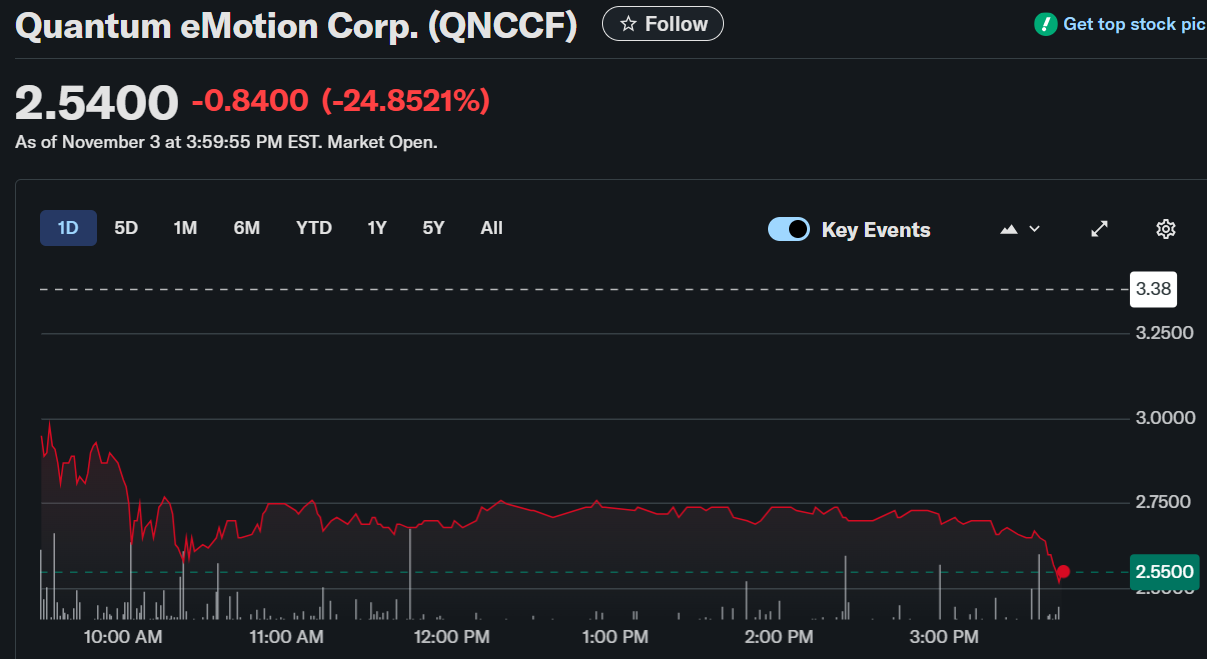
The decline came despite the company’s announcement of a major innovation in the cryptocurrency security sector. Quantum eMotion, alongside Krown Technologies, unveiled the launch of Qastle, a quantum-secured hot wallet designed to protect digital assets from both cyber and quantum computing threats. The timing of the stock plunge has drawn attention, with analysts scrutinizing the possible factors behind the market response.
Qastle Wallet Revolutionizes Hot Wallet Security
Qastle offers a groundbreaking approach to securing digital wallets, addressing common vulnerabilities in current systems. Unlike traditional hot wallets, which are susceptible to key theft and phishing attacks, Qastle leverages Quantum Entropy-as-a-Service (EaaS) and post-quantum cryptography to enhance security. The wallet integrates continuous, on-demand quantum entropy from Quantum eMotion’s QRNG2 true-entropy engine, ensuring a level of randomness that exceeds the capabilities of both software-based random number generators and hardware modules.
This level of security is designed to protect users from both classical and future quantum computing-based attacks. By securing wallet seed creation, session keys, and ongoing key refresh cycles, Qastle offers a robust defense mechanism against potential threats. In addition, the integration of post-quantum encryption ensures that Qastle remains secure in a future where quantum computers could decrypt current cryptographic systems. This proactive approach positions Qastle as a future-proof solution for the cryptocurrency wallet market.

The Market Impact and Adoption Potential of Qastle
Krown Technologies, in collaboration with Quantum eMotion, has high expectations for Qastle’s adoption. The company projects between 50,000 and 150,000 users in the first quarter, with the potential to surpass 1 million users by year-end. With an estimated first-year gross revenue ranging from $8 million to $15 million, Qastle is expected to generate significant revenue through transaction fees, premium QRNG-secured tiers, and licensing royalties for enterprise integrations.
The wallet’s potential to disrupt the $12.6 billion crypto-wallet industry is clear, with Qastle targeting a rapidly expanding market projected to exceed $100 billion by 2033. As the first wallet to offer quantum-grade security, it is well-positioned to capture a sizable market share, offering unique features that could redefine the standard for hot wallets. Despite the recent stock decline, the market’s response to Qastle’s launch may reveal long-term growth potential, with early revenue projections supporting the wallet’s commercial viability.
Quantum eMotion’s Position in the Quantum Cybersecurity Market
Quantum eMotion’s involvement in Qastle highlights its growing presence in the quantum cybersecurity sector. The company’s Entropy-as-a-Service (EaaS) platform is integral to Qastle’s security features, providing the necessary quantum randomness for key creation and protection. This position not only establishes Quantum eMotion as a key player in the evolving cybersecurity landscape but also sets the stage for future developments in quantum-safe technologies.
Quantum eMotion’s ability to bring quantum cybersecurity from theoretical to practical use demonstrates the scalability of its platform. As the company continues to innovate, it is positioned to capitalize on the increasing demand for security solutions that can withstand the advent of quantum computing. While the drop in stock value may raise questions in the short term, the long-term potential of Qastle and its quantum security capabilities could redefine how digital assets are protected in the future.
Get 3 Free Stock Ebooks
Discover top-performing stocks in AI, Crypto, and Technology with expert analysis.
- Top 10 AI Stocks - Leading AI companies
- Top 10 Crypto Stocks - Blockchain leaders
- Top 10 Tech Stocks - Tech giants


