



Key Highlights
- For the first time in over a decade, XRP has recorded six straight monthly declines, plummeting more than 60% from its $3.65 peak.
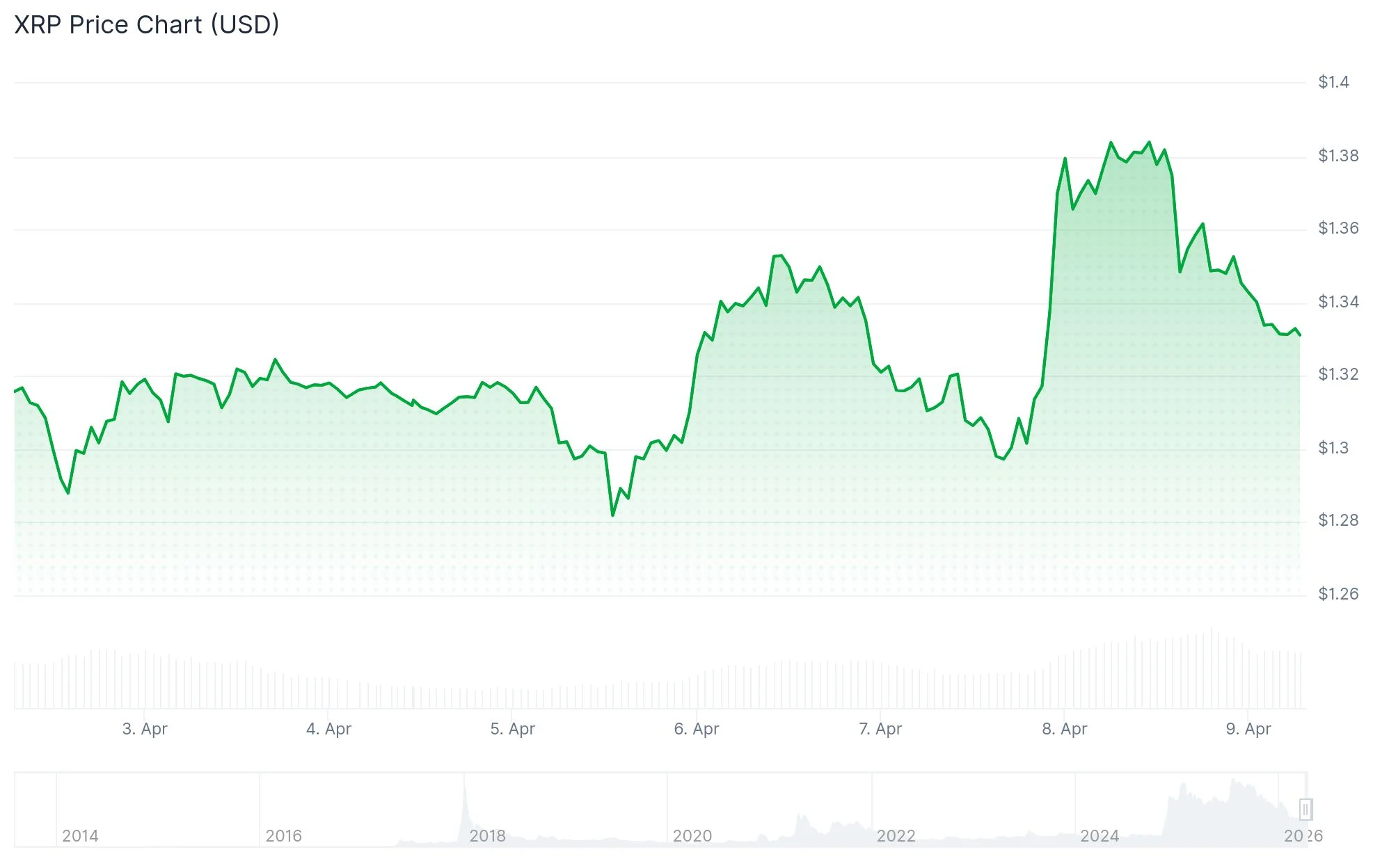
- Recent trading saw XRP slip from $1.37 down to $1.33, with persistent selling pressure emerging at the $1.37–$1.38 resistance threshold.
- Investment products tied to Ripple recorded $3.32M in capital inflows, marking a departure from March’s outflow trend, though insufficient to halt downward momentum.
- Large-holder addresses have accumulated an average of 11 million XRP daily over the past 30 days, based on April 6 CryptoQuant analytics.
- Breaking the losing pattern requires XRP to close the month above $1.33, with the CLARITY Act and Bitcoin’s resurgence identified as possible positive drivers.
Ripple’s native token has experienced an unprecedented six consecutive months of decline, representing its most extended period of losses since 2014. From its cycle peak of $3.65 reached last July, the digital asset has shed over 60% of its value. While brief momentum toward $1.40 emerged, persistent selling has maintained downward pressure.
The bearish trajectory began in October 2025 following President Trump’s announcement of 100% tariffs on Chinese goods, which sparked the largest single-day liquidation event in cryptocurrency market history. Within 24 hours, more than $19 billion in leveraged trading positions were eliminated. XRP tumbled from above $2.80 to levels below $2.00 during this turbulent period.
Attempts at price recovery during November and December were thwarted by exchange-traded fund outflows and diminishing institutional appetite. Subsequently, late February 2026 brought escalating tensions involving Iran, with crude oil prices surging past $100 following the closure of the Strait of Hormuz shipping lane.
The Federal Reserve’s response included revising inflation projections upward, prompting institutional investors to retreat from higher-risk assets. Despite favorable XRP developments in 2026 — such as commodity classification discussions, ETF capital inflows, and strategic Ripple partnership reveals — these positive catalysts proved insufficient against prevailing macroeconomic headwinds.
Additional downward pressure came from existing XRP holders liquidating positions. Approximately 60% of circulating tokens are held at unrealized losses. Each price bounce approaching the $1.44 average acquisition cost triggered selling from underwater investors seeking exits. This cyclical selling pattern persisted throughout November to March.

Resistance Zone Maintains Selling Dominance
Hourly chart analysis reveals XRP’s descent from $1.37 to $1.33, with accelerated downward movement following rejection near the $1.38 level. Elevated trading volume accompanied the decline. Late-session trading saw prices touch $1.31 before modest stabilization, though recovery efforts remained subdued.
A descending trendline has established itself with resistance positioned at $1.3550. The token currently trades beneath its 100-hourly Simple Moving Average. The combination of increasing volume alongside declining prices indicates distribution behavior rather than accumulation patterns.
Ripple-associated investment vehicles attracted $3.32M in fresh capital, contrasting with March’s withdrawal pattern. However, thinning exchange liquidity raises concerns about amplified volatility should critical support thresholds fail. Immediate support rests at $1.33, with the crucial level to monitor at $1.28.
Large-Holder Activity Reaches 10-Month Peak
April 6 analytics from CryptoQuant indicate whale accumulation has reached its highest point in ten months. Substantial wallet addresses have been acquiring over 11 million XRP tokens daily based on 30-day rolling averages. Concurrent with this accumulation, exchange withdrawals have intensified, contracting available selling inventory.
The previous week witnessed XRP leading all cryptocurrency assets in ETF capital attraction with $120 million in inflows. Bitcoin has advanced beyond $71,000 while XRP maintains trading activity above $1.35.
March concluded with XRP at $1.33. A monthly closing price exceeding this threshold would terminate the half-year decline sequence. Legislative progress on the CLARITY Act, which would establish permanent digital commodity classification for XRP under federal regulations, may advance if the Senate Banking Committee completes its review process during late April.
Get 3 Free Stock Ebooks
Discover top-performing stocks in AI, Crypto, and Technology with expert analysis.
- Top 10 AI Stocks - Leading AI companies
- Top 10 Crypto Stocks - Blockchain leaders
- Top 10 Tech Stocks - Tech giants


