


Key Highlights
- First-quarter operating profit forecast reaches 57.2 trillion won ($37.8 billion), representing an over 700% increase compared to the prior year.
- Quarterly revenue projected to climb approximately 70% to 133 trillion won during the January–March timeframe.
- Explosive growth in artificial intelligence chip requirements has created supply constraints in the memory sector, driving significant price appreciation.
- The company has narrowed its competitive position against SK Hynix in the high-bandwidth memory segment, delivering HBM4 units to Nvidia starting in February.
- Geopolitical tensions in the Middle East present potential challenges, including possible disruptions to critical manufacturing materials such as helium and increased energy expenses.
Samsung’s preliminary first-quarter 2026 operating profit projection stands at 57.2 trillion won — representing more than a 700% increase from the comparable period last year — significantly surpassing analyst consensus expectations that ranged between 40–42 trillion won according to LSEG SmartEstimate data.
Should these projections hold, the figure would represent nearly triple the company’s previous quarterly profit record of 20 trillion won achieved in the fourth quarter of last year. The forecast also surpasses Samsung’s entire 2025 annual operating profit.
Quarterly revenue projections indicate a total of 133 trillion won, marking a 68% increase year-over-year. Final confirmation of these preliminary figures is scheduled for April 30 when the company releases its comprehensive earnings report.
The exceptional performance stems primarily from Samsung’s memory semiconductor operations. Booming demand for AI infrastructure has triggered widespread shortages throughout the memory chip market, catalyzing sharp price increases. Industry research firm TrendForce anticipates contract DRAM pricing will surge over 50% during the current quarter.
According to estimates from a Meritz Securities analyst, Samsung’s memory chip segment alone generated approximately 54 trillion won in operating profit this quarter. Meanwhile, its logic chip operations recorded losses near 1.6 trillion won. The mobile device division contributed roughly 4 trillion won in profit, experiencing a modest year-over-year decline.

Competitive Position Improves in High-Bandwidth Memory Segment
Twelve months ago, Samsung’s chief executive publicly acknowledged the company’s disappointing financial results and its technological disadvantage versus competitor SK Hynix in providing high-bandwidth memory solutions to Nvidia. That competitive gap has begun narrowing considerably.
In February, Samsung commenced deliveries of its newest HBM4 chip technology to Nvidia. Nevertheless, according to Heungkuk Securities analysis, high-bandwidth memory products represented less than 10% of Samsung’s total DRAM chip revenue during the first quarter. The primary driver of profitability came from conventional DRAM products experiencing heightened demand from AI inference applications, which have intensified shortages across standard memory products.
Heungkuk Securities analysts project Samsung’s total operating profit could reach an additional record of 75 trillion won in the second quarter, supported by anticipated DRAM price increases exceeding 30%.
Currency fluctuations have also favored the company, as the South Korean won trades near its weakest level versus the U.S. dollar in approximately 17 years. This exchange rate dynamic has enhanced the value of repatriated international earnings.
Geopolitical Tensions Create Industry Uncertainty
The escalating U.S.-Israel conflict with Iran has introduced new risk factors for semiconductor manufacturers. Potential interruptions to supplies of essential semiconductor production materials — particularly helium — could impact manufacturing capabilities at firms including Samsung and SK Hynix.
Elevated energy costs associated with regional instability have prompted questions regarding whether AI data center demand might decelerate during the latter half of the year.
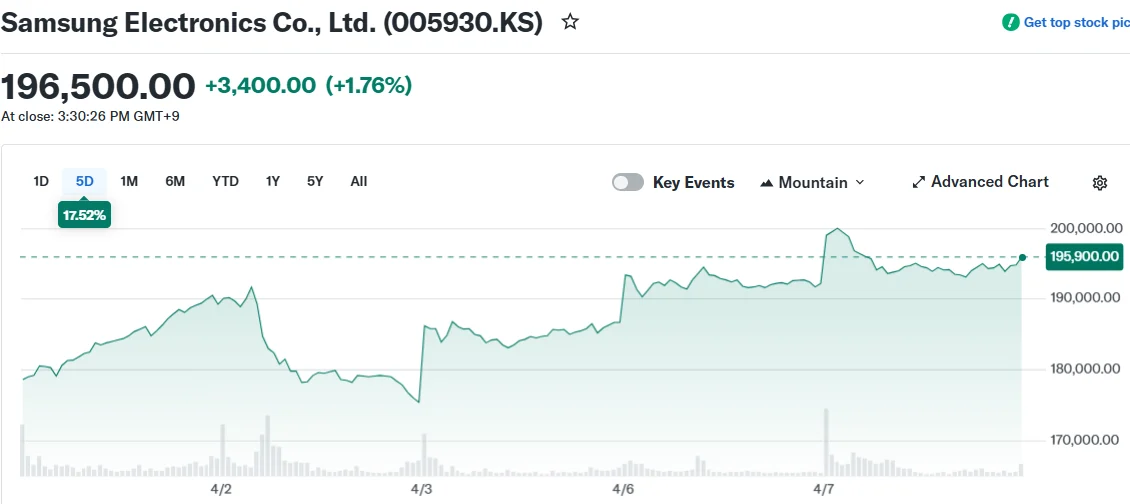
Spot market DRAM pricing experienced slight softening recently, with TrendForce observing that customer demand has struggled to keep pace with elevated pricing levels. Google’s March introduction of TurboQuant, a memory-optimization technology, applied additional downward pressure, contributing to a market correction that has reduced Samsung’s stock valuation by approximately 9% since hostilities commenced on February 28.
Despite this recent pullback, Samsung’s shares remain up over 60% in 2026, building on a 125% advance recorded throughout 2025.
Competitor SK Hynix shares advanced 3.4% higher during Tuesday’s trading session.
Get 3 Free Stock Ebooks
Discover top-performing stocks in AI, Crypto, and Technology with expert analysis.
- Top 10 AI Stocks - Leading AI companies
- Top 10 Crypto Stocks - Blockchain leaders
- Top 10 Tech Stocks - Tech giants


