


TLDR
- Samsung Electronics shares surged 4.9% to 6.4% on reports of HBM4 memory chip mass production beginning this month.
- The chipmaker will deliver HBM4 chips to Nvidia by mid-February for use in Vera Rubin AI accelerators.
- Samsung’s timeline beats Micron Technology, which won’t start HBM4 production until the second quarter of 2026.
- Analysts expect Micron to maintain its 20%-25% HBM market share despite Samsung’s head start.
- AI chip manufacturers are shifting to three-supplier strategies instead of relying on two providers.
Samsung Electronics stock got a healthy boost Monday after news broke that the company will start churning out next-generation memory chips this month. Shares climbed between 4.9% and 6.4% in trading.
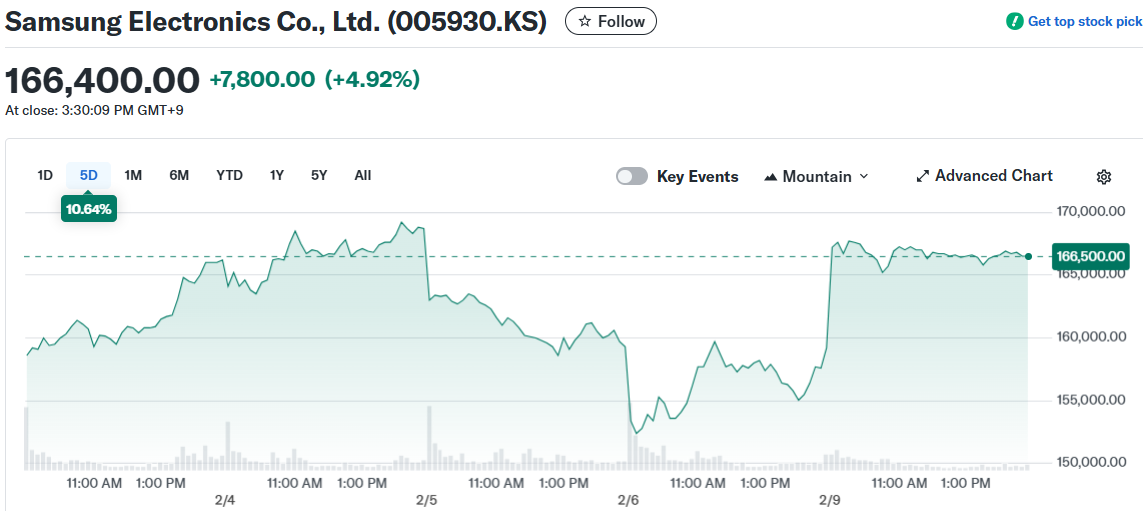
South Korea’s Yonhap news agency reported that Samsung will launch mass production of HBM4 chips in late February. Industry sources provided the timeline to the outlet over the weekend.
HBM4 represents the latest evolution in high-bandwidth memory technology. These chips are essential for running advanced artificial intelligence processors.
Samsung will ship the first batch of HBM4 chips to Nvidia by mid-February. The chips will integrate into Nvidia’s Vera Rubin AI accelerators, marking a key supply chain victory for the Korean manufacturer.
The news lifted other chip stocks too. Nvidia shares jumped 7.87% while SK Hynix gained 5.72%.
Competition With Micron Heats Up
The production announcement creates pressure for Micron Technology. The American chipmaker has dominated headlines with its HBM growth story over the past year.

Micron’s stock price has more than quadrupled in 12 months thanks to booming HBM demand. Shares still managed a 3.08% gain Monday despite Samsung’s competitive move.
Micron CEO Sanjay Mehrotra told analysts the company would begin HBM4 production in the second quarter of 2026. That schedule puts Micron about three months behind Samsung’s rollout.
Both companies are fighting for position in the AI chip supply chain. Samsung’s stock has nearly tripled over the past year as the memory chip market expanded.
Market Can Support Three Players
Wall Street analysts believe there’s enough demand for Samsung, Micron, and SK Hynix to all succeed. The market isn’t zero-sum at current growth rates.
UBS analyst Timothy Arcuri wrote that AI accelerator vendors are adopting three-supplier sourcing models. This represents a shift from previous strategies that relied on two suppliers.
The change works in everyone’s favor. Analysts project Micron can hold onto the 20%-25% market share it secured last year.
HBM chips deliver higher profit margins compared to standard memory products. The margin advantage makes the market appealing for all three major manufacturers.
Samsung reported revenue of $223.32 billion with 7% growth over three years. The company’s market cap stands at $694.62 billion.
Financial metrics show a current ratio of 2.63 and debt-to-equity ratio of 0.04. The balance sheet indicates strong liquidity with minimal leverage.
Strong Technical Indicators
Samsung’s gross margin sits at 36.65% with a 9.51% operating margin. The company’s Altman Z-Score of 7.78 points to solid financial health.
The stock trades at a P/E ratio of 32.73, close to its one-year peak. An RSI reading of 100 suggests the stock may be overbought in the near term.
Samsung declined to comment on the production timeline when contacted. The HBM4 rollout marks a critical milestone as demand for AI infrastructure continues climbing.
Get 3 Free Stock Ebooks
Discover top-performing stocks in AI, Crypto, and Technology with expert analysis.
- Top 10 AI Stocks - Leading AI companies
- Top 10 Crypto Stocks - Blockchain leaders
- Top 10 Tech Stocks - Tech giants


