


TLDR
- Silver plummeted 17% in 24 hours, wiping out recent recovery and pulling gold and copper lower
- Forced liquidations totaled $16.82 million in long XYZ:SILVER positions on Hyperliquid exchange
- Michael Burry’s warning about crypto collateral forcing metal sales proved accurate
- Thin market liquidity and excessive leverage drove the selloff more than macroeconomic factors
- The metal has fallen over 33% from its all-time high reached on January 29
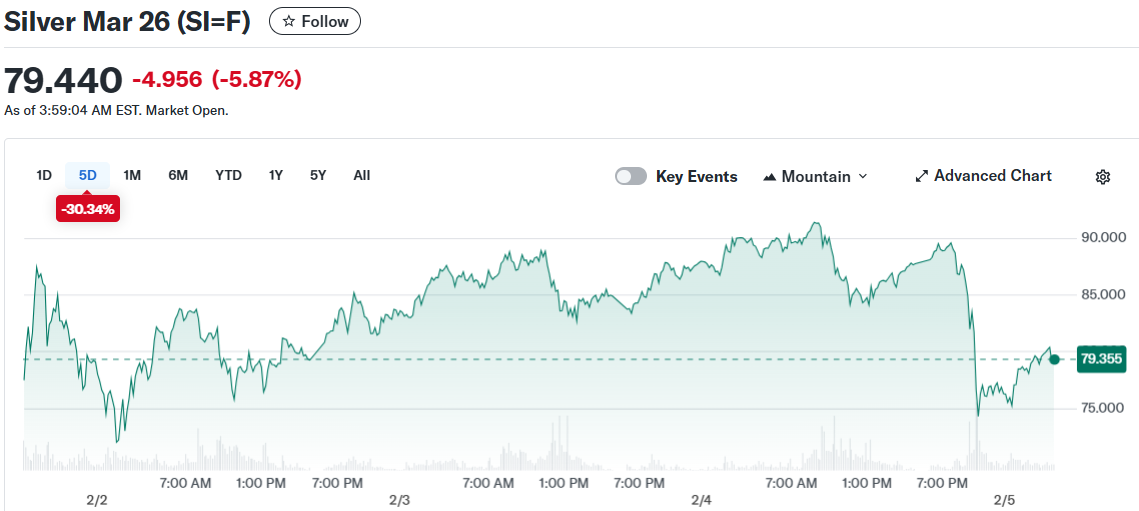
Silver prices collapsed 17% over 24 hours, eliminating gains made earlier this week. The precious metal traded at $76.99 per ounce after touching $90 briefly in Asian markets.
Other metals followed silver lower. Gold decreased 3.5% in choppy trading while copper fell under $13,000 per ton.
The white metal has lost more than 33% from its January 29 record high. Friday delivered the biggest single-day decline in silver’s trading history.
Market participants cite low liquidity and heavy speculation as primary drivers. These conditions accelerated price movements in both directions.
Crypto Platforms Record Major Forced Sales
Digital asset exchanges showed the extent of leveraged positions. Hyperliquid data indicated $16.82 million in compulsory closures of long positions tied to XYZ:SILVER tokens.
Combined liquidations totaled roughly $17.75 million. The figures reveal traders who bet on rebounds got stopped out when prices swung again.

Hedge fund manager Michael Burry forecasted this dynamic earlier this week. He described a “collateral death spiral” affecting tokenized metal markets.
The process unfolds when rising prices encourage more borrowing. Falling crypto collateral values then force traders to sell metals for margin requirements.
Burry highlighted that bitcoin declines could push institutions to liquidate winning metal trades. Current liquidation patterns match his prediction.
Precious metals rallied in January on speculative flows and geopolitical worries. Questions about Federal Reserve independence boosted buying.
Traders built substantial positions throughout the month. Leveraged exchange-traded products saw strong inflows.
Activity in call options increased sharply. The uptrend reversed abruptly when selling started last Friday.
Policy Uncertainty Adds to Market Volatility
Kevin Warsh’s Federal Reserve chair nomination creates questions for markets. President Trump said Wednesday he would not have selected Warsh if he wanted higher rates.
Trump told NBC News another Fed rate cut seemed likely. Lower rates help precious metals because they produce no yield.
Standard Chartered analysts predict ongoing gold volatility. Monetary policy uncertainty will sustain unstable conditions.
Exchange-traded product redemptions could increase selling pressure. This represents another potential headwind for prices.
The bank still sees positive long-term fundamentals. Analysts forecast eventual upward movement.
Silver shows greater volatility than gold because of market structure. Limited liquidity amplifies swings in the smaller market.
Current volatility exceeds normal ranges. Speculative money and thinner over-the-counter activity made moves more severe.
Christopher Wong at Oversea-Chinese Banking Corp observed weak sentiment across markets. He called it a feedback loop given light trading volumes.
Margin calls and forced selling control price action now. Macroeconomic considerations take a back seat to position unwinding.
Hyperliquid liquidation figures show leverage dominates market behavior. Technical factors outweigh fundamental analysis in present circumstances.
The selling originated during Asian trading hours Friday. It extended through early this week before temporary buying emerged.
Those buying attempts proved short-lived. Renewed selling pressure overwhelmed support levels.
Get 3 Free Stock Ebooks
Discover top-performing stocks in AI, Crypto, and Technology with expert analysis.
- Top 10 AI Stocks - Leading AI companies
- Top 10 Crypto Stocks - Blockchain leaders
- Top 10 Tech Stocks - Tech giants


