


TLDR
- Equity futures declined Thursday morning, reversing the previous session’s gains across major indices in pre-market activity.
- Tensions in the Middle East involving the United States, Israel, and Iran continued for a sixth consecutive day with no resolution apparent.
- Tehran rejected reports suggesting it initiated ceasefire discussions with Washington, undermining Wednesday’s market optimism.
- Crude prices climbed higher, with Brent surpassing $83 per barrel and WTI approaching $76 amid concerns over Strait of Hormuz disruptions.
- Safe-haven assets including gold, the greenback, and government bond yields all advanced as risk aversion increased.
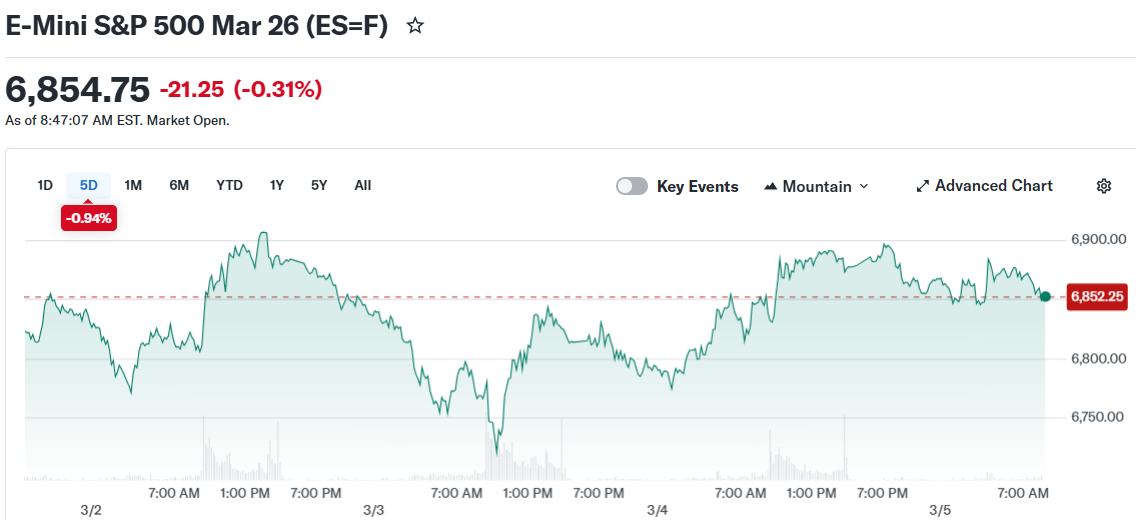
Equity futures in the United States tumbled Thursday morning, erasing gains from the previous trading session. Major indices including the Dow, S&P 500, and Nasdaq 100 all registered declines during pre-market hours as traders reassessed emerging information regarding Middle Eastern hostilities.
The prior day’s trading had delivered encouraging results. The Dow managed to break a three-session downward trend, while the S&P 500 and Nasdaq Composite both posted positive closings. Market sentiment received a lift from robust economic indicators and media reports suggesting Tehran had discreetly contacted Washington to express willingness for ceasefire negotiations.
However, that optimism quickly evaporated. A spokesperson from Iran informed state-controlled media outlets that “no message has been sent from Iran to the US,” further stating Tehran would not engage with American diplomatic overtures. This rejection dampened market enthusiasm entering Thursday’s session.
The military confrontation involving the United States, Israel, and Iran reached its sixth consecutive day without indication of de-escalation. President Trump stated Wednesday that America was “doing very well on the war front.” Administration officials reported American military operations had eliminated over 2,000 targets and were advancing toward “complete and total control of Iranian airspace.”
Crude Prices Resume Upward Trajectory
Oil prices stabilized following an initial spike before resuming their ascent during overnight trading. Brent crude advanced 2.1% to reach $83.12 per barrel. West Texas Intermediate increased 2.6% to settle at $76.62 per barrel.
The primary anxiety centers on the Strait of Hormuz. This narrow waterway represents one of the planet’s most critical passages for petroleum tanker traffic. Iran ranks as OPEC’s fourth-largest crude producer, meaning any interference with supply flowing through this channel could trigger further price increases.
President Trump announced the United States would provide risk insurance coverage and military naval protection for vessels transiting the strait. While this measure temporarily calmed supply anxieties earlier this week, it failed to prevent renewed price escalation.

Deutsche Bank’s analyst Henry Allen observed that “both the US and Iran have made clear they aren’t backing down,” noting that crude prices were “moving up again overnight.”
Traders Monitor Employment Figures and Corporate Results
Escalating petroleum costs are triggering inflation anxieties. Elevated energy expenses might compel the Federal Reserve to reconsider planned interest rate reductions. The benchmark 10-year Treasury yield advanced to a three-week peak of 4.12%.
Gold appreciated 0.8% to reach $5,176 per ounce as market participants gravitated toward protective assets. The US dollar index similarly strengthened 0.2% relative to competing currencies.
Weekly unemployment claims data arrives Thursday. Friday’s comprehensive nonfarm payrolls release is viewed as a critical indicator for determining when the Federal Reserve might initiate rate cuts.
Quarterly financial disclosures from Costco and Marvell Technology are scheduled for release following Thursday’s market close.
The Cboe Volatility Index, commonly referenced as the VIX, registered slightly above 21, suggesting market participants anticipate approximately 1.3% daily fluctuations in the S&P 500 throughout the upcoming 30-day period.
Get 3 Free Stock Ebooks
Discover top-performing stocks in AI, Crypto, and Technology with expert analysis.
- Top 10 AI Stocks - Leading AI companies
- Top 10 Crypto Stocks - Blockchain leaders
- Top 10 Tech Stocks - Tech giants


